
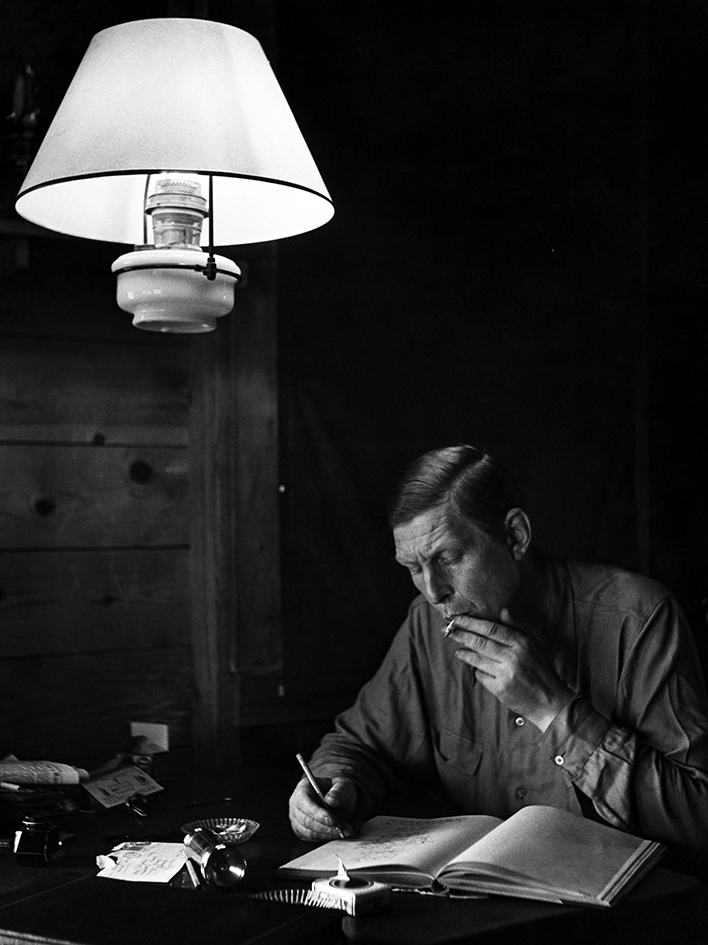
Wystan Auden admired his name. Derived from the Old English for “sanctuary stone”, the name Wystan recalls from folklore the tale of St Wigstan, a 9th-century Mercian royal who was slain after preventing his widowed mother from marrying his cousin. It is a family drama redolent of Hamlet – a story that originates in Norse legend – as might the poet’s surname. Auden was proud to learn that a Norse settler named Auðun Skökull frequently appears in the Icelandic sagas. His fascination with the north, “the place of isolation and the home of the sacred, the mysterious, the terrible” – as Peter Ackroyd puts it – never ceased to inspire him. Across his early and late works, Auden’s psychic landscapes are frequently given to dissolution, like limestone in the rain:
If it form the one landscape that we, the inconstant ones,
Are consistently homesick for, this is chiefly
Because it dissolves in water
— “In Praise of Limestone”
Poets in Auden’s circle understood that England’s sense of its mythic past could also dissolve, were it not for the vigilant help of the homesick artist.
Ackroyd’s new life of Auden, who was born in York in 1907 and died in Vienna in 1973, neatly weaves together biographical detail with literary commentary. We learn that Auden’s childhood residence in Solihull gave rise to an obsession with industrial machinery and northern desolation. Poems about mills and mines pepper his juvenilia. Perhaps the work with the strongest sense of the pathos of industrialism is his difficult, Eliotian poem mixing prose and verse, The Orators: An English Study (1932), replete with images of desolate landscapes, “frozen fjords”, aircraft and England in unrest.

From Ackroyd’s account of Auden’s school days, it becomes clear that he was always an obsessive. Auden claimed that for more than a year of his adolescence he endeavoured to read Thomas Hardy and “no one else”. He believed so strongly that the brooding Victorian was his poetical predecessor that he insisted that Hardy physically resembled his father. Auden’s family background also informed his long-standing preoccupation with English class stratification. Belonging to a family of middle-class professionals, he sought excitement in transgression, living for a time in a “slum” in Berlin and writing a parody of English middle-class niceties in the form of a play, Paid on Both Sides: A Charade. As Ackroyd is careful to note, “It was not that he hated his own class, or his own family, but, rather, that he found them inherently comical.”
To understand Auden, readers must appreciate his sense of Englishness, which was simultaneously rooted and restless. England was that sanctuary that he intermittently fled but to which he always returned in his mind’s eye. It was at once a muse and a subject to parody, the environment that determined his eccentricities, erudition and the debauchery that likely contributed to his death aged 66: even as an ageing man in America, he “always carried a bottle of vodka or gin in his suitcase, for use in the event of arriving in a ‘dry’ county”. Scotland, where Auden was a young schoolmaster, also proved ripe for poetic plumbing. An “invigorating and rhythmically inventive chant”, “Night Mail” – a poem about crossing the border into Scotland – proved Auden to be “a master of all forms of poetry” and was turned into a short film with a score by Benjamin Britten, who would become a long-standing collaborator. Being mocked for his Englishness while tutoring in Helensburgh might have suited him; he liked to stand out, and while at Oxford would scandalise his peers with vulgar sexual divulgences and provocative pronouncements about life and art. Like many a university wit, “Auden’s talk tended to be dogmatic,” Ackroyd writes. “The cinema was not of the slightest interest; modern drama was impossible; the ballet should be forbidden.”
Auden liked to monologue, often asserting himself in conversation, yet his self-assertion accompanied self-admonition. It is well known that Auden disowned his sensational anti-war poem “September 1, 1939”, which exhorts that “we must love one another or die”. After the war, Auden considered it to be “infected with an incurable dishonesty”, omitting it from his collected poems and, not for the first or last time, “rejecting the role of bard or public poet”. So great was Auden’s embarrassment over the poem’s dogmatic tone that he claimed to wish he never saw England again, “in disavowal of his old self”. A contemporary remarked that Auden “was naturally anarchic but had inside him a demon which was deeply conservative”. That conservative impulse, which made him recoil from his youthful indulgence of lofty political rhetoric, might have been a saving grace. Auden improved his poem with the subtlest change of a word: that infamous line became “we must love one another and die”.
As in all biographies of Auden, the poet’s romantic failures feature significantly. It is difficult not to paint a tragic portrait here of an oft-rejected lover who remained close to the objects of his yearning. “The poet’s heart was made to be broken,” Ackroyd solemnly notes. Poems like the mournful “Funeral Blues” invoke the stars, betokening the fated suffering of a gay man in Auden’s time. While it would be easy to dwell on stories of unrequited love or sexual passion, Ackroyd does not catastrophise Auden’s perennial predicament as “the more loving one” (the title of his tender, confessional poem), and reveals a redeeming side to the story: that intellectual exchange and mutual goodwill between Auden and his companions – Christopher Isherwood, Chester Kallman, Robert Medley – could persist despite Auden’s frustrated designs.
Biographies of Auden might be sifted into categories: Auden as the frustrated gay lover; Auden as the political artist; Auden as the intellect. Ackroyd provides a well-rounded biography that gets to the heart of the man without confining him to a role in literary or political history, and only occasionally lets his personal judgements show – and some of them are bold. Writing of Auden as a young man, he asserts that, “Auden could speak the truth only in his poetry, and two poems of the period provide some access to it.” His choices are “Song” and “A Communist to Others”; each poem considered, with varying degrees of irony, the prospect of joining the Marxist cause. After becoming, for his contemporaries and readers, a token of the new radical poetry of the 1930s, Auden would go on to regret these verses, appending a note to some of them: “Mr WH Auden considers these five poems to be trash which he is ashamed to have written.” Wanting his words to be his, Auden knew intimately well the difficulty of being a famed artist on whom others depended for political representation.
No reasonably sized life of Auden could discuss all of his major poems. There is no mention of “Friday’s Child”, the masterpiece Auden dedicated to the German wartime martyr Dietrich Bonhoeffer. An almost laconic poem in lines of tetrameter and trimeter, it breathlessly asks us what to make of such theological mysteries as the problem of evil, free will and the incarnation. Its resolution is impossibly Audenesque: by “suffering in a public place/A death reserved for slaves”, Christ in fact – Auden says – saves “Appearances”. This is an obscure reference to the philosopher Owen Barfield’s idea that reality is made legible through symbols – in this case, the Cross, a cathartic reminder of the sacrifice of the incarnate God. Ackroyd does make cursory mention of the similarly theological poem For the Time Being: A Christmas Oratorio, a libretto intended to be set to music by Britten. It is conversational but austere, and mourns – perhaps scoldingly, perhaps rousingly – that human flaws persist even during the celebration of a miracle:
Once again
As in previous years we have seen the actual Vision and failed
To do more than entertain it as an agreeable
Possibility, once again we have sent Him away,
Begging though to remain His disobedient servant,
The promising child who cannot keep His word for long.
Here is Auden’s inner conservative. Liturgical festivities, with their drunkenness and family squabbles, magnify a broader English attitude to religion: that it is no motivation to change our ways for very long. Auden’s instinctual Anglo-Catholicism was catalysed more by his equally instinctual irony than by his allegedly native anarchism. Not long after penning the oratorio, Auden wrote to a friend: “Miss God appears to have decided that I am to be a writer, but have no other fun.”
Fans of Auden might be left wanting more literary exegesis. Perhaps more poems could be mentioned and a more sustained analysis provided on some of Auden’s most ambitious works, whose context is so lucidly set down. But the facts of the poet’s life are poetic: Auden lived a tragicomedy, sometimes by design. Ackroyd gives us an eminently readable new biography that is, from start to finish, both frequently funny and profoundly sad.
Auden
Peter Ackroyd
Reaktion Books, 400pp, £25
Purchasing a book may earn the NS a commission from Bookshop.org, who support independent bookshops
[Further reading: Alice Coltrane’s transcendent score]
Content from our partners


Related
This article appears in the 18 Mar 2026 issue of the New Statesman, The new world war
Join the debate
Subscribe here to comment