
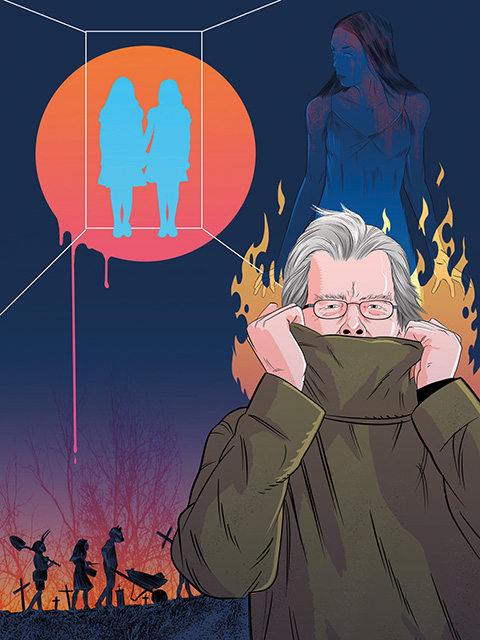
Stephen King, 78, is the pre-eminent horror writer of our time: he is reputed to have sold more than 400 million books worldwide. Not since Charles Dickens has a storyteller held so many readers spellbound. In spite of his detractors (“king of trash”, “sultan of schlock”), King remains an author of towering cleverness, whose fiction appeals to a reading public both popular and serious. Bret Easton Ellis, Colson Whitehead and Haruki Murakami all cite King as an influence; his success and popularity are beyond question.
Before he became emperor of the bestseller, King studied American literature at the University of Maine, his birthplace and the setting for many of his novels, among them It, The Dead Zone and the adrenalin-quickening Misery (Penelope Lively’s favourite). The novels are brocaded with references to Edgar Allan Poe, Shirley Jackson and other maestros of horror-suspense that King read as a student. Bram Stoker’s 1897 masterwork Dracula, in particular, taught King how to keep the pages turning. A fiction without a story, King knows, is scarcely worth its weight in paper.
Caroline Bicks, a US-based Shakespeare scholar, devoured King’s books as a teenager in New York City in the 1970s when she was susceptible to all things loathly and grotesque. She became a devotee of King’s necromantic imagination. Four decades on, she holds the rather grand-sounding Stephen E King chair in literature at the University of Maine, where she teaches. In Monsters in the Archives, a wonderfully absorbing study of King and his world, Bicks considers five of his superlative early works: Carrie, ’Salem’s Lot, The Shining, Night Shift and Pet Sematary.
These books were written in the 1970s when King, by his own admission, was an alcoholic who drank himself into oblivion almost daily (he had a “drinking problem”, as Bicks delicately puts it). How such extraordinary fiction was written in the thick of addiction is a mystery. King put something of himself into Jack Torrance, the boozed-up author who goes insane in The Shining while holed up with his family in a hotel in the Colorado Rockies.

For more than a year, Bicks scrutinised typewritten drafts, Xeroxes and galley proofs of her chosen five books and assessed chapters that did not make it to the final cut. The manuscript material is held in a climate-controlled annexe of King’s mansion in Maine, not far from the university. King allowed Bicks unlimited access to the archives and answered her many questions with his accustomed courtesy.
She discovered that ’Salem’s Lot, which updates Dracula to 1970s small-town Maine, was originally titled Second Coming, but, according to Bicks, King’s wife Tabitha thought it “sounded like a sex manual”, so the title was altered in the third and final draft to Jerusalem’s Lot. The publishers then made a last-minute change to ’Salem’s Lot as “Jerusalem” suggested an unwanted religious book. The European vampire who terrorises the sleepy Maine town, Count Barlow (called Sarlinov in the first two drafts), borrows from Stoker’s bloodsucker in his saturnine looks. As he spreads contagion into ’Salem’s Lot, so Barlow represents the fear of violation by a dark outsider. (By giving a Semitic curve to his own vampire’s nose, Stoker may have revealed his xenophobic response to the arrival of Jews to London at the turn of the century.)
King’s darkly off-putting imagination lent Carrie, his 1974 debut, an almost Jacobean horror. Bicks finds references to Macbeth in the novel, which Margaret Atwood praised for its ability to tap into “the collective unconsciousness” of our age. The telekinetic Carrie White, bullied and abused at school, wreaks a lethal revenge on her tormentors. Her horrific first menses in the school shower scene embodies the fears many teenage girls have about their changing bodies, says Bicks. Unsurprisingly, Carrie has become deeply embedded in the “mythos” of American girlhood. King dismisses Carrie as a juvenile bagatelle, but the paperback rights sold for $400,000, and launched him as the professional writer he wanted to be. Owing to its violence, Carrie remains one of the top banned books in American schools. King’s editor, we learn, cut out a scene in which Carrie blows up an airborne Delta 747 by means of her telekinesis. Domestic flights in the US were presumably thought to be vulnerable to terrorist attack – King had gone too far.
Bicks reminds us that the 1970s were a golden age of horror. William Peter Blatty’s 1971 occult novel The Exorcist, based on a real-life exorcism case in Maryland in 1949, was a bestseller for 15 months before it was brought to the screen by William Friedkin. Reports of extreme audience reactions – people charging the screen in an effort to “get the demon”, self-immolations, faintings and miscarriages – advertised one of the most frightening movies of the Nixon era. In one notorious scene, the devil’s chosen vessel performs sex acts with a crucifix while her tongue lolls wolfishly. In the devil’s obscene occupancy, King saw possibilities for Carrie’s own supernatural disturbance. Carrie’s mother Margaret, a violent Christian fundamentalist, recites the Prayer of Exorcism from Deuteronomy and (according to a neighbour) bays uncontrollably at the moon. Carrie’s popularity owed a good deal to The Exorcist and other 1970s psychological horror movies such as The Omen and Don’t Look Now.
Of all King’s novels (some 60 to date), Pet Sematary is the one that frightens readers the most. King himself was so spooked by the manuscript that he shelved it for four years, until he felt able to publish it in 1983. A native American burial ground in Maine has the power to reanimate its dead; in grimly atmospheric pages, revenants torment the living. The novel’s frightscapes are among the most discomfiting in contemporary horror. Yet, beneath the gibber and gloom, Bicks detects a punctilious craftsman at work. Mindful of creating aural effects, King frequently uses cognates of the words grit and grate. (A spade “gritted across something” as it hits a coffin buried underground.) On the novel’s typescript a copy editor has circled the word “clittered” and asks, “word OK?”; King responds, “A clitter is a very soft, ghostly clatter.” (The word was allowed to stay.) Handwritten margin notes of this sort are lost to us today with traceless computer editing, Bicks laments.
As Bicks fossicks in the archives in search of other textual variants, she begins to confront her own childhood fears of glow-in-the-dark vampires and other horrible imaginings. The word horror, she points out, comes from the Latin verb horrēre, to bristle or shudder. Some of the variants she unearths are significant. “The Shine” (King changed the title to The Shining when he learned that shine was a racist term) was originally modelled on Shakespeare’s Hamlet, with sections labelled “acts”. In the first draft, Jack Torrance’s wife is called Jenny; King changed her name to Wendy because he did not care for Jenny’s alliteration with Jack. (“It’s too jingle jangly,” he tells Bicks.) Stanley Kubrick’s 1980 film of The Shining offended King by his portrayal of Torrance (Jack Nicholson) as demented rather than Hamletian tragic. The film’s most famous line – “Here’s Johnny!” – is not even in the novel. Kubrick’s film is nevertheless now part of the American zeitgeist. And the “shining” – an ability to detect psychic powers in other psychics and share in their predictive dreams – has entered the popular vernacular.
King’s first (and still greatest) short story collection, Night Shift (1978), combines pages of farcical grotesquerie with heart-pounding suspense. Some of the stories (“Strawberry Spring”, “Night Surf”) were conceived while King was an undergraduate at Maine from 1966 to 1970. Bicks has read the weekly column King wrote, “King’s Garbage Truck”, for his student newspaper, which served as a metaphorical dumping ground for his (left-wing, anti-war) political views and discussion of his favourite books. Stoker’s Dracula is hailed as a “monster-piece”. Stoker’s metaphors of penetration and impalement – the vampire’s staked heart, the puncture of fangs – make Dracula one of the most sexually charged novels ever written. (By contrast, King, who was brought up by a strict Methodist mother, has never been good at describing sex: he is a writer of wormy circumstance rather than of eroticism.)
Recent novels by King have disappointed, though his time-travel fantasy about the Kennedy assassination, 11/22/63, published in 2011, was halfway decent. Bicks has almost nothing to say about King’s alcoholism (King achieved Alcoholics Anonymous sobriety in around 1988) and I lost count of how often she uses that annoying, inflated word “iconic”. These are quibbles, though. Monsters in the Archives, an impressively researched work of literary detection, provides an excellent guide to King and his enduringly dark vision. In his own words: “I like to tell people I have the heart of a small boy. Then I say it’s in a jar on my desk.” Only King could make light of the ghastly in this way. He is still keeping us up at night.
Ian Thomson’s books include “The Dead Yard: Tales of Modern Jamaica” (Faber and Faber)
Monsters in the Archives: My Year of Fear with Stephen King
Caroline Bicks
Hodder and Stoughton, 304pp, £25
Purchasing a book may earn the NS a commission from Bookshop.org, who support independent bookshops
[Further reading: Sylvia Townsend Warner’s obscure forces]
Content from our partners



Related

This article appears in the 13 May 2026 issue of the New Statesman, Never-Ending Chaos
Join the debate
Subscribe here to comment