
Twice a year, throughout the 17th century, ships from across Spanish South America gathered in Havana in Cuba to catch their breath before heading into the Atlantic. This flotilla carried the riches of New Spain – a vast swathe of land and islands that encompassed what are now Mexico and Peru, the Caribbean, a tranche of the southern United States and a slice of Brazil. The cargoes included not just bullion but also all manner of ethnographical artefacts and flora and fauna. Back in 1520, Albrecht Dürer recalled witnessing the unloading of one such vessel. As mosaic masks, feathered shields, jaguar pelts and live macaws were arranged on the quayside, Dürer, the son of a goldsmith, was stupefied: “All the days of my life I have seen nothing that rejoiced my heart so much as these things,” he wrote, “for I saw amongst them wonderful works of art.”
Accompanied by a royal warship, the treasure fleets set sail for Seville, the main port of entry for this stream of bounty, which transformed the city into the richest in Europe. But the trade went both ways: Spanish settlers wanted luxury goods for their homes, churches and administrative buildings. One of the local painters who supplied pictures for this market was Francisco de Zurbarán (1598-1664). In 1647, in a bizarre instance of cultural exchange, he dispatched a series of 12 paintings of Caesars on horseback to South America: Spain, the commission made clear, was the new Rome.
Another batch of paintings took a different route: a set of 13 paintings showing Jacob and his Twelve Sons, each figure life-size and made between 1641 and 1658, was most likely on one of these return trips when the ship was intercepted by a British privateer. The pictures were taken and made their way first to London before, a century after they were painted, being sold to the Bishop of Durham in 1756. Twelve of the paintings (the 13th is in Grimsthorpe Castle, Lincolnshire) have hung in Auckland Palace in Bishop Auckland, County Durham ever since. So these images from Spain at the height of its Catholic fervour graced the dining room of a prince of the Anglican Church.
This is not perhaps as incongruous as it seems. Zurbarán, alongside his friend Diego Velázquez and the younger Bartolomé Esteban Murillo, was part of a triumvirate of great painters who defined the Spanish Golden Age. Each man had distinctive and complementary gifts: Zurbarán was the consummate depicter of an intense and imaginative spirituality, a painter who gave the human figure almost sculptural form, and whose compositions have rare clarity. These were traits that transcended sectarian differences and they can now be savoured at the National Gallery in the first major exhibition here dedicated to his work.

Although Zurbarán was born some 70 miles north of Seville, the city was nevertheless his home for most of his career. As well as numerous patrons made wealthy from South American trade it was home to a host of religious orders – Capuchins, Carmelites, Carthusians, Franciscans, Dominicans, Jesuits, Augustinians and Mercedarians – whose policies towards art were changing in the wake of the Council of Trent. To counter the Protestant Reformation, its “Decree on images” stressed the importance of visual storytelling in the service of the faith. Although Zurbarán’s output – some 250 paintings as well as works by his studio – contains immaculate still-lifes and a cluster of secular and classical works, religion was his great theme.
When he arrived in Seville as a teenager Zurbarán was apprenticed to a sculptor as a painter of the unnervingly realistic figures of saints, martyrs and the Virgin that dot Spain’s churches, but he learned carving too. The experience is evident in his ability to give his figures a sense of three-dimensionality. This was revealed most startlingly in his Crucifixion of 1627 for the monastery of San Pablo el Real in Seville. It is a spare, indeed thrilling painting: Christ hangs on a rough wooden cross against a black, formless void – there are no lamenting figures, no soldiers, no landscape. He is picked out in a shaft of light from a single source and a cloth of brilliant white billows around his midriff. The painting’s tenebrism and taut emotional drama is evidence of the influence of Caravaggio. The picture hung behind a grille in the sacristy of the monastery where, according to the Spanish Baroque writer and artist Antonio Palomino, it received “little light”. Nevertheless, such was its potency – a true trompe l’oeil – that “everyone who sees it, and does not know it, believes it to be a sculpture”.
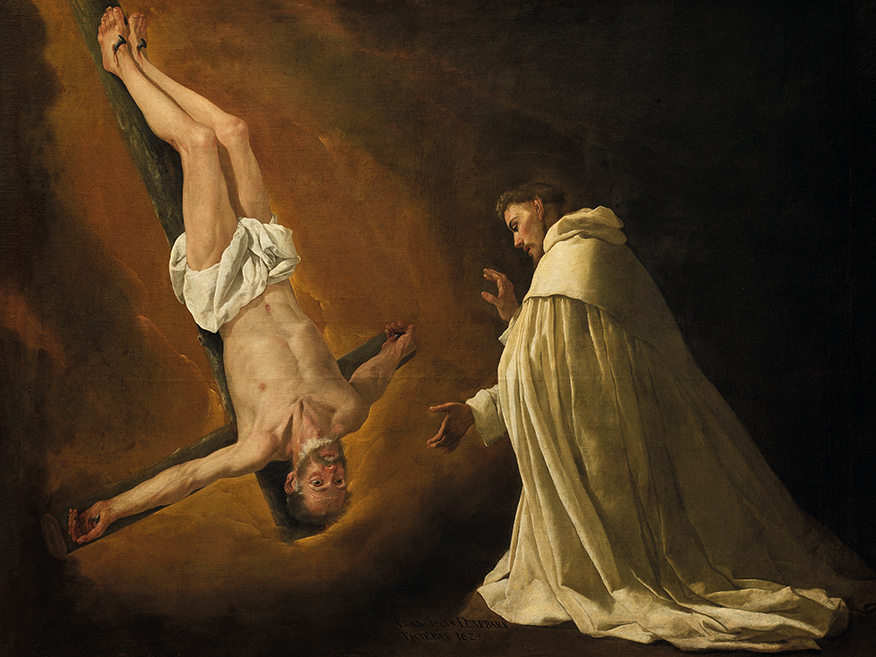
This innovative approach to the spiritual imagination – faith and realism mixed – was evident too in The Apparition of Saint Peter to Saint Peter Nolasco (1629), one of a suite of 22 pictures commissioned by the Mercedarian order to mark the canonisation in 1628 of their founder, Saint Peter Nolasco. Here too, the scene is otherworldly: Peter Nolasco had been unable to visit Rome so the apostle came to him in a vision. Christ’s disciple, crucified upside down at his own request, appears propped on a bank of glowing clouds while his namesake, set in a more solid but undefined temporal space – his physical presence stressed by the beautiful rendering of his robes – venerates him. The sacred and the profane are joined in an enclosed world.
Inevitably, Zurbarán’s skills led to Philip IV, possibly prompted by Velázquez, summoning him in 1634 to Madrid where he was asked to help decorate the new Buen Retiro palace. He produced ten pictures depicting the Labours of Hercules – his hero being on the clodhopping side of athletic strength – for the vast Hall of Realms and a large-scale image of The Defence of Cadiz Against the English in which he showed the gout-stricken Spanish commander Fernando Girón y Ponce de León, confined to an armchair, overseeing the defeat of an English fleet of 100 ships. They were to be the only works Zurbarán made for the king and in 1635 he returned to Seville and picked up the religious themes that had served him so well.
There his production and inventiveness continued to flourish: when needed – or appropriate – he added a lightened palette to the drama of his chiaroscuro, and broadened his pool of patrons by painting full-length portraits that are almost indistinguishable from his imaginative images of single saints. His Don Juan Bazo de Moreda (c1655), a governor in Spanish Flanders, and Saint Casilda (c1635), a Muslim princess who aided persecuted Christians, could be brother and sister. Both are distinguished by their sartorial elan – Zurbarán’s father had dealt in fabric and the painter’s detailed depiction of cloth reveals an inherited eye for the texture and allure of stuffs. He painted still-lifes too – depicting lemons, ceramics and roses with an intensity of concentration that is almost spiritual (his son Juan was to make this theme his own).
But then Zurbarán’s most striking paintings are extensions of still-lifes too. Not just his heart wrenching trussed lamb, Agnus Dei (c1635-1640), so stoically awaiting its sacrifice, but a series of starkly-lit, shadow-cut portraits of St Francis which play with illusionism: are they imaginative portraits or literal (the saint’s uncorrupted remains had been disinterred in 1449) or a Franciscan monk role-playing? In these paintings, an amalgam of rapture, yearning and faith, Zurbarán showed not just his remarkable ability to interpret a heightened religious sensibility but a no less remarkable ability to give it tangible and memorable visual form.
Zurbarán
The National Gallery, London WC2
2 May – 23 August
[Further reading: The female painters who redefined the British landscape]
Content from our partners

Related

This article appears in the 29 Apr 2026 issue of the New Statesman, The cover-up?
Join the debate
Subscribe here to comment