
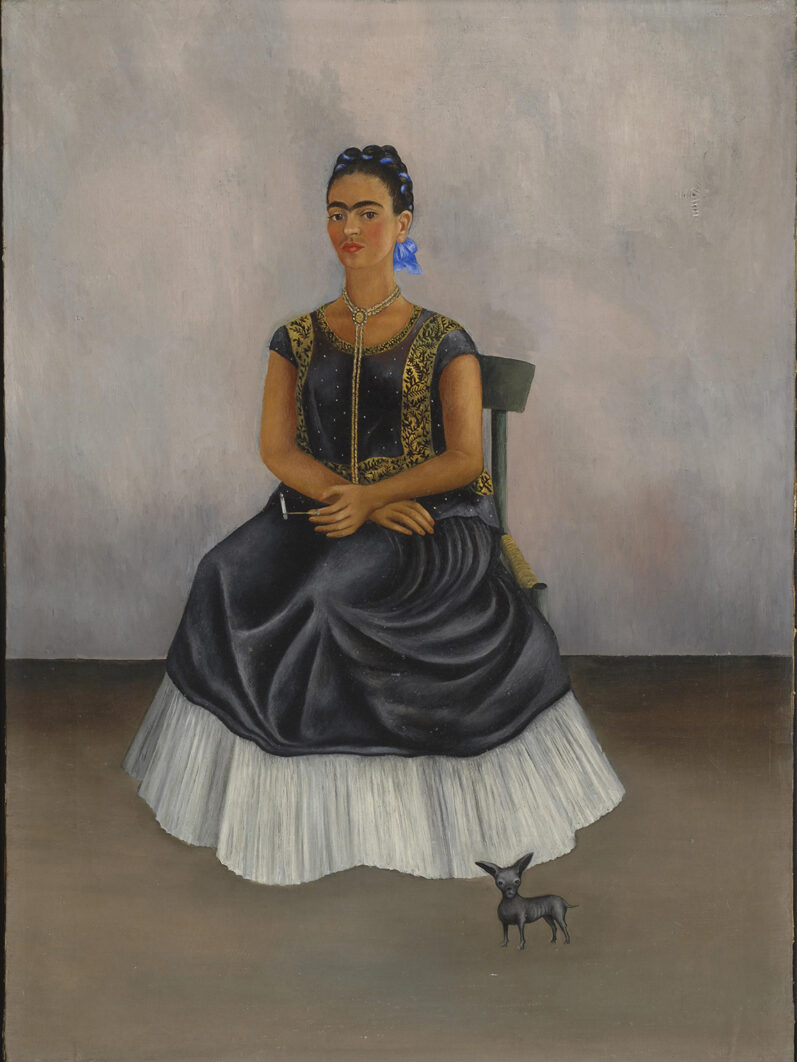
Fridamania, the cult of Frida Kahlo, is not of longstanding. During her lifetime (1907-1954), her husband, the muralist Diego Rivera, was far better known internationally. Although a self-portrait, The Frame, was purchased by the Louvre in 1939 (it is now in the Pompidou Centre), it wasn’t until she was championed by feminist art critics in the 1970s that her ascent really built a head of steam. Now, Kahlo is no longer merely a painter but sits alongside Van Gogh and Andy Warhol for recognisability, her monobrow (which she realised was a sort of trademark and touched up with imported French cosmetics) as instantly identifiable as Van Gogh’s lopped ear. In 1984, Mexico declared her works part of the national cultural heritage and prohibited their export from her native country.
Kahlo’s rise is clearly waymarked by the prices fetched by her pictures: in 1977, The Tree of Hope Stands Firm (1944), was the first of her works to be sold in an auction and made a modest $19,000; in 1990, she became the first Latin American artist to reach $1 million when Diego and I (1949) sold for $1.4 million; in 2006, Roots (1943) fetched $5.6 million, and in 2016, Two Nudes in a Forest (1939) went for $8 million. Then, in 2021, Diego and I sold a second time, this time making $34.9 million, which currently stands as her auction record, though works are said to have changed hands for more in private sales.
Now, a forthcoming sale of El Sueño (La Cama) – “The dream, the bed” (1940) – is scheduled at Sotheby’s, New York, in November. The Art Newspaper reports that it has been consigned by the Turkish-American record label executive Nesuhi Ertegun and his wife Selma, important collectors of Surrealist paintings. The picture is being touted as a potential record-breaking work and carries an estimate of $40 million to $60 million. The current most expensive work by a female artist is Georgia O’Keeffe’s Jimson Weed/White Flower No 1 (1932) which made $44.4 million in 2014. Chatter, the art market’s favourite thing, suggests this will be left in the dust.
Although money is no indicator of artistic worth, the reason for the step change in her prices is that her pictures, and even more importantly, her life, have hit a moment of perfect confluence with current social mores. Kahlo was someone touched by tragedy who as a result developed a near obsessive concern with herself; she made up her own world; she lived in pain and her pictures share it; she had strong convictions; and she was a woman who more than held her own among famous men. These are all traits privileged today.

Her biography is worth a recap. Kahlo was born to a German father and a mother of mixed indigenous-European heritage and contracted polio as a child. At 18 – exactly a century ago this month – she was involved in a catastrophic bus accident that left her crippled: “the handrail pierced me as the sword pierces the bull”, she later wrote, puncturing her abdomen and uterus and fracturing her spine. The result was that, as a friend wrote, she “lived dying”, confined to supportive corsets of steel or plaster, undergoing some 30 operations, and losing her right leg after contracting gangrene. There were miscarriages too.
Painting was a way of occupying her time and she took herself as her main subject (of her 140 or so paintings, more than 50 are self-portraits) faute de mieux: “I paint myself because I am often alone and I am the subject I know best.” Her strange Surrealist pictures – solipsistic, mystical, death haunted and harking back to Mexican folklore – attracted attention. She had a topsy-turvy relationship with the muralist Diego Rivera, whom she married in 1929 and then again, after a brief divorce, in 1940. Neither was close to faithful and she titivated the relationship with affairs with both women and men: one of her lovers was Leon Trotsky.
As a painter, she was hailed by the Parisian Surrealists and the group’s panjandrum, André Breton, enthusiastically claimed her as one of their own. She travelled widely in America and Europe where she met Picasso, Marcel Duchamp and the couturier Elsa Schiaparelli. Among the buyers of her pictures was the gangster-flick actor Edward G Robinson (Madonna, never one knowingly to miss a style moment, supposedly owns five Kahlo paintings and outraged Mexicans last year when she claimed to have tried on clothes and jewellery belonging to “my Eternal Muse”). For all this celebrity proximity, Kahlo was politically committed and joined the Mexican Communist Party, which inspired some of her clunkiest pictures – try the unfinished but irredeemable Peace on Earth so the Marxist Science may Save the Sick and Those Oppressed by Criminal Yankee Capitalism (1954).
So the eventual purchaser of El Sueño (La Cama) will be buying not just a painting but a rich, full backstory too. They will also acquire one of her most interesting works, a self-portrait in which Kahlo shows herself asleep in a four-poster bed that is floating in the sky. Her body is entwined by creeping thorny rose tendrils while on the canopy a skeleton with sticks of dynamite strapped to it and holding a wreath of lilies mimics her pose.
This is not entirely a work of the imagination, with the skeleton as some sort of avatar for the painter herself. She did in fact sleep with a papier-mâché skeleton above her bed; for Kahlo it was a constant reminder of the proximity of death to life, while Rivera would jokingly claim it was her lover.
Mortality, tendrils, fantasy, inner life, symbolism, ambiguity… El Sueño (La Cama) is a compendium of many of the themes that distinguish Kahlo’s paintings. This should help raise the price come November, as should the fact that female Surrealists have been doing well: Les Distractions de Dagobert (1945) by the British-born Leonora Carrington sold for $28.5 million in 2024.
The art market is currently bobbing in the doldrums and could do with a big hit. Kahlo the artist, meanwhile, would benefit from being distanced from the merchandise that has – like the plant tendrils of her pictures – overtaken her (a Kahlo Barbie doll, Frida socks, mugs and water bottles, cushions, mobile phone cases, tote bags, keyrings, figurines and assorted other gewgaws) and remind the public that she was not just an emblem – art’s Mater Dolorosa – but a painter too.
[Further reading: Patricia Lockwood’s dispatches from the brain fog]
Content from our partners


Related


Join the debate
Subscribe here to comment