
On the day of David Hockney’s death, it seemed appropriate to visit Tate Britain. I wondered where I had first seen a painting by Hockney and thought it was probably that enigmatic portrait Mr and Mrs Clark and Percy, in this gallery. I must have been about seven. Back then, I wondered who Mr and Mrs Clark were, but I loved the way Ossie’s toes get lost in the shag pile carpet.
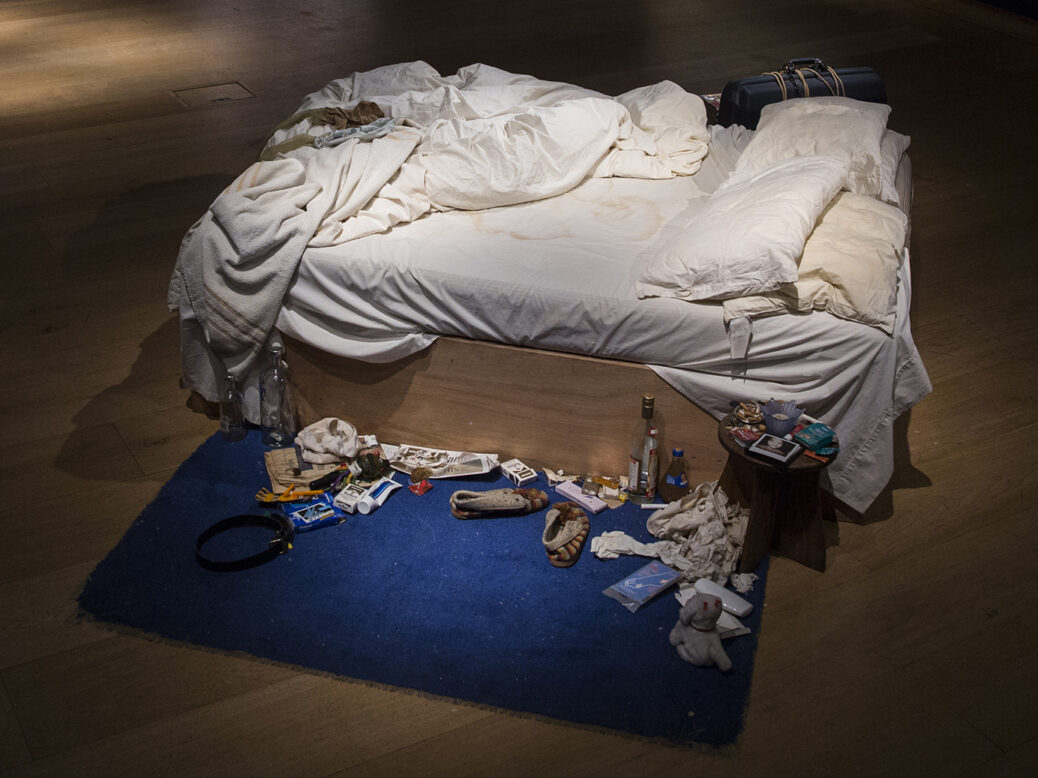
This time round, I was at the Tate for the “Friends” summer party, which offered food and cocktails in addition to the art. In the last room of the James McNeill Whistler exhibition, a man in a Tate lanyard came past, writing down numbers on a clipboard. I wondered if he was counting Friends. Actually, he was counting works of art. Everything at the Tate is regularly counted, even the 123 items on Tracey Emin’s My Bed. Thieves, be warned – every artwork has a bright yellow panel behind it, so any gap on the wall is immediately evident. Sometimes people add works of art to an exhibition, complete with explanatory signs in the Tate font. Any anxiety about adding, or indeed taking away, by tonight’s guests? “No. The Friends are a discerning crowd,” he said.
O followers of Scotland
The next day, we took the train to Glasgow. An exhausted-looking steward in the buffet car told me a large proportion of the Tartan Army had travelled the other way, en route to Heathrow for Scotland’s opening World Cup fixture in Boston. “It was quite a lively train,” he said. Were many kilts worn, I wondered? “Och aye.”
My Glaswegian-born husband had eschewed his kilt, but was still properly kitted out in a pink Scotland away shirt for a night at the Hydro, “Scotland’s biggest fan zone” – the next best thing to Boston’s Gillette Stadium. The Hydro was bristling with large men in full national dress, bars flogging beer, whisky and Irn Bru, and a “Can you reach McTominay’s boot?” challenge on the wall – referring to the Scotland midfielder’s astonishing 2.53m overhead kick to score in the qualifier. My husband, who is extremely tall, managed it by simply raising his arm.

National pride thus satisfied, we sallied into the arena for a pre-match concert, during which every famous Scottish song save “Auld Lang Syne” was sung by a line-up almost drowned out by an 8,000-strong crowd that knew every word. “England has a story to tell, but nobody cares about it,” shouted the presenter, to wild acclaim. Although, if you parse them, Scottish anthems from “Loch Lomond” and “Caledonia” to “Why Does It Always Rain on Me?” are pretty gloomy. Yet when “Flower of Scotland” was belted out from both sides of the Atlantic, hearts were high. After the match, which Scotland somewhat improbably managed to win, we issued out. It was 4.30am and broad daylight. “Well, it’s been shite so far,” said a large man in a kilt.
Déjà vu debacle
I’ve been deconstructing national consciousness in the French degree I’m taking at Birkbeck. We have looked at national constitutions, Haussmann’s Paris, poems by Baudelaire and the battle of Trafalgar. I can’t help talking about it at home. “Do you know where Trafalgar is?” I asked my elder son Gabriel. “Wales?” he offered.
This week was the deadline for my 1,500-word essay on Zola’s 1892 novel La Débâcle (in English – I’m only in my first year). It is a brilliant chronicle of the carnage, brutality and recklessness of the 1870 Franco-Prussian War, including a vivid account of the Battle of Sedan, which caused the surrender of Napoleon III to the king of Prussia and his chancellor, Otto von Bismarck. La Débâcle was Zola’s greatest commercial success, selling nearly 200,000 copies in its first six months, though one wonders whether enough people had read it before committing to fight again, on the same fields, against the same opponent, 22 years after publication.
Generation games
So much for national pride. What about family pride? In the Millard clan, much is made of Family Running Records. The marathon FRR has been held by yours truly since 2018 (three hours, 48 minutes in Tokyo). I was pretty confident this would stand, even when cheering on my extremely competitive daughter at the Edinburgh Marathon, her first. She looked fresh at ten miles, but we veterans know the game doesn’t start until mile markers brandish a double figure beginning with two. “We’ll see,” I said to my younger son, up in Auld Reekie with me as support team. “Let’s get to the finish line early,” he said, ominously. And lo, along with a lot of men in singlets, there was my daughter, charging to the finish. Not only did she beat my record, but trampled on it. Three hours, 25 minutes. Do I feel like Arnold Schwarzenegger, who said of his actor son Patrick, “If I go to my grave knowing my son outdid me, I’m in Heaven”? No. I am furious.
[Further reading: David Hockney was as serious as he was fun]
Content from our partners



Related
This article appears in the 17 Jun 2026 issue of the New Statesman, The Race
Join the debate
Subscribe here to comment