
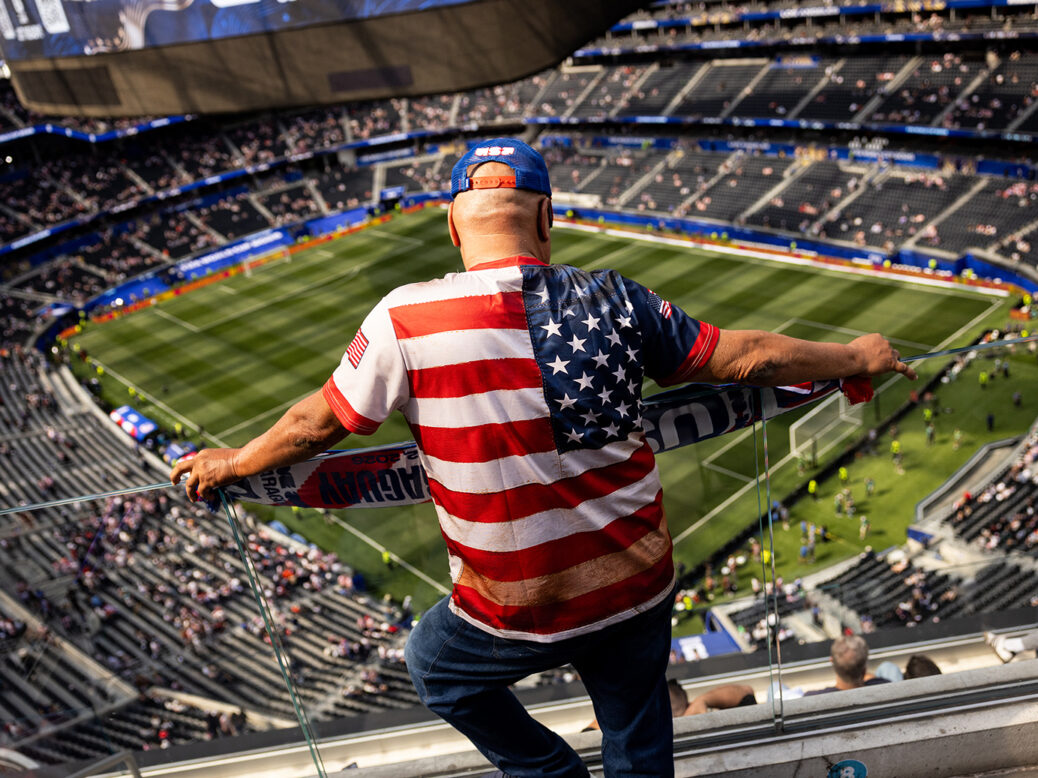
On Eastern Standard Time, football always starts early. Often at 6am on a Saturday, football shirt over pyjamas, the room recedes into darkness around your big American TV. You may never walk alone, but the bars aren’t open and your partner’s asleep, so you sit on the couch and watch it.
I call up Adam Friedland, one of America’s most vocal and verbose soccer fans and host of The Adam Friedland Show, a show with nearly half a million subscribers. Being one of America’s most verbal soccer fans, he’s also just launched a new podcast about the World Cup, The Beautiful Pod. He saw my British +44 number and said, “Yo, I thought Keir Starmer was calling.” If modern Britain means two things to the rest of the world, it is embarrassing politics and football. We spoke about the latter.
A devout Gooner, Friedland takes Arsenal seriously. “It’s a very monk-like, solitary experience,” he says. “I watch it in the mornings in my apartment, alone, and then they ruin my weekend before it’s even started. I don’t know what to do when something good happens.”
I ask him what he did when Arsenal won the Premier League. “I literally just sat there in my living room and I was like, what do I do? I put on my 2003 Gilberto Silva kit and took my dog for a walk.”

Friedland recently hosted the New York mayor, Zohran Mamdani, on his show. “My main takeaway was like, oh, he also likes hip-hop and Arsenal. Like, we’re losers.” Friedland muses that Mamdani is one of the first people of his generation to hold a serious leadership position. “In Congress, they’ve got all these 700-year-old people who have been stealing money for a hundred years and just won’t retire. So Zohran’s the first guy like me.”
Football, then, has become a cultural signal in America. It can be harnessed to connect with very specific demographics. “My parents were so excited that Bill Clinton’s campaign song was Fleetwood Mac’s ‘Don’t Stop’,” Friedland says. “They were like, this is our guy. Mamdani and Arsenal is kind of like that.”
Friedland pledged himself to Arsenal because they had “cool guys”. Maybe it is because of it has a history of legendary players such as Thierry Henry and Dennis Bergkamp. Arsenal are much beloved across the pond, the second most-supported Premier League club after Liverpool.
“I have a sense of superiority over the Ted Lasso boys at the Arsenal pub [who are wearing] the worst whatever neon road-worker kit with, like, Dani Ceballos on the back,” Friedland says, referring to the recent Apple TV comedy series, which follows an American football college coach managing the struggling London-based football team, AFC Richmond. Critics accused it of possessing a saccharine positivity and generally being “too American”. Friedland is of similar mind. Rigorous zeal for a football club and its history, so familiar to Brits, can lean cultish in the States. Or, as Friedland puts it, “I have a couple friends who are like me and it’s like we’re homosexuals in the 1950s.”
That may be true of the transfer-obsessive stat fanatics, but Ted Lasso-style casual interest in football is rapidly growing in America. As US audiences have increased, the value of football’s international media rights has almost tripled since 2017, from $340m to $900m. Some fear this will be seen as justification for longer ad breaks in and around games. At the current World Cup (which has the US as one of three host nations, alongside Canada and Mexico) mid-half hydration breaks have been introduced because of extremely hot conditions in several stadiums. But these also offer ample opportunity to sell pharmaceuticals, takeaways and military recruitment to TV viewers.
This World Cup has arrived at a moment when America’s voice in “soccer” is getting louder. Eleven out of 20 clubs in the Premier League are now majority owned or controlled by American owners. (Two of these 11 owners are a husband-and-wife team.) To buy a sports team in the States, you have to be a billionaire. Whereas in the England, particularly in the lower leagues, any millionaire average Joe can take a pop.
Brad and Sharon Galinson bought Gillingham FC, a team that is currently in League Two and is based in the town in Kent, in 2022. “No one likes change,” Brad says. “But the Brits really don’t like change.” Put another way, resistance to change can also be understood as a desire to protect community heritage. Friedland recognises a certain bent in his culture for what we would call iconoclasm and Americans might call growth. “You guys have a connection to your old buildings and shit,” he says. “In New York City we don’t have that crap. Just tear that shit down. We don’t have a romanticism for the past or a notion of nostalgia. You guys have heritage. We don’t do that.”
Where football is concerned, bigger and more commercial does not necessarily mean better. Yankified additions to the game, such as pre-match or half-time concert-style performances, like the Killers’ concert before this year’s Champions League final, are not always met with approval here. “I’m going to watch the football,” Sam Jaffe, a Notts County FC fan, tells me. “I’m not turning up to see the concert beforehand. The atmosphere created by the fans is what makes football special, and I don’t think we need to copy other sports.”
One of the most storied American takeovers of a British club, and perhaps the antecedent to the football gold rush, has been Ryan Reynolds and Rob McElhenney’s fever-dream dalliance with Wrexham AFC and the accompanying Disney+ docuseries, Welcome to Wrexham. In 2011,before the A-listers arrived, the Football Conference demanded a £250,000-bond from the club’s then-owners to ensure their participation in the upcoming season. When the owner’s provided only £150,000, the fans raised £100,000, essentially saved the club.
Reynolds and McElhenney bought the team for £2m in 2021, when Wrexham were in the fifth-tier National League and operating at a loss. After the takeover, film crews set up camp in the stadium and around the grounds. “We were concerned it would be poverty porn,” Wrexham fan Rich Fay says. “Look at these yokels from North Wales, they’ve got nothing. Here comes Hollywood money.” But after the first series of the documentary came out, it was clear the community was being treated with respect.
Since the takeover, Wrexham have returned to the Football League after 15 years. This year, they finished seventh in the Championship, narrowly missing the play-offs and the promise of Premier League riches in their highest finish since the early 1980s. Reynolds and McElhenney haven’t just changed the club for the better, but the town itself.
“Wrexham used to be somewhere people would make fun of you for being from,” Fay says. “Now everyone tries to claim they’re from here. It’s gone from being ridiculed to an absolute badge of honour.” The town has seen a 20 per cent yer-on-year boom in tourism since 2021, injecting millions into the local economy. “They say money can’t buy you happiness,” Fay notes, “but we’ve got self-belief and confidence again.”
So money cannot buy you happiness, but it can buy you a football club.
Before buying Gillingham FC, Galinson had made his money in real estate. When he arrived in the English Football League (EFL), he was dismayed by the lack of financial protection given to clubs and their communities. In the States, he says, profit and sustainability laws protect teams from going under. “Over here, the community is so important, but you guys don’t protect it.” He sits in the camp of owners who understands how critical football is to the community.
“The only comparison I could make is to family. With family someone might go to the emergency room, or get engaged, or get into college. But in football that intensity happens every Saturday. We don’t feel that way in America.”
Football mania is evangelical. Galinson no longer watches the NFL because it feels it’s too slow and lacks that intensity. But the danger, as Galinson sees it, is that almost every lower-league British club is about seven days away from falling into administration if its owners decide they have had enough. “When the EFL allows nearly every club to be one month away from administration with a change in circumstance or mood of their owner, it’s sad and irresponsible.” He believes the EFL needs to adopt Uefa-style profit and sustainability rules.
The question of protection, though, is fraught. One proposed solution to football’s financial volatility was the European Super League. In 2021, 12 of Europe’s richest clubs announced plans for a breakaway competition, backed by major clubs including Manchester United, Liverpool, Arsenal, Chelsea, Barcelona, Real Madrid and Juventus, and finacially supported by JPMorgan Chase. The project proposed a largely closed league in which founding members would be guaranteed entry every year. Gone would be the nail-biting tightrope of promotion and relegation. It was designed to rival, and potentially replace, the Champions League as the most lucrative club tournament in football.
But it was met with disdain. Supporters’ groups across Europe called it “unpopular, illegitimate and dangerous”. Because the tightrope of promotion and relegation is what makes the game: it provides the drama, the jeopardy, the stakes. To be or not to be. Not just to be. And while the Super League was not simply an American invention – Real Madrid, Barcelona, Juventus and others were central to it – its American imprint was hard to miss: a US investment bank financing the project, and several American-owned clubs helping to drive it. Given that US sport is built around closed leagues without promotion and relegation, it is easy to see how football’s essential exhilaration might be mistaken for inefficiency.
According to Galinson, the EFL is surprisingly matey at the top. When owners find themselves in each other’s cities, they play golf, go for dinner and discuss how to protect and promote the financial soundness of the EFL by the 2027-28 season. Proposed measures such as salary caps, however, have been immediately opposed by players’ and managers’ unions. “If the owners show up, they’re pretty committed,” Galinson says. “Some of them are absentee owners, which is their business.”
One such co-owner is the rapper Snoop Dogg, who joined Swansea City’s ownership group last year in a bid to give the club the backing it deserves. “They’re an underdog that bites back, just like me,” he said. After touring South Wales in this new mode of Yankee ownership tourism, he concluded that Swansea needed more investment and that one day it could be the “Vegas of Wales”. He hopes the city will attract world-class chefs, hotels and clubs so the team has somewhere to “celebrate in style” after winning trophies. One local resident told the BBC, “I think he should leave us alone to be honest.”
Maybe, for these absentees, football ownership tourism is the new NFT: sport in the sixth dimension, fulfilling schoolboy dreams, taking over stadiums as a weekend Airbnb, ordering Champagne to the owner’s box. The trend was identified in HBO’s Succession, with its usual sharp satire: a son buys his billionaire father’s childhood football team, Hearts, only for his father to wave him away and say his team is Hibs, their rival. The disparity between how much football means and how little this rich man understands is eye-watering.
In discussions about American ownership, it is worth remembering that the problem is not simply nationality. Football’s ownership crisis is much wider than that. Some of the most powerful clubs in the game are now owned or effectively backed by Gulf-state wealth and sovereign investment. Manchester City, Paris Saint-Germain and Newcastle are clear examples, teams that are owned by Abu Dhabi, Qatar and Saudi Arabia, respectively. Manchester City’s owner, Sheikh Mansour, is a senior UAE political figure, and the UAE has been accused of backing the Rapid Support Forces in Sudan, a militia accused of genocide, ethnic cleansing and mass killings in Darfur. Football ownership can become part of a much larger project of soft power and reputation laundering.
That does not mean all foreign ownership belongs in the same category. American money has also proved a lifeline to clubs like Wrexham, which were on the brink long before Hollywood arrived. The question, then, is not whether English football should accept American money, but what it must refuse to sell in exchange.
Arsenal’s owner Josh Kroenke has played a major role in the club’s success over the last five years. At the Arsenal Premier League Champions parade on 31 May, he posed on the open-top bus in a T-shirt with players Saliba and Gabriels’ faces imposed on characters from the film Stepbrothers. Somehow, this guy gets it.
The parade dominated Islington for the entire Sunday and into the small hours of Monday morning. By American standards, it was notably lo-fi. Two buses crawling through the streets from 2pm to 4pm and a few sound systems. That was it. No mega-floats. Shakira was nowhere to be seen. No one had bothered to choreograph a dance. But somehow the atmosphere was full-tilt ecstasy because our love of the game doesn’t have to be coaxed into creativity. Who comes up with football chants? How does everyone know what they are? Who’s idea was it to bellow “Sweet Caroline” and why is it so good? (So good.)
After the parade, I found the Arsenal America gang, who have spent an average of $1,500 on plane tickets to be there that weekend. I muscled my way into their WhatsApp chat and asked if anyone wanted to meet for a beer and talk about the team. No one argued with my pub choice, and seven of them arrived within half an hour. They all had great teeth and wore serious merch. They seemed even happier than the average Gooner, glowing after a weekend spent transcending our pedestrian, siloed human experience, packed together with loving strangers, drinking beer on foreign shores. The ineffable atmosphere is the cultural export.
A guy called Don arrived late, having travelled all the way back from Heathrow. Don was from Memphis and was wearing blue-tinted shades and had picked up a Big Gabi T-shirt, for centre-back Gabriel Magalhães.
The general consensus within Arsenal America was that they want to protect football from American influence. “I’m very wary of American investors because I don’t want the sport to get more American,” one of them said. “The whole reason I don’t watch NFL or baseball is because I don’t want to watch a four-hour game that’s 90 per cent commercials.”
A professed Anglophile, Matt came to Arsenal through a love of British culture, typified for him by Monty Python, Black Books and The IT Crowd. That interest led him to Nick Hornby’s Arsenal fan memoir Fever Pitch. “I don’t want the Americanisation of this sport in any way,” he said.
Don’s experience of football tracked with Friedland’s. After Danny Welbeck headed in a winning goal against Leicester City on Valentine’s Day in 2016, Don left the house at 6am and returned “steaming”, flowers not in hand. “I was in serious trouble with my girlfriend,” he said. “Actually, she’s not my girlfriend anymore.”
For people who have flown across the world for a football match, they seemed surprisingly distressed by the state of transport infrastructure in their home country. They envied the way we can just walk to our stadiums. Matt Sommer is a high-school teacher from Wisconsin. He thought he was coming down with the flu. His most local team is in Chicago, Illinois, a two-hour drive away and a place that everyone in Wisconsin hates. In the US, it is more typical for a stadium to be at least a 40-minute drive out of the city, where there is space for horizon-defying parking lots.
It was the same story for everyone. Local football community is incompatible with America’s vastness. Zachary Leiter and Claire Gammon, from Evansville, Indiana, said there is little hope of getting their kids properly into football because coaching opportunities and tournaments would all be a four-hour drive away.
None of the Americans I spoke to have bought tickets to the World Cup. Long distances and record-high prices without ticket-touting restrictions have made it an incredibly inaccessible tournament. Don’s group of friends plan to fly to the UK for the 2028 Euros instead. “The World Cup might as well not be at home,” Don said.
Americans turn to soccer because the rampant capitalism of US sports has, at times, precluded that closeness and community. In 2016, Stan Kroenke, Arsenal’s main shareholder, moved the NFL team the Rams from St Louis, where they had been based since 1995, to Los Angeles, a four-hour plane ride away.
Let us imagine, for a moment, if Arsenal moved to Cornwall. It would not just be a relocation, but also an ontological severance. Arsenal would no longer be Arsenal by any meaningful standard. Football is not about profit, or pop music, or network ratings. It’s only partly about what happens on the pitch. The rest is something we already understand – home or away.
[Further reading: Staying up for Scotland]
Content from our partners



Related


Join the debate
Subscribe here to comment