
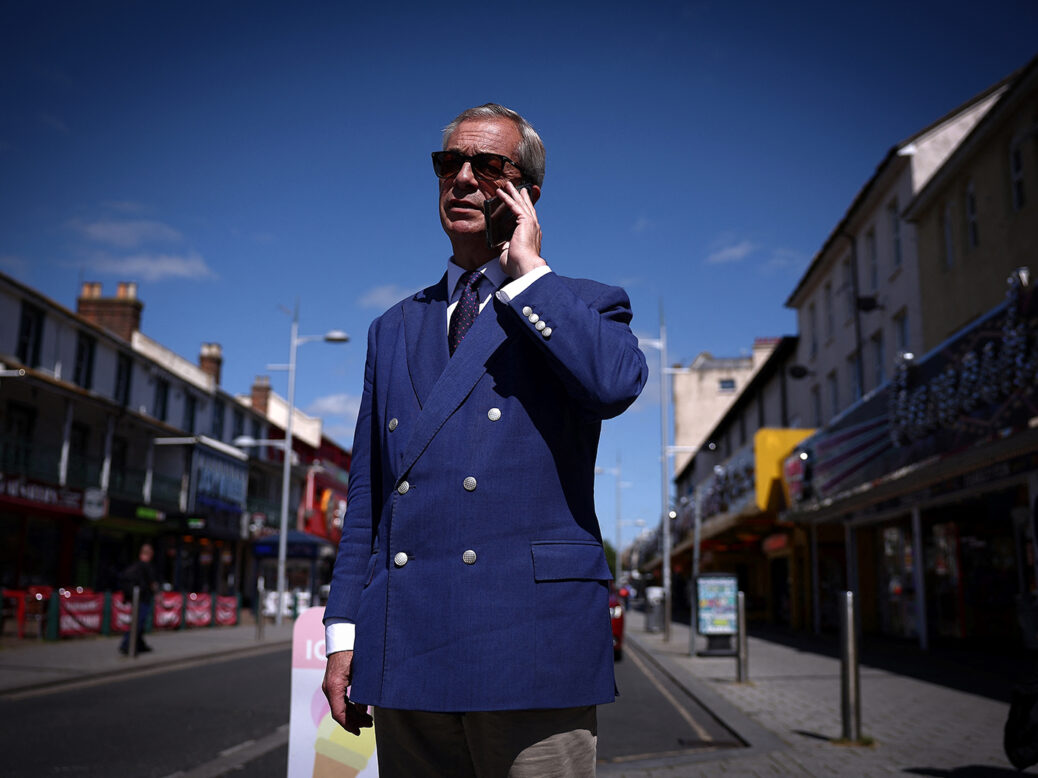
Whenever I’m back in Essex I wait for the first mention of his name. How long before I hear about my parents’ local MP, Nigel Farage? Will it be ten minutes, half an hour, one hour before the Great Nige is invoked? This time I had barely put my bag in my dad’s car at Thorpe-le-Soken station before Farage was alluded to. It was just a few days before Essex went to the polls. A party that didn’t exist a decade ago was about to end 25 years of Conservative Party dominance on Essex County Council. Dad wanted me to know about a cardboard cut-out of the Reform UK leader tied to a lamp post just outside of Frinton-on-Sea. On the drive from the station, I counted all the Union Jacks, all the St George’s crosses, snapping smartly in the cold sea breeze that never goes away here. Another one, another one, another one.
They may as well be more cardboard Nigels. He is omnipresent, hyperactive, interested in everyone’s business, contrary to the London-based hope that he is never in the constituency. My auntie sees him in the local health spa. My cousin heard about the furniture he bought for his constituency home. He was in St Osyth – one of those low-to-the-ground, spooky Essex villages where they’re always finding broken-up skeletons of witches buried between dry walls – a few days ago, according to several Facebook posts. My grandfather, a disgruntled and elderly socialist who lives there, was horrified. Ask anyone – and I do – and they will tell you Farage has turned Clacton-on-Sea into Clacton-on-the-map. What about that undeclared £5m donation from the crypto billionaire? “The what?” comes every reply, before conversation moves on to what a “wanker” the Prime Minister is.
The only politician who really matters is Farage. I think about other places I’ve been where conversation turns so insistently to the sayings, doings and potential actions of one man. All that comes to mind is Saudi Arabia. Later, I watched as all eight seats on the district council (Tendring) were swept up by Reform on 7 May. I’m uncertain as to whether MBS would be able to pull that off, not that Riyadh bothers with elections.
Bitter medicine
I’m home at what seems like the worst possible time, because I’m unaccountably ill. Nothing too serious, although there have been some queasily intimate tests conducted on me by hard-working NHS doctors. Am I OK to put a finger in there? Yes. OK, then. Fine. Do it. Two harried trips to clinics result in stern medical injunctions. I must cover myself in thick white unguents. I must begin an intense pill-popping regimen. The drugs are deeply boring unfortunately. I half wish I was more ill, so I could have the good stuff. But no. My mum reassures me by saying that something like this runs in the family. All I have to do to make it go away is engage a seasoned practitioner of Chinese medicine. They’ll give me some bitter black roots, which, combined with boiling water, make a powerful and disgusting draught to drink. How long does it take to work, I ask? “Immediately,” she says. Brilliant! Let’s go. I start smiling. “But you have to keep drinking it for three years.” Oh. Thanks, Mum.

History repeating
China was already on my mind. In what is shaping up to be his only legacy, the Prime Minister secured 30 days of visa-free travel to the Middle Kingdom for Brits during a visit to Beijing in January. As a result, I’ll be flying to Chengdu this week. I’ve started reading up on Chinese history, from what can only be described as a perilously low knowledge base. Five thousand years of civilisation are all so much virgin snow to me. I press my dermatitis-strafed face into the Harvard University Press’s six-volume History of Imperial China. I’m reading multiple books by different authors at the same time, cross-referencing them. The Later Han period (roughly AD 25-220), as described by John Keay, might as well be the Later Starmer period (roughly July 2025 – May 2026): “The succession passed to a motley collection of infants, invalids, weaklings and imbeciles… they seem more deserving of pity than censure… seldom can a change of power be taken to indicate a transfer of power or an adjustment of policy. Power changed hands between factions, not emperors; policies where discernible, were dictated by events.”
Neutered ambitions
The older histories tend to be hard on the mischievous, power-mad eunuchs who infested later Han courts. Keay points out that while women and peasants of the Han era have been rescued from the condescension of posterity by gender- and class-conscious historians, no school of testicularly challenged writers has arisen to save the eunuchs. I wonder who the archetypal scheming eunuch figure was in the court of Later Starmer? What was the name of that bloke who used to be the ambassador to Washington?
[Further reading: The speech that failed to save the Prime Minister]
Content from our partners


Related
Join the debate
Subscribe here to comment