
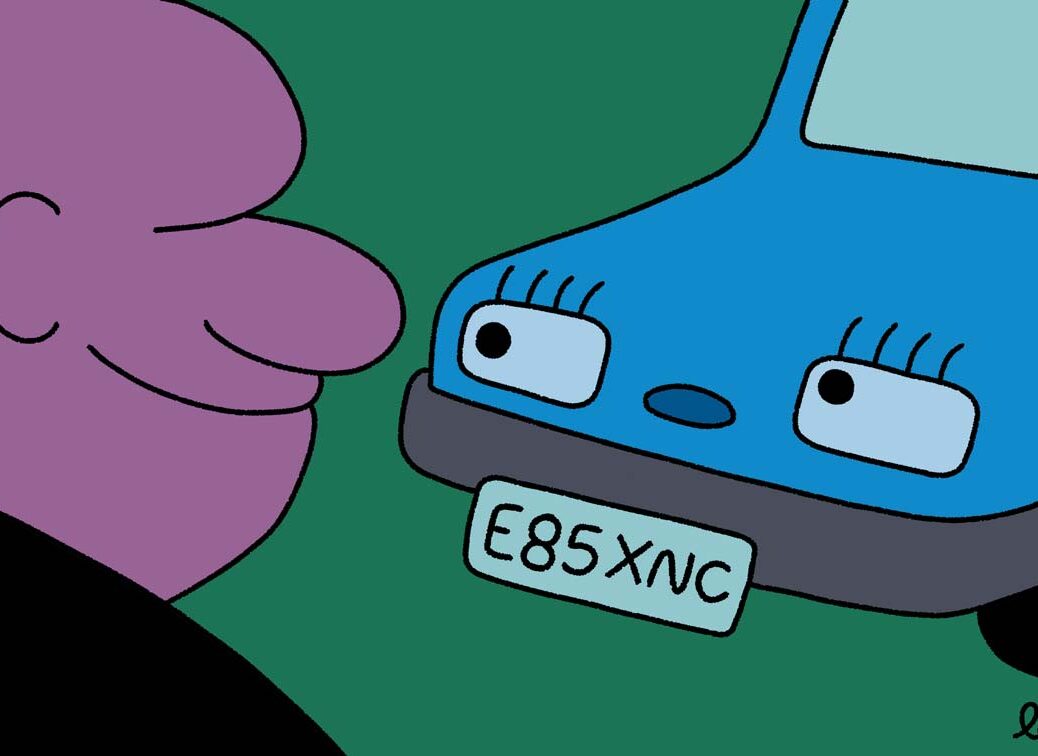
A train, a trudge through a field, an argument down the line with a local taxi company, rendered worse by patchy service; a long wait on a roadside embankment under a tree to shield from the rain, and a taxi successfully hailed. Of all the barriers to entry when it comes to attending a vintage car festival in rural West Sussex, not being able to drive must be the primary one.
Anyway, here I am at the South of England Showground in Ardingly for the Classic Ford Show – or “Europe’s largest classic Ford event” to you (does this accolade warrant a plaque?). In my limited knowledge of the automobile, Ford always stood out as pure Americana: that boxy frame designed for the industrial East Coast highway; Bruce Springsteen, if he had an axle and four wheels. And whatever other clichés we can summon – the blue jean? The blue collar?
I thought this car would fail to navigate the transatlantic language barrier – a world apart from the metrosexual Italian Alfa Romeos, the self-regarding German BMWs, the monstrously self-regarding English Aston Martins. Moments after arriving in Ardingly I hear the engine of a dinky turquoise number rev. Yep, that sounds pretty Yank to me.
Well, consider my assumptions disproved, my romantic nationalism dashed. Because in this field, surrounded by hundreds of the things – Ford mecca, the Ford bazaar, “Europe’s largest classic Ford event” don’t forget – I am witnessing a very particular slice of England. There are hundreds of enthusiasts, hobbyists, amateur and professional mechanics, collectors and devotees united by a shared, irony-free love of the Ford Fiesta – or Sierra, or Escort, or Transit or any subspecies thereof. They are pretty much all men, pretty much all over 50, pretty much all white, and rather a long way from the United States, in countenance and in accent.

“Alright Kev,” a man jocularly greets his friend, with a real clap on the back. (Please set your “Kevin Tracker” to one.) I follow the pair down the singular path that cleaves the sea of cars in two, all lined up, engines off, waiting to be inspected by passers-by. Some have their “hoods” suggestively and pre-emptively propped open – is this the automobile equivalent of flashing? Some are grouped by breed: a handsome row of rally-modified Escorts catches even my eye. Others are in considerable disrepair (I, for one, would wash my car before taking it to a car pageant).
Onwards, through the festival ground. There are typically sad food stalls: sausage sandwiches, ice creams, candyfloss, drab pizza and all else you might associate with a day out at the beleaguered English seaside, though we are, by my calculations, 20 miles away from the coast. Most attendees procure their own tinfoil-wrapped sandwiches. I am sitting in a shed now – white picnic furniture is scattered with an alarming disregard for order and social cohesion. A sign shouts at me: “FUNZONE”, which appears to refer to a plastic stacking container and a barren concrete floor. There is a bar but no one is drinking. Music irritates from a tinny speaker: “Dancing in the Moonlight”, “Jolene” – you know, that sort of thing.
And the whole thing only gets harder to parse from there. Outside of the shed different men appear to be hawking huge piles of rusting scrap metal – a few springs, something I can identify only as “adjacent to wheels”, broken car bonnets and seats, all splayed on the ground, as if a Transformer exploded and no one came to inter its corpse. “Why is anyone queuing up to buy this miscellaneous junk?” I ask, hopefully more politely than it appears on page.
Well, one man says, it’s not miscellaneous junk (young lady!) but those are “tubular exhaust manifolds” and these are “suspension control arms” and that’s a “brake plate” and these are “mounting brackets”. He explains that what I am looking at is a carefully curated and sourced selection of old Ford “bits” from cars out of manufacture. And so – if you wanted to replace a broken part of your 1987 Ford Sierra RS Cosworth then you might find this pile of miscellaneous junk rather compelling. In fact, the only means to prevent these cars from going extinct altogether is to trade their parts, and constantly to repair the finite and therefore dwindling stock.
Are these men the truest incarnation of conservative in this country? I ask Kevin from Bournemouth (Kevin count: two) why his car – gold, with a number plate that reads “Speedster” – is both on a podium and attracting so much attention. Well, a crowd of four or five – but these things are relative. He responds in what I can only describe as car babble or vehiclese, though I do learn that two years ago Kevin found an official 1990 drawing of a Ford model that never got made, and decided to build it himself from old parts. I wonder if he inspected the scrap heap, too. Today was “The Great Unveiling” of the Speedster. Everyone is very impressed.
Elsewhere, I spot a man selling a huge collection of old car brochures, “from before the internet” he helps me understand. He is wearing an NHS Test and Trace fleece, though tells me he is retired from a career in aviation. Collecting was a hobby, then it became an obsession, and now it is a full-time, post-retirement job. He likes the crowd at the Ford festival better than, say, the Jaguar festival. More “down to earth” he says, euphemistically. I ask his name. Kevin! “No way,” I reply. He returns a puzzled expression.
The rain has worsened. And, well, the cars are nice but there are rather a lot of them, and the law of diminishing returns has kicked in with tremendous force. And so I am standing outside the South of England Showground again, under a tree, waiting for a taxi to collect me (a Toyota, alas). A black Ford with racing stripes kind of Tokyo-drifts out of the gate and bombs off down the road. The effect is jarring in the verdant, peaceful countryside.
It’s not like Goodwood, that seat of the classic car show, on an aristocratic estate, replete with its own racecourse. Nor is it like Ascot, the queue at Wimbledon, the Chelsea Flower Show, the Wolseley in 2012 or the Ivy in 1995, either – where south-east England’s upper middle goes to be seen. No, Kevin isn’t here to be seen – Kevin has never gone anywhere to be seen. Kevin just exhales exhaust fumes and speaks fluent automobile (somewhat to the detriment of his English). His brain, I suspect, is a series of tachometers and dials and gauges. Kevin knows what an ABS hydraulic pump unit is; he might even have a spare in the garage if you ask nicely.
When Henry Ford all but invented the car in 1896 perhaps he never thought his imperium would extend so far. He also might never have suspected he would owe plenty of his legacy to a few men from south-east England. Without these enthusiasts, and their ability to scan a scrap heap of junk, these cars would go extinct. Most of them will anyway: 1.93 million classic vehicles are registered in the UK, and their owners have an average age of 66.
Looking around the Ford festival, I suspect that number will only go up. The Tories have just lost control of West Sussex Council, as Reform encroaches. But there is nothing radical, reforming, new or outré about the politics on the Ardingly showground today. These men are driven (ah!) by a terminal, chronic instinct to preserve and maintain the past – thorough, romantic conservatives of a kind you would never find in America.
[Further reading: Dog days at the Romford races]
Content from our partners


Related


Join the debate
Subscribe here to comment