
As Keir Starmer looked around his cabinet table on the morning of Tuesday 19 May, he met the gazes of people who had told him, only days before, that his time was up. Many of them had reached that conclusion more in sorrow than in anger. For the Prime Minister it was a dark moment of soul searching.
Others had told him it was over, starkly and brutally, and then briefed it to the press. Starmer is furious with many of them, but he continued as though it was business as usual. Such is the oddity of the very polite, protracted coup that is underway: Starmer is pressing on while his whole party rallies round the man who hopes to oust him.
Inside No 10, things are “very, very odd”, as one insider describes it. After a week of high adrenaline and moments where it all looked to be over, people are picking themselves up, dusting themselves off and returning to “semi-normal”.
Many in Labour are relieved that the state of paralysis that has gripped the party for months is now coming to an end. The circular questions over whether and how to replace Starmer have been answered. Yet a new stasis has set in while the party waits for Andy Burnham to fight the by-election in Makerfield.

Starmer’s anger with many cabinet colleagues stems from a feeling of betrayal, both personal and political. He is frustrated that positive news for the government – on economic growth and NHS figures – was relegated to the fourth or fifth item on the news last week, bumped by manoeuvrings of Burnham and Wes Streeting. Egged on by figures like Steve Reed, the pugnacious Housing Secretary, Starmer has adopted a new mindset: “keep on fighting until you can fight no longer”. In public, Starmer continues to insist he will fight a leadership challenge against him, however misguided that seems to others. “He doesn’t like being pushed around. It makes him fight harder,” one ally observes.
Beyond his own position, Starmer remains convinced of the need for stability in the country and concerned about the economic shock that’s due to hit from the Iran war over the summer. He has publicly spoken about his feeling of “responsibility” to carry on in the job. His critics are bitterly scathing about this account of his motivations. “This stopped being about what was best for the country or the Labour Party a long time ago. It’s about what’s best for Keir,” one Labour figure, who has recently returned to the back benches, says. Critics on his own side now compare him to Boris Johnson “squatting in No 10” and say that his apparent stubbornness in recent weeks has even challenged the consensus that Starmer is, for all his flaws, a “decent man”.
Starmer and his remaining loyal cabinet ministers want to make every day that they are still in office count, and are determined to cut through the noise of the leadership drama. Many cabinet ministers, who may not survive long in their posts if Starmer is replaced as Prime Minister, are desperate to set a legacy and bank achievements in their briefs while they can. “Let’s get out there and make the case for what we’re doing,” has been Starmer’s message to colleagues. There is even a fleeting hope inside Downing Street that the leadership speculation “burns itself out”, that “Wes and Andy tearing chunks out of each other for weeks might just make Keir look better”. But even many loyalists accept that is wishful thinking. “The writing is on the wall, even if we don’t know exactly what form that takes yet,” one concludes.
Burnham and Streeting spoke on 14 May, as the sun set on a day that may well have sealed Starmer’s fate. They reflected on a dramatic day; Streeting had resigned as health secretary, while Burnham had finally found his route back to Westminster. Burnham, a former health secretary himself, had given Streeting advice on the health brief before and the two had worked together on devolving more health powers to Manchester.
This time, they reflected on the grim necessity of the past few days of manoeuvrings, the dire state of Labour’s recent electoral performance and the need to turn the party’s fortunes around. Streeting pledged Burnham his full support in Makerfield and told him he looked forward to a proper battle of ideas soon. Burnham agreed, although those close to him are acutely aware of the risk of a Labour civil war. Many of Burnham’s supporters are making the case for skipping a contest and going straight to a coronation should their man win in Makerfield.
Streeting, for his part, is “unleashed”. He now has six weeks to set out his stall, unencumbered by collective responsibility. “It’s a relief,” an ally says. “For the first time in six years, Wes can say what he really thinks. Now he is free to spell out his vision.” Streeting argues that Labour hasn’t had a proper intellectual debate about where it is going and what it believes for the best part of a decade, and that a leadership contest is desperately needed for those ideas to be thrashed out. “The Labour Party, and the new leader, will be the stronger for having tested their ideas,” is how one Streeting ally puts it.
Streeting has already started that “battle of ideas” by setting out his view that the UK should rejoin the EU – an intervention that put Burnham on the spot over his own position on the issue in Leave-voting Makerfield. Streeting’s justification for this is that he is simply remedying the incoherence of the government’s current position – that Brexit has been a mistake but that Labour wouldn’t try to reverse it.
More than half – 55 per cent – of voters now believe Brexit was a mistake, compared with the 34 per cent who still support it. This is where the public is, Team Streeting argues, but Westminster has failed to catch up. And this represents a bigger issue for Streeting: he believes Labour has spent too long afraid to make an argument or have a row. He is prepared to pick fights and make the case to voters for what he believes, on Brexit and on other issues.
Streeting’s critics, however, see all of this as simply “styling out defeat”. His allies insist he had sufficient numbers to mount a leadership challenge last week, but decided against it because he didn’t want to destabilise the government by triggering scores of ministerial resignations; rivals, including inside No 10, are deeply sceptical. No one resigned from the cabinet along with Streeting; Peter Kyle and Liz Kendall, friends from the same wing of the Labour Party as him, came out in support of the Prime Minister in a very public display of disagreement with Streeting over whether now was the right time to trigger a leadership contest.
Polling of Labour members is not promising for Streeting either. In fact, Streeting is currently projected to lose heavily to every serious rival for the leadership, including Starmer himself. But he fights on, keen to make his case to that selectorate and the country.
In the coming weeks, Streeting will set out an economic growth plan, taking in industries and challenges, such as deindustrialisation and the technological revolution, that allies say the government simply “hasn’t been on the pitch for”.
Streeting is aware of critics who say they don’t know what he would do differently compared to the status quo, and will argue that this is the first time he has been free to make his case outside the government. He will make the case for “taking the fight to the tech companies”, and also intends to set out his thinking on homelessness and arrangements for children in temporary accommodation. “Wes’s single biggest priority as a politician is giving children from poorer backgrounds the same opportunities as better-off children,” an ally says, nodding to Streeting’s own background as the son of a struggling single mum in east London. He will articulate his thinking on that issue in the coming weeks.
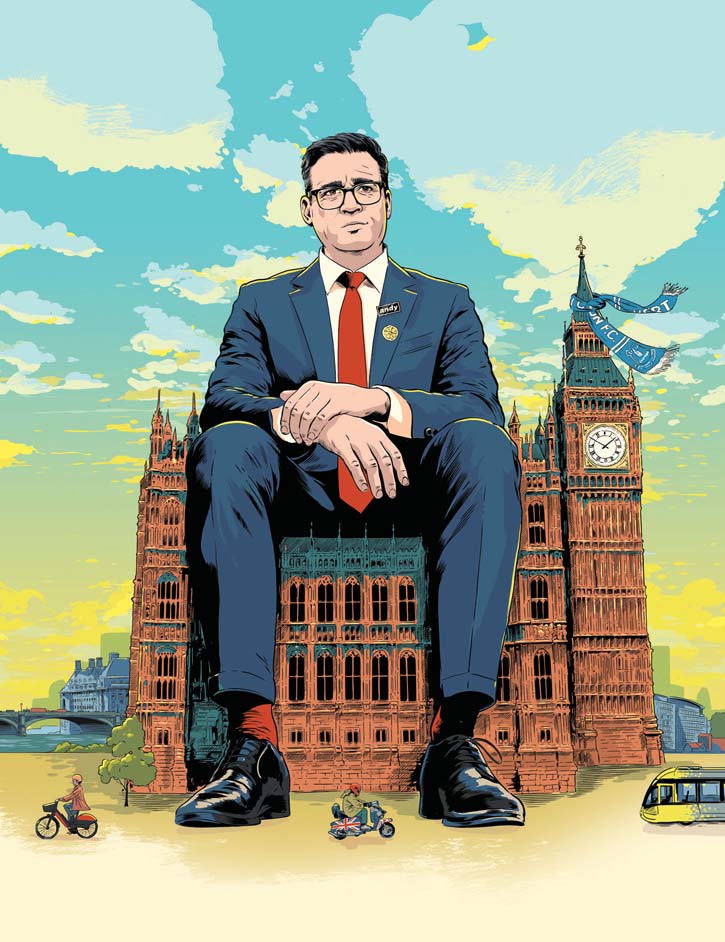
For now, all eyes are on Burnham. On 19 May, he was formally selected as Labour’s candidate for the Makerfield seat. His slogan is chosen (“Vote Andy – For Us”), the music rights acquired from Oasis for his first campaign video (to Burnham’s delight), the pitch established (Westminster hasn’t been working for the north, ending neoliberalism, taking services back into public control).
Yet, there is a cautiousness around Burnham’s operation. He has tried and failed to become Labour leader twice before, struggling with U-turns on positions in the glaring spotlight of a campaign. “He is a vastly superior politician to who he was back then,” as even one critic acknowledges. But he now faces the unique challenge of winning over two very different selectorates in tandem: the Labour Party membership and the people of Makerfield.
In choosing a seat where Labour is currently being hammered by Reform, Burnham is setting the stage for a “proof of concept” by-election. As one supporter puts it: “He’s walked into the fire of Labour’s culture collapse and said, ‘I am the person to do this.’”
He is pitching himself as the outsider and the change candidate, giving voters a sense of what he could offer as Labour leader. If he can defeat Reform here, he will show his party and the country that Labour can win again with him as leader. Labour can barely contemplate what it would mean if he can’t. Though perhaps Starmer and Streeting can.
[Further reading: Tony Benn’s lesson for Andy Burnham]
Content from our partners



Related


Join the debate
Subscribe here to comment