
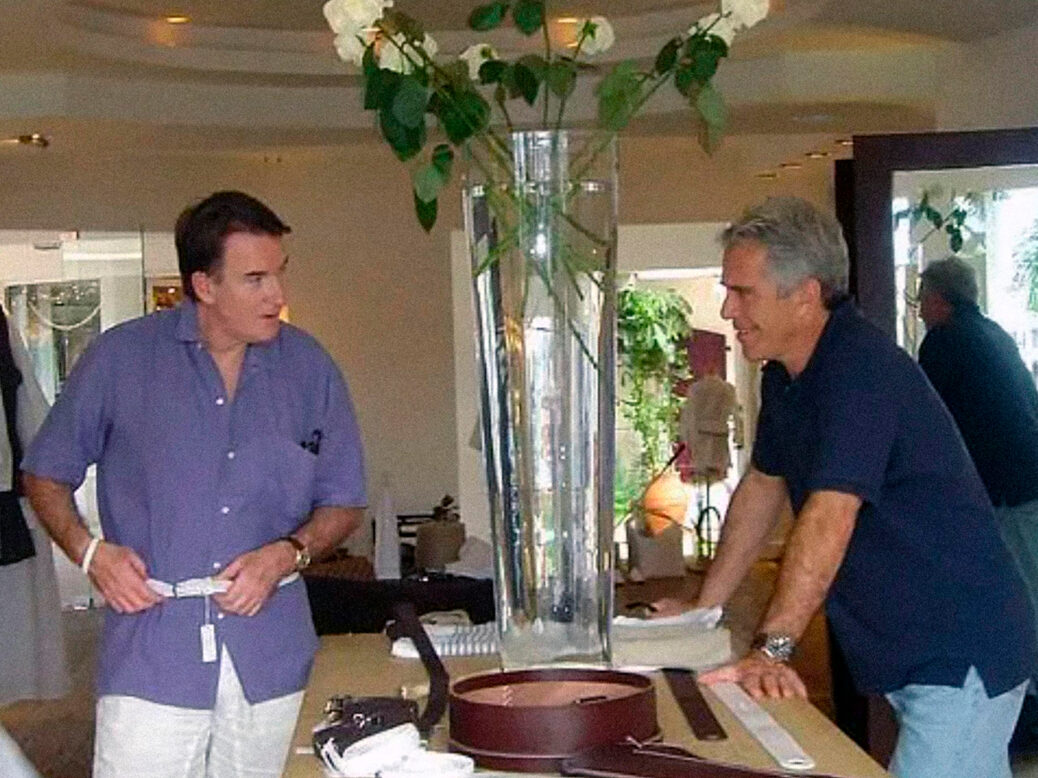
The ongoing Peter Mandelson crisis, with his arrest on 23 February on suspicion of misconduct in public office, is shocking even for those who have spent their careers covering his ups and downs. The depth of Mandelson’s friendship with Jeffrey Epstein – and the possibility that the former trade secretary had shared sensitive information with the financier while serving in Gordon Brown’s government – is not something even Keir Starmer’s sternest critics would have imagined. He can still surprise, even – to declare my interest – 28 years after he told my Evening Standard colleagues, and eventually my editor, that he had been able to afford a Notting Hill mansion because he had inherited it. In fact, a rich friend loaned him the money.
But where does this apparent recklessness come from? Is it in his genes? He is Labour royalty, being the son of the former Labour home secretary Herbert Morrison’s daughter, Mary, who lived in Hampstead Garden Suburb and died 20 years ago last weekend this month aged 82. “Mary reflected her mother’s privacy and reticence,” wrote Illtyd Harrington, deputy leader of the Greater London Council, in a Guardian obituary at the time, citing her amusing, steadying influence, intellect and determination. “Down the street were Mary and Harold Wilson. The two wives were similar in many ways, intelligent and wistful judges of character.”
If there is an inherited sense of entitlement there, we should not be surprised. But the Morrison connection can be overplayed: the Labour grandee was a remote figure to his daughter, and even more remote to young Peter. Morrison died when his grandson was 11.
Mandelson’s brass neck came from his father. “Tony” Mandelson (known professionally as Mandy) was in the RAF during the Second World War, and claimed to have been the first Allied soldier into liberated Denmark in 1945. His own father Norman, founder of the Harrow (United) Synagogue, had been financial advertising manager of the Jewish Chronicle between the wars. Tony and Mary met when they were both working at Dorland advertising agency and married soon after she divorced her first husband in 1948.

The necessary divorce of both his daughter (having been married in her teens) and of his son-in-law was probably seen by Morrison as potentially politically embarrassing in those restrictive times. The birth of their first son, Miles, less than eight months after the marriage would have been doubly so. The former Labour minister Bernard Donoughue, who wrote Morrison’s biography, says accusations of anti-Semitism are probably wide of the mark in explaining the senior man’s evident lack of enthusiasm for the match – it was more likely a fear of controversy. “Herbert was a great Labour politician and very careful. He was always afraid of being exposed in the papers. He tried not to put a foot wrong.” The marriage was not to be the last time that Tony Mandelson defied convention.
Being an advertising manager at the JC – his eventual career – did not come easily to Tony. An article published in the paper in 1997 records that when Tony joined two years after the war, first as assistant general manager, “he was, frankly, terrible… But he was discovered to have an almost heaven-sent talent – he could sell almost anything to anyone.”
“To say Tony was flamboyant would be an understatement,” remembers a former colleague on the JC. “He was a character. In fact, a character’s character.” Sociable and often the centre of attention, Tony, remembers the colleague, would park his car by Golders Green Tube station on double yellow lines. “He had this droit du seigneur that no one would give him a parking ticket, and he was right. No one ever did.”
He availed himself of the good life that the job offered, getting himself invited to expensive dinners. A family acquaintance recalls him doing some eccentric things when representing the Jewish Chronicle. “If he went to an event, he would ring up and demand prawns and lobster [shellfish are forbidden under Jewish law]. You just don’t do that when you’re there for the JC. But he always got away with it.”
Colleagues recalled the Christmas lunch one year of the Press Advertising Managers’ Association, at London’s vast Connaught Rooms. The usual routine was the president of the day to offer a brief and dignified welcome to the esteemed guests. But this year, instead, the room darkened. A spotlight blazed upwards towards the top corner of the gallery. It was Father Christmas. “Shalom, everyone,” roared Santa, easily recognised as Tony Mandelson, on a tripwire. “Merry Christmas from the Jewish Chronicle!”
Alan Rubenstein, one of Tony Mandelson’s successors at the JC, says he was a formidable operator. “For years, he played the eccentric – until finally, he was no longer playing at it – he became that part, totally.”
Those familiar with newspaper advertising told me that Tony Mandelson had “an interesting relationship with the truth”. He was not the first in that business to stretch circulation figures to their limit. But he was regarded as brilliant at selling ads and as a raconteur he was skilled, not always requiring his audience to believe in the literal truth of his stories. Immaculately dressed, often with a cravat, he was forever popping off to Jermyn Street to buy shirts.
On several occasions he brought his sons into the offices of the JC, where they would be treated as warmly as was their father. Miles Mandelson was surprised to see Tony, as the head of advertising, in authority over anything. “The kind of relationship my parents had meant that my father was never really able to assert his authority at home. The moral authority came from our mother, she taught us manners. My father taught us how to break the rules.”
Peter Mandelson confessed in his autobiography, The Third Man, that as a teenager he was slightly embarrassed by his showman father. As an adult, however, Mandelson wrote: “I would come to recognise that much of my own political passion and public personality came from him.” Tony, he said, was “so much like the person and politician I became”.
That’s only part of the story. Peter was more moderate politically than his father, who was something of a romantic, keen on radical voices being heard in Labour. Tony is believed to have supported Tony Benn for the deputy leadership in 1981. “These people stopped Labour being in power for a generation,” said Peter later. “My father contributed a wee bit to that.” Tony died in 1988. Miles believes their father’s death, from a heart attack after he had been diagnosed with cancer, left some unfinished business between father and younger son. The biography leaves the reader in no doubt how bereft Mandelson was by his father’s death.
Peter did not exactly worship his father, friends say, but he was very fond of him and amused by him, sharing his father’s natural gregariousness. He once said he was “so like my father I can feel it”. Donald Macintyre, who wrote a biography about Mandelson and New Labour, reports Miles saying Peter was the opposite of a shrinking violet. “He never seemed to be fazed by anything and always seemed to predominate in a situation.” Miles, often the butt of his brother’s mischief, got revenge by inventing a character that he believed Peter would become: Osmold Smish – “someone with probably an overinflated sense of his own importance but also somebody who is a wheeler and a dealer and a fixer”.
Can we put Peter Mandelson’s apparently unquenchable longing for the company of the rich and powerful down to his father? Up to a point. Of the two parents, Tony was the risk-taker, but, as Macintyre reports, when offered a job at the Observer, he was persuaded to play safe. He turned the job down because, the ever-sensible Mary insisted, “you can never get the sack at the Jewish Chronicle”.
The stakes of Tony’s life were lower than Peter’s. Besides which, he could charm his way out of most holes. Tony would cut corners, but within limits. Peter will be reiterating that he too stayed within the tramlines, though that will be for the police to decide (at the time of writing, he has been released on bail).
It is affecting to read of the devotion with which Mandelson’s parents brought up their two sons. In the optimism of postwar Britain, Peter was ideally placed to bear the Labour flag to greater heights, as indeed he did, helping the party to three successive election victories. One of Mandelson’s biographers, Paul Routledge, quoted Mary saying that if her father Morrison “could see Peter today, I think he’d be rather pleased”.
His friends, who normally speak of Mandelson’s loyalty, have recently gone quiet. After Tony Mandelson died, Peter told Alastair Campbell he thought he would never get over the death of his father. Campbell sought to console him, saying “you get over things like that by being the sort of thing your father would want you to be”. Mandelson’s risk-taking, though, ended up exceeding even his father’s.
[Further reading: The crumbling Crown]
Content from our partners


Related
This article appears in the 25 Feb 2026 issue of the New Statesman, The Crumbling Crown
Join the debate
Subscribe here to comment