
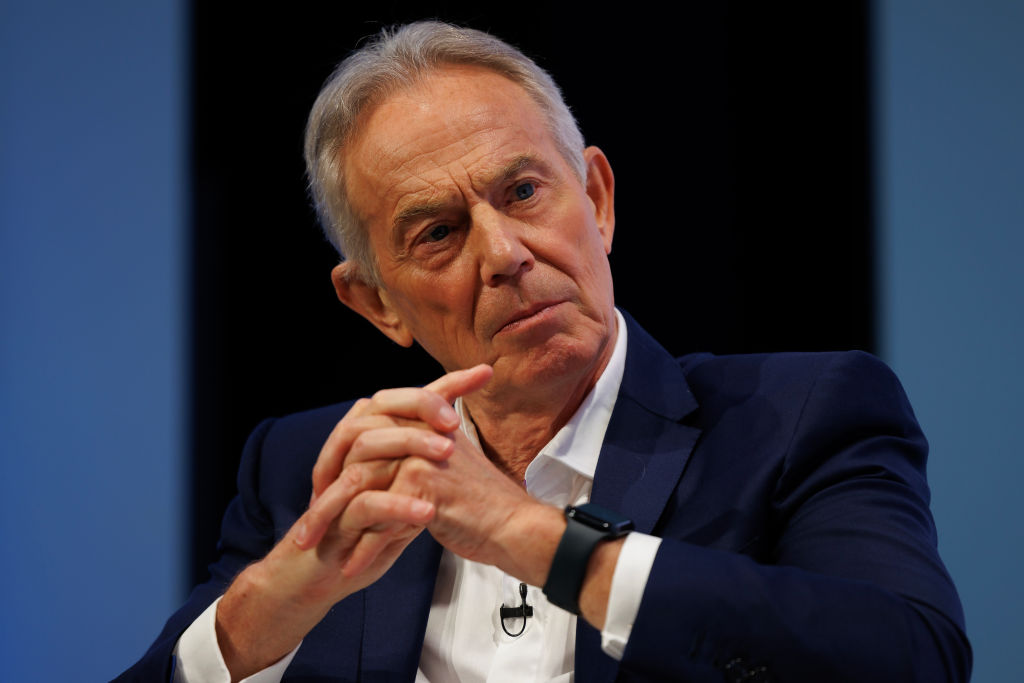
Keir Starmer is an unusual prime minister in so many ways. One of them is his open and unashamed reliance on those who once worked for Labour’s last election-winning leader, Tony Blair. This trend is almost freakish in its distinctiveness.
The PR adviser Tim Allan is Starmer’s latest recruit from the past. Allan worked for Blair even before he became leader, and served under Alastair Campbell in the early era of New Labour. His predecessor but one under Starmer, Matthew Doyle, also arrived in the Prime Minister’s office from Blair’s.
They are only the beginning. The former prime minister’s chief of staff, Jonathan Powell, is Starmer’s security adviser and a huge influence in shaping his foreign policy. Arguably the most famous “Blairite” of them all, Peter Mandelson, is UK ambassador in Washington. Peter Hyman was an important Blair adviser in opposition and during his early years in government. Hyman was a Starmer aide until the election. The Prime Minister’s director of policy delivery, Liz Lloyd, was brought into No 10 to fulfil a similar function as she had behind the scenes for Blair. The former prime minister, himself, is in regular contact with Starmer. Blair’s advice ranges widely and seems to include suggestions about who Starmer brings into his operation.
There is no comparable example of a past prime ministerial court dominating a successor’s. When he became leader in 1994, Blair did not hire the likes of Joe Haines and Marcia Williams from Harold Wilson’s team. Indeed Blair moved in the opposite direction, dismissing the recent past as “old Labour”. He would be “new”. He appointed a team – Campbell, Allan, Powell and David Miliband – that remained in place for years. Powell was his chief of staff from the beginning until the end in 2007. Another election-winning prime minister, Margaret Thatcher, did not contemplate for a nanosecond turning to Edward Heath’s advisers. Heath would have been shocked if she had done so, and so would she.

From Starmer’s perspective, the appeal of figures from a successful previous era is powerful. Blair had high standards. He wanted the best to work for him. Not only did Allan work under Campbell, the smartest reader of the UK’s wild media to have worked for a Labour prime minister, but he understands business – as Allan showed when he set up Portland Communications, a hugely successful PR company. Starmer is relatively new to politics, and though he was considered a serious prospect for the leadership almost from the moment he became an MP in 2015, he did not get to know many brilliant Labour figures during his speedy ascent to power. So he turns to Blair, who toiled as a Labour MP for 11 years before he became leader. This meant Blair knew where to turn for talent.
But politics and leadership are about much more than recruiting experienced figures who have delivered in the past. In very different ways Thatcher and Blair sought to own the future, or appear as if they did so. The symbolism of Blair’s closest and most famous aides at the heart of another political operation decades later is unhelpful to a Prime Minister who urgently needs to make his own distinctive and authentic pitch.
I have written a biography of Blair that is published this month, part of a series on postwar prime ministers. Writing the book was like re-entering a foreign land. Blair was formed by the 1980s and early-1990s when Labour was slaughtered by the Conservatives in four successive elections. The Conservative Party was always on his mind. “The Tories are sleeping but they will wake up soon,” he declared often. Blair knew he had a rare capacity to draw middle England voters away from the Conservatives, partly by reassuring them they had nothing to fear from New Labour. He saw that traditional Labour voters had nowhere else to go, thereby forming an invincible coalition of support. The determination to retain that support was a factor in his hellish path towards Iraq, his view of public-service reform, and erratic approach to tax and spend, when he sometimes sought tax cuts and public spending increases more or less simultaneously, to the fury of Gordon Brown.
Blair’s intoxicating presentational skills conveyed a sense of coherent radicalism. His favourite word was “bold”. He deployed the term often, not least when he was being pragmatically cautious. His genius, with the help of those closest to him, was to win three successive elections. Over such a long period, cautious incrementalism could lead to significant improvements in people’s lives.
Starmer is in a different land. The Tories will be sleeping for a long time. Reform flourishes for now. Disillusioned Labour voters also have the option of the newly “eco-populist” Greens, perhaps a new Jeremy Corbyn-led party, and the Liberal Democrats pitching to the left. The SNP is doing likewise in Scotland, as is Plaid Cymru in Wales. Voters respond to promises of sweeping change. Meanwhile Britain is out of the EU while Donald Trump’s Washington makes the regime of George W Bush seem calm and stable, which it was not. The UK economy is hardly growing. Public services are underfunded and fractured, with absurdly blurred lines of accountability and responsibility, partly arising from “reforms” of recent decades.
This requires a huge amount of fresh thinking, strategically and in terms of policy implementation. Obviously those arriving from the New Labour past are not wholly trapped by it. I have heard Jonathan Powell reflect brilliantly in public on the many lessons of Iraq. Tim Allan knows he functions in a media landscape unrecognisable from the mid- to late-1990s. No doubt all of them will seek to adapt. But they would not be human if they were able to step aside entirely from their intense experiences of power under Blair.
I have heard several examples from within government of internal tensions between the past and now, relating to media strategy and policy. Liz Lloyd appeared to arrive in No 10 with a set of assumptions about city academies that differed from those of the current Education Secretary, Bridget Phillipson. Lloyd was part of the old battles when a few successful academies were established by Blair and Andrew Adonis. Phillipson seeks to raise standards in all schools at a time when there are thousands of city academies attended by most pupils in England. The scale of academies is unrecognisable from the New Labour era. Similarly, Powell and Mandelson might have moved on from Iraq but they began in a very different position from Starmer, who was an opponent of the war at the time.
As for the latest recruit, at Allan’s leaving-do in No 10 Blair half-joked “Tim’s even more right-wing than me… even I baulk at some of his ideas”. Those ideas will be outdated now, as were some of Starmer’s articles and speeches and electoral gambits (another pledge card anyone?) in the run-up to the 2024 election, which had echoes of those delivered by Blair in the New Labour era.
I suspect that is because they were written by people whose strategic mindsets were still from that distant political landscape. “The centre ground (not defined)… reform (not defined)… no need for tax rises (there was)… Margaret Thatcher is a model (that trick does not work any more).” If Starmer instructs all these sparkling talents from the past what to do with his own deep sense of coherent purpose, perhaps none of this will matter. Unavoidably shaped by Labour’s past, if the Blairite advisers fail to define Starmer in this second phase the future will be owned by others.
Steve Richards’s biography on Tony Blair is published on 11 September by Swift Press
[See also: How Labour learned to love the flag]
Content from our partners



Related
Join the debate
Subscribe here to comment