
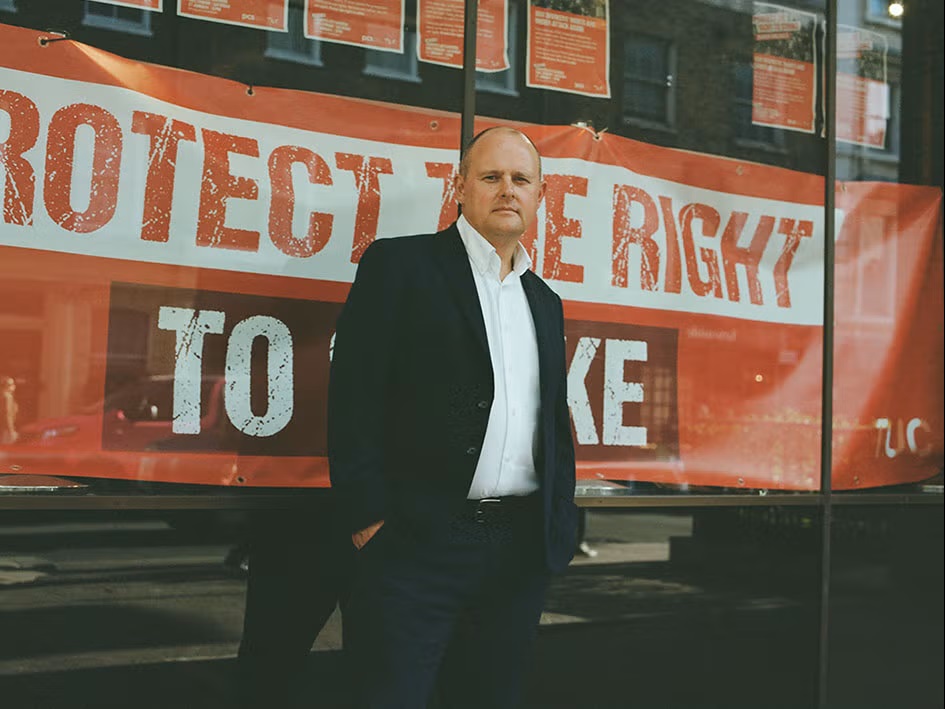
“The only stories that really make the headlines in terms of unions are unions on strike or unions and the Labour Party,” Paul Nowak tells me over a pint of Guinness in his favourite pub in Birkenhead. “Either we’re ‘calling the shots’ of the Labour Party, or we’ve ‘fallen out’ with the Labour Party and we ‘can’t get enough influence’.”
The general secretary of Trades Union Congress (TUC) has been involved in the movement far too long to buy this simplistic dichotomy. Now 53, Nowak first joined a union when he was 17, working part-time at an Asda on the Wirral as the store’s health and safety rep. Subsequent jobs – all on insecure, temporary contracts – included working as a hotel night porter and for the local council’s bus information team, as well as in a BT call centre as part of an outsourced agency. There, realising they were being paid significantly less than the BT employees they were working alongside, Nowak organised dozens of colleagues to sign up to a workplace communications workers union and organise for more rights. The result was for the employer to take them off the contract.
Nowak calls this one of the “most defining experiences” of his career. “It’s a tough lesson… You’re not playing fast and loose with this sort of stuff, it’s people’s livelihoods.” The question, he says, was “[do] I never put my head about the parapet again, or… say ‘this is fundamentally wrong and we’ve got to do something about it?’”
“Doing something about it” has been Nowak’s mission ever since. Today, having succeeded Frances O’Grady in December 2022, he heads up the umbrella organisation for 47 member unions across the country, representing more than 5.5 million workers. Nigel Farage and Reform UK might be kicking off the party conference season this weekend, but they have competition for grabbing the government’s attention and setting the political agenda from the TUC, whose annual congress begins in Brighton on Sunday.

In anticipation, the TUC released new polling on Thursday on a series of “wealth tax” measures, offering some helpful ideas for a Labour government scrabbling for ways to raise much-needed cash that won’t risk its already precarious position in the polls.
Options garnering widespread support include a windfall tax on banks and other financial institutions (66 per cent in favour vs 21 per cent against), a gambling tax (71 per cent vs 19 per cent) and raising capital gains tax (51 per cent vs 34 per cent), as well as a specific 2 per cent wealth tax on individuals with assets worth over £10m (68 per cent vs 22 per cent) as mooted by former Labour leader Neil Kinnock earlier this year. Crucially, these rates of support all increase with voters who switched from the Tories to Labour in the 2024 election, and with those who voted for Labour but are now leaning towards Reform. The framing is clear: a wealth tax, the TUC’s polling suggests, could help Labour fight off Farage.
Nowak, who wrote for the New Statesman calling for a wealth tax in 2023, isn’t shy about his views now. He wants what he calls a “grown-up conversation about tax”, and will be using this annual Congress to make the case that the public agrees on the need for tax reform to invest in public services.
“If the choice is cut public services or asking those with the broadest shoulders to pay a fairer share, we’re very clear that we should be prepared to think creatively about tax.”
All this might sound fairly typical for someone who has spent their entire career in the union movement. Having already served as vice president of the Wirral Trades Union Council aged 19, Nowak was 26 when he was accepted into the first intake of the TUC’s Organising Academy, an initiative by O’Grady to equip workers with skills including collective bargaining, campaign planning, and leadership development. Fellow trainees of that cohort included Sharon Graham (now general secretary of Unite), Roz Foyer (general secretary of the Scottish TUC), and Rachael Maskell, who was one of the MPs to lose the Labour whip in July after she called the government’s controversial welfare reforms “Dickensian cuts belonging to a different era and a different party”. A “class of troublemakers”, Nowak says with a wry smile.
He is well aware of the impression he gives – a few years ago he joked to the New Statesman: “I fit every stereotype of a Daily Mail trade unionist… I’m a slightly overweight, balding Scouser who gets a little bit too aerated.” But self-deprecating humour (and fanatical support for Everton) aside, he knows how to challenge the stereotype. As he picks me up from Liverpool Lime Street station, he tells me all about his favourite trade unionist, fellow Wirral boy Walter Citrine, who redefined the British labour movement from the General Strike in 1926 to the end of the Second World War; on the way back, he waxes lyrical about his love of Taylor Swift. He says he took a delegation of Japanese trade unionists out for karaoke over the summer. Did they know all the words? “Not as well as I do!”
Nowak defies the tired cliché of bellicose union leader causing trouble for business and government alike. Since he took over, the TUC he has been keen to stress how the interests of workers and employers can be aligned, championing the government’s flagship Employment Rights Bill (expected to get royal assent later this year), which he hopes will drag the UK “into the European mainstream”, and insisting that the most commercially successful companies are those that have strong relations with their unions.
“The vast majority of our members do not go to work to go to war with their employer,” he tells me cheerfully. The voices in the business community warning about the risks of the legislation, which will end zero-hours contracts and grant workers basic rights from day one, are “exactly the same voices that 25 years ago were saying the minimum wage would send the UK economy off the edge of a cliff. And it didn’t happen.” While it may increase costs for some businesses, those costs “will be transferred directly from low-paid insecure workers to employers who should be doing the right thing”.
It’s misguided, he adds, to frame workers’ rights as a risk to the economy. “Our members, when they get decent pay rises, when they feel confident at work, they go out and spend that money in the local economy, they get someone to build their extension. They buy a new car. They don’t squirrel it away in an offshore tax haven.”
Novak also strikes a more nuanced, less antagonist note when it comes to the government. (A few weeks after our conversation, he was quick to offer a sympathetic defence of Angela Rayner, tweeting “Politicians – like the rest of us – aren’t perfect” and praising her work on the Employment Rights Bill, saying she “can be rightly proud of her role in delivering that legislation which will improve life at work for millions”.)
Some of his fellow union leaders have been increasingly vocal about their frustrations with Labour under Keir Starmer. Over the summer, Unite’s Sharon Graham warned that it was getting “harder to justify the affiliation” to the Labour Party, after representatives voted to suspend Rayner’s membership and “re-examine” its financial support for the party.
Unlike Unite and other unions such as GMB, the TUC is not affiliated with Labour. Unite is a TUC member, but Nowak won’t be drawn on whether it would be the right decision to break ties, or on whether unions should explore new connections with Jeremy Corbyn’s nascent party on the left: “I don’t think it’s useful for me to offer them advice on what they should or should not be doing.”
He does, however, reiterate his personal support for the historic connection between the union movement and the party. “I think there is a value in having that link between unions and the Labour Party, because I want the voices of millions of working people to influence the party that is in government. I think our politics is going to be poorer if the voices of hundreds of thousands of shop workers or social care workers or people working in nuclear power plants aren’t reflected in party politics.”
The pub Nowak has taken us to on this windy day at the end of the summer recess is a ten-minute drive from the Royal Albert Dock in Liverpool where tens of thousands of politicians, party members, businesses, activists and journalists will descend in a few weeks’ time for the annual Labour Party Conference. But it’s a very different side to the area he wants to show me.
First, we go to Chinatown. “I haven’t been down here for years,” Nowak says quietly as we drive through a maze of gentrified new-builds side-by-side with low-rise terraced flats. He points out where his mother grew up as one of 11 children raised in a three-bedroom flat. Her mother was a Liverpool-Irish local; her father was Hong Kong-Chinese, arriving in Liverpool during the Second World War as a cook in the merchant navy.
Nowak’s paternal grandfather was a Second World War immigrant too. He was in the Polish air force, and ended up working in an aircraft factory in Liverpool. Nowak, who was born in Bebington on the other side of the Mersey, is fiercely proud of the city, which has been a melting pot for immigrants for over a hundred years. Last summer’s riots, sparked by the murders in Southport just up the coast, shocked him. “You wouldn’t have thought that the far-right would be on the rampage in Liverpool and people would be burning down libraries but that’s what happened.”
Through the Queensway Tunnel under the River Mersey, we drive past the Cammell Laird shipyard, where his father once worked as a welder, and where, in 1984, workers staged an occupation to protest mass redundances, with 37 arrested. The yard had employed 20,000 people during its peak in the 1940s; it later became a symbol of the deindustrialisation of the Thatcher era. The labour landscape was so precarious that, when Nowak was 11, his father went to work on North Sea oil rigs – two weeks on, two weeks off – and then in the oil industry in places like Nigeria and Dubai. He would be gone for months at a time.
“That was just the nature of what the economy was like in Merseyside in the Eighties,” Nowak tells me. “It wasn’t a case of ‘get on your bike’” – to paraphrase Norman Tebbit – “it was literally fly to the other side of the world for work.”
It’s not hard to see how these experiences have shaped Nowak’s politics – on immigration, on workers’ rights, and on why the two go together. “Unions and the left can’t say, ‘migration is difficult to talk about, so let’s leave it to Nigel Farage’. We’ve got to talk about it as well,” he insists. He recalls the wave of migration from the “Accession Eight” countries that joined the European Union in 2004, in particular Poland: “It was entirely lawful for an employer to have agency workers from Poland work alongside their existing workforce, and pay them less,” he tells me. It was understandable for British workers to worry that their jobs were being undercut – but the issue wasn’t migration itself, but the labour market exploitation.
The solution then, he says, wasn’t to tell people they were wrong to be concerned. “We were sending people along to the Polish services to engage with newly arrived Polish workers. I brought over two organisers from the Polish unions to work with the British unions to think how about how [to] organise Polish migrant workers who come to live in the UK.” Nowak sees similar potential to detoxify the current climate in the Employment Rights Bill and in strengthening protections so workers feel secure, whatever their background. “I don’t care whether you were born in the UK, born in Poland, born in Ghana: if you work in the UK, these are the rules and everybody gets treated the same.”
Speaking of standing up for workers, I ask what he makes of Farage’s claim that Reform is now the party of working people. “I think he’s taking the piss.”
He argues that we should judge politicians on what they do, not what they say. “So what has he done in parliament? Voted time and time again against the Employment Rights Bill… And then he had the temerity to turn up at Scunthorpe and British Steel.” Farage’s claim that he is standing up for workers in the UK should be viewed, Nowak says, in the context of him “hanging on the coattails of Donald Trump”, whose tariffs are directly threatening British jobs in the steel and automotive industries. “Where’s his condemnation of Trump’s arbitrary approach to tariffs?”
The role of unions, he says, is to expose “what’s underneath all the bonhomie and working-class cosplay”. He cites a recent media appearance from Andrea Jenkyns, the Tory-turned-Reform mayor of Greater Lincolnshire, admitting “I don’t like trade unions” and calling the protections in the workers’ rights legislation “ridiculous”. “I think our job is to shine a light on what they actually do, and what they would do when they get hold of power.”
Fear of opening the door to the right-wing populism Farage represents is part of what drives Nowak towards giving Labour the benefit of the doubt, even as he acknowledges that “at the moment, change still feels like a slogan”. Unlike some on the left who seem to be egging Starmer on to fail, he says he can’t afford to be cynical. “That doesn’t mean that I’m going to give government a free pass. I’ve got to hold them to account to deliver the manifesto.”
It’s a tense moment for Labour and the unions, which are once again playing an integral role in British politics. The government has just lost Angela Rayner, one of the strongest links between Starmer’s frontbench and the union movement. The summer kicked off with the five-day strike by resident doctors organised by the British Medical Association over pay restoration; strike action by the RMT is due to bring the London Underground network to a standstill next week over pay and working conditions. If Labour ministers hoped unions would give them an easy ride after a decade of toxic relations under the Conservatives, they’ve had a dramatic wake-up call. The same could be said of unionists’ hopes for Labour.
But at a time when the electorate is fracturing into multi-party chaos, with Labour seemingly struggling with both its values and its traditional base, Nowak has a warning for those so disillusioned they are looking for “some great left-wing alternative” to Starmer’s government: “The alternative is going to be Nigel Farage and the right wing of the Tory party. And I know how that story ends for the people that we represent.”
[See also: Shockat Adam on Britain’s new left: “We’re not anti-wealth”]
Content from our partners

Related
Join the debate
Subscribe here to comment