
Tucked in to the back row of the House of Commons opposition benches are six politicians whose next moves will define the future of the British left. The Independent Alliance, a bigger group than the four Reform MPs who sit in front of them, is building a new left-wing party. So far, the party has neither a leader nor a name. Its soft launch in July turned into more of a crash-landing, when it appeared Jeremy Corbyn had been bounced into its creation by his fellow ex-Labour MP Zarah Sultana.
Despite its fuzziness, this new party would win the support of a third of Labour voters. If it allied with the Green Party, the proportion would jump to nearly half, according to polling revealed exclusively by the New Statesman from Ipsos. Labour MPs, particularly in urban centres packed with young progressives, are fearing for their seats, and pollsters predict a split in the left-wing vote.
The Independent Alliance members are in constant contact and meet formally once a week, either in one of their offices, which are mostly on the same floor of Portcullis House on Parliament Street, or over pudding in the MPs’ tearoom. Corbyn and Sultana are well known; the other four are less familiar. These four have been lumped together as the “Gaza independents” – characterised at best as a bunch of single-issue obsessives who happened to beat Labour MPs in a quirk of the 2024 election, and at worst as shady operators elected “on the back of sectarian Islamist politics” (in the words of the Conservative leader, Kemi Badenoch).
Shockat Adam, a 52-year-old optometrist, doesn’t come across as either. In fact, during our conversation at his constituency office on a terraced street in the centre of Leicester, he sounded more like a pained liberal than a radical – championing entrepreneurs, defending landlords, warning against “polarisation” and dreaming of a pluralistic politics.

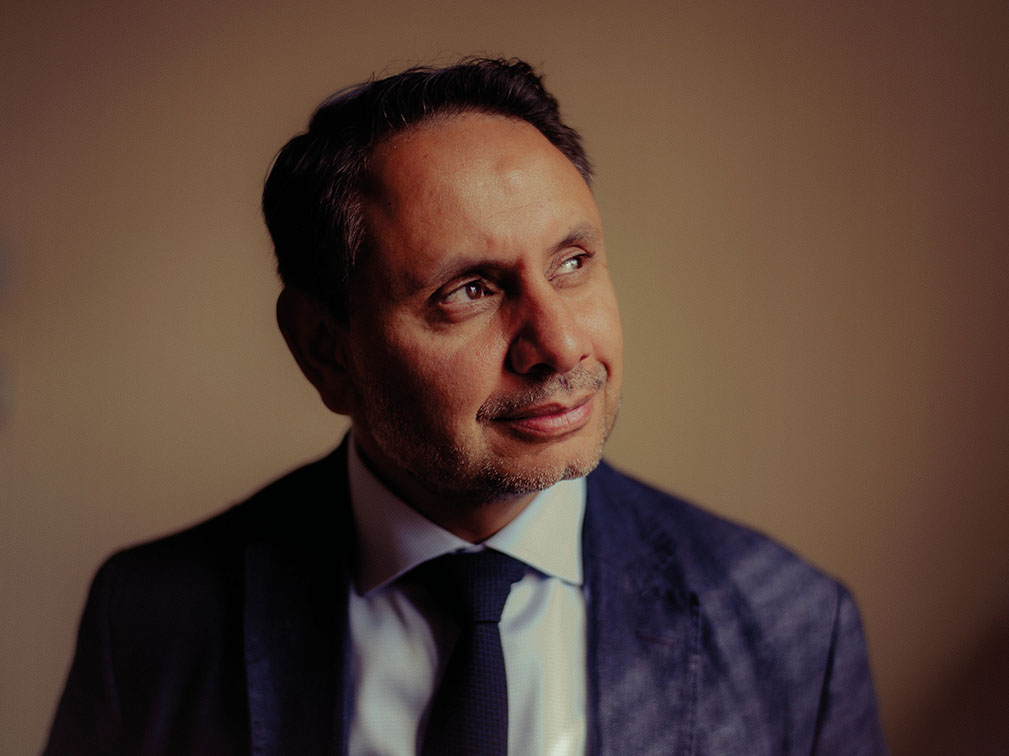
Tall and a little stooped, he pliantly folded his lanky frame into various poses for the photographer as he wandered through the autumn-flecked city centre. Eschewing the dressed-down quarter-zip sweater and chino uniform beloved of MPs on recess, Adam wore an ink-blue suit and tie, his hair oiled into a side-parting. Beneath the silvering stubble, he has a grin like a schoolboy – all tooth and goof. He is known for his dad jokes in parliament: he promised to keep his maiden speech brief, before unfurling a long scroll of paper to the floor; then he made a litany of optical gags (“let’s not make a real spectacle of ourselves”).
In the front room of his office, we sat down at a desk bearing his tortoiseshell glasses, his laptop and a framed photo montage of constituency visits, including the message “Dear Shockat, thank you for saving our playground”, written in a primary-school wiggle. In a surprise result last July, he beat the cabinet-bound Labour MP Jonathan Ashworth by 979 votes in Leicester South. “This is for the people of Gaza!” he declared in his acceptance speech, holding aloft a keffiyeh.
It was a fraught campaign. Ashworth and another candidate, Osman Admani, accused Adam’s activists of bullying and intimidation. He denies this, as well as any links to anonymous leaflets that were distributed showing Ashworth’s face superimposed over a picture of weeping children, captioned: “A vote for Labour is a vote for genocide.” He also refused to speak on behalf of his brother, who has been accused of saluting Hamas, and rejected claims that a Leicester local now facing terror charges played a key role in his team.
When I mentioned that he has decided to join a new left party, he looked momentarily confused. “Have I?” Well, yes. The Independent Alliance members backed the idea in July. “It’s an opportunity of a lifetime – I have decided to be part of something that I can shape,” he gushed, before retreating again into ambivalence.
“I don’t want to win for the sake of winning. There’s no point. There’s enough parties people who want to be MPs. It has to be something different. If we can get that off the ground, then I’ll be a very active member of it.”
If? “We’re hoping to have a conference, we’re working towards that.” This year? “We’re trying, we’re trying. Whether that…” he paused. “Because it has to be right. We won’t get many chances to get it right.” His one certainty is that “we must work together” with the Green Party and smaller left outfits, such as the former North of Tyne mayor Jamie Driscoll’s Majority movement in the north-east. “That would be the type of politics that I would love to work in.”
The name of the party will be put to a vote. One option hovering around is “The Left”. But Adam suggested this could put people off. “I think we should have a name that appeals to people who are politically homeless. And people who are politically homeless are those, say, for example, white working-class people, who feel disenfranchised, who have now been politically exploited. So we mustn’t make them feel that they don’t belong to this political party as well.”
The leadership, too, will be put to a vote. Resurrecting Corbyn as an opposition leader is a risk. After all, trying the same thing twice and expecting a different result… “is a definition of insanity” – Adam finished my sentence with haste. “Jeremy got more votes losing than Keir Starmer did winning, so we have to remember that as well,” he said, while admitting he felt, “as an outsider, that sometimes things [in Corbyn’s Labour] weren’t clear and as strongly articulated as they could have been”.
The values of the new party are indeed in contention. It is supposed to fill an apparent void left by Labour on economic and social justice, to appeal to progressives and minorities who feel ignored by a government trying to cut welfare and squirming away from the moral case for diversity: “the asset-poor working class, downwardly mobile graduates and racialised communities”, in the words of James Schneider, a former Corbyn aide and organiser of the project.
But these independent MPs feel more a product of Margaret Thatcher’s “nation of shopkeepers” than the economist Guy Standing’s “precariat”. Among Adam’s fellow independents are a barrister and landlord, and he founded his own optometry business, Sask Optics, in 2005. “We must have opportunities as small-business owners; we’re not an anti-prosperity party or anti-wealth party,” he warned. “Tenants must be looked after. We must have fair, affordable housing. But there is a risk of polarising every landlord as ‘evil’, so we must make sure we don’t fall into that trap.”
Four Independent Alliance MPs are Muslim men. One of the group, the Blackburn MP Adnan Hussain, recently posted on X: “It’s no secret that Muslims tend to be socially conservative. Is there space on the left to create a broad enough church to allow Muslims an authentic space, just as it does all other minority groups?”
While many Muslims and progressive activists may unite over anti-racist and pro-Palestinian stances, they’re less likely to gel as social liberals. This tension recently played out in the Green Party leadership election, as the deputy leadership candidate Mothin Ali declined to sign any pledges of support for various interest groups, including LGBTIQA+ Greens. Hussain has supported a gender-critical perspective on trans rights, arguing: “Women’s rights and safe spaces should not be encroached upon.”
Adam, who abstained on decriminalising abortion and voted against assisted dying, admitted “there will have to be uncomfortable conversations that have to be had” among the new movement’s diverse supporters. For example, opposition to banning first-cousin marriage, voiced by Iqbal Mohamed – the independent MP for Dewsbury and Batley – may challenge feminists who associate the practice with old-fashioned patriarchy.
“It’s about respecting a feminist perspective and point of view and at the same time the traditions of other communities,” Adam said. “Whether you’re part of the LGBTQ community or whether you’re from a conservative background community, nobody should be discriminated against. Everybody should be treated equally. These, I think, are conversations that, I genuinely believe, if they’re done in sincerity from both sides, can be resolved.”
Exasperated at being pigeonholed as a Muslim MP – “I’m Muslim, and I’m British, and I’m an MP for everybody” – Adam also feels vulnerable. He has received death threats, including a bullseye drawn on a piece of wood inscribed with “the perfect bullet”, left outside his practice. “You know, in parliament, you have scanners, they scan everything. The one thing they can’t scan is human faeces. And not once, twice, I think possibly three times, we’ve seen the police about it – we’ve been posted that with death threats.”
As I leave, I notice the letterbox on the Ribena-purple door of his constituency office is screwed shut.
Shockat Adam, the youngest of four children, was born in a small village in Malawi called Kasungu. When he was three he moved with his family to Leicester, part of a wave of Gujarati families migrating from East Africa to Britain in the Seventies. His parents didn’t speak English and his father couldn’t read or write. His mother insisted Shockat and his siblings stay in school after turning 16 instead of beginning work. He was subjected to the stereotypical ambition of such families. “When I mentioned to my mum that I was considering a history degree, she looked at me as if I was about to become history! So I did my conventional studies, optometry.”
The National Front was headquartered in Market Harborough, a town south of Leicester. Racists targeted Adam as a kid. “When I grew up, there was overt racism. I’ve been chased, I’ve had dog poo thrown at me and my late mother, I’ve been sworn at and physically attacked,” he recalled. “But you knew what a racist looked like in those days. The difference now is they wear grey suits, speak articulate English, went to the top universities, sit on breakfast shows and get media time, and that is by far more dangerous.”
Leicester is a diverse city in the truest sense. In 2021 it became the first plural city in the UK – one where no ethnic group has a majority. This is often referred to as “super diversity”: the majority, 59 per cent, of its citizens are from minority ethnic backgrounds. Amid Britain’s latest spasm of anxiety over immigration, and the radical right’s conjuring of ethnic Englishness, it’s a fragile trophy. Leicester’s politics is shifting: Adam won a historically Labour seat; the only Tory gain in the general election was Leicester East, and Reform UK is now the largest party on Leicestershire County Council.
“Leicester is a battleground for the soul of this country,” said Adam, who speaks English, Punjabi, Gujarati, Hindi and Urdu with his constituents. “It is a battleground for those that want to hold it up as a beacon of community cohesion, and those who say Leicester is a perfect example that community cohesion doesn’t work.”
It turns out holding eye-tests is the perfect way of taking the local temperature: Adam has heard all kinds of views from his patients. “I have extended appointment times – an eye test might take 15, 20, 25 minutes, and the rest is talking.” Lonely elderly people stay and chat. He also learned to listen to those who had “polarising views” about their cosmopolitan city. “In the majority of cases, those views come from a good place. They want things to be better. ‘Never hate people who have been lied to’ is my motto.”
When rioting and violence broke out between groups of Hindu and Muslim men on the streets of Leicester in 2022, Adam learned how ethnic tensions can light the kindling of local discontent. He was a community activist at the time, and condemned the unrest as the chair of Muslim Engagement and Development (a group later announced in parliament by Michael Gove as being under investigation for extremism – a characterisation it rejects).
Adam drew parallels between this period and recent unrest, such as the protests outside hotels housing asylum seekers. “That taught me that when you have a community of recent arrivals put into the heart of a community that is already fighting for limited resources, unsociable behaviour that nobody wants to resolve and address, and nobody takes leadership to resolve this issue, religion then starts to be weaponised.”
To the east of Leicester city centre is the oasis of Spinney Hill Park – home to otters and egrets, bat corridors and insect hotels – surrounded by the roar of main roads. In its south-eastern corner is a small public cricket pitch; 13 local teams compete here to use one wicket. “There’s only one pitch; people were all coming from different groups wanting to play, so all of a sudden, they’re having a bit of disagreement, then it becomes a religious thing. But it’s not: it’s a lack of resources,” said Adam. “You can extrapolate that to housing, jobs, doctors’ appointments, school places. It’s a metaphor.”
Since canvassing to become an MP, he has discovered what he calls a “city within a city” of uninhabitable rodent-infested housing, families whose children don’t go to school, doctors working second jobs as Uber drivers and young people of all cultures feeling “there’s nothing for them” in modern Britain.
“When I was growing up, there was hope and optimism,” he said. “Now the narrative is: ‘It’s not the greatest, it’s not what it used to be, it’s a dump.’ We need to have something that gives people hope. This is a wonderful country. We’ve got resources, we’re the sixth-richest country in the world, we’ve got talent. We just need some brave leadership.”
Whether the country calls upon Nigel Farage or Keir Starmer for that leadership is the question already dogging Britain, four years out from the next election. An alternative left party, whenever it appears, could form part of the answer – if it can hold together an uneasy coalition of young progressives, veterans of the old left, traditional Muslims and centrist dads like Shockat Adam.
[See also: How Labour learned to love the flag]
Content from our partners
Related
This article appears in the 03 Sep 2025 issue of the New Statesman, The Age of Deportation
Join the debate
Subscribe here to comment