
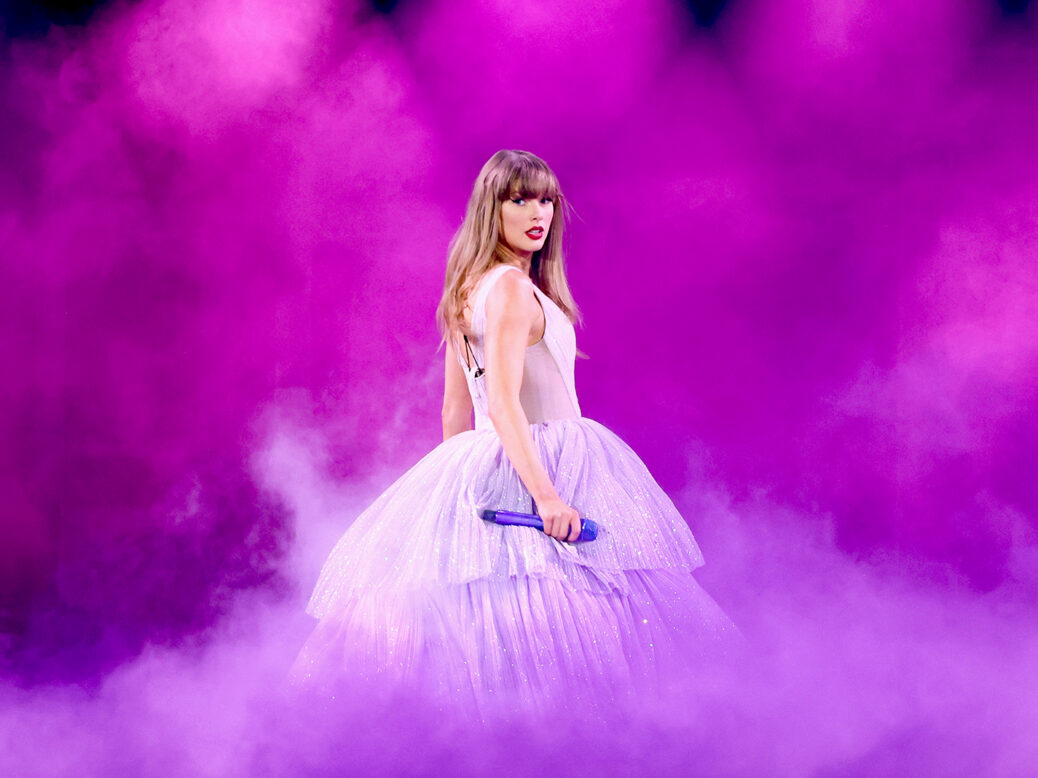
When Donald Trump called Taylor Swift a “terrific person” this week, following the news of her engagement to NFL player Travis Kelce, it was not a gesture of reconciliation but of recognition. The President, who in May last year posted “I HATE TAYLOR SWIFT” on Truth Social and derided her as a “woke singer,” is not known for revising his opinions.
His turn tells us less about Trump and more about Swift, who has, with startling efficiency, recast herself into a figure even the President can admire. She is playing the same game that he mastered.
Taylor’s management strategy has grown with the times. The things that usually define a pop star’s fame have become meaningless for her: she hasn’t done an interview with the mainstream media in two years; she avoided all journalists throughout the Eras tour. She has evolved past the need for traditional channels. Trump has the same impulses, and similar circumstances. He invented his own social media platform rather than answer to the rules or owners of any existing ones. New York Times interviews are for Kamala Harris – not for Trump or Taylor.
The Trump camp might have learned a thing or two from the sharp tactics of Swift’s publicist, Tree Paine, who has won enough reflective fame to have her own dedicated fanbase. Paine would have had her hand in Swift’s appearance on Kelce’s New Heights podcast, where she announced her new album. It was her Joe Rogan moment; a pivotal turn towards the Maga-coded podcast bros that have come to define Trump’s America. (Trump’s appearance on Rogan still beats Taylor’s appearance on New Heights, 59 million YouTube views to 21 million). That Kelce chose the day after the engagement to announce a partnership with American Eagle, the clothing brand in hot water over their controversial Sydney Sweeney ad, only further clarifies the ideological terrain Swift is orienting herself towards: one shaped by conservatism and mainstream cultural dominance.

But the “Swiftonomics” of her brand already resembled “Trumponomics”. Both saturate the media without engaging with it. Both trade in the idea of individual destiny shaped by genius. They make their followers feel like insiders to something historic. And both, crucially, are treated less like celebrities and more like movements.
Trump’s brand is inseparable from his pageantry. This was nowhere clearer than his Miss Universe pageants, which promised that sexuality, when properly packaged and judged, could be a legitimate path to power. Swift’s earlier image resisted this particular fusion. Her girl-next-door innocence, carefully preserved throughout her country debut and early pop records, served the conservative structures of Nashville. And then she pivoted, keeping up to date with the Buzzfeed liberalism of the 2010s and the attendant mainstream ideals of millennial white feminism. The styling of 1989 (2014) was sleek, cosmopolitan, girl power incarnate. And, curiously, sexless.
But when she held up her new album cover, The Life of a Showgirl, during her appearance on New Heights, and Kelce clapped in frame, it was clear something had changed. Gone was the lib-ambivalence; her sexuality was no longer coded or abstracted, but front and centre. Swift of 1989 (an aesthetic era marked by a refusal to ever expose her belly button) was gone; Swift of folklore (her 2020 pivot to baggy linen dresses and big tartan coats) nowhere to be seen. This is Swift as a showgirl – legs, decolletage and, yes, belly button on show.
Her impending marriage to Kelce might act as a shield for now, girding her “good girl” image even as her performances lean further into eroticism. Like the Miss Universe contestants, she can be desirable now she’s domesticated, a consumable fantasy with patriotic sparkle.
There’s also the matter of Kelce himself, a walking PR miracle. Years before he even appeared on Swift’s radar, he’d hired a publicity team who planned to make him “as famous as the Rock”. Even the most devoted Swiftie might easily wonder whether their courtship was organic or something shadier. However genuine their romance, it is also a marriage of cosmic brand convenience. Kelce offers Swift a masculine inroad to the demographic, perhaps the last one, that has remained immune to her charms: beer-drinking, NFL-watching American men. She, in turn, elevates him into the billionaire class. It is not marriage for love nor money but for power, or perhaps its more elusive cousin: reach.
The opening line of Trump’s guide to business is a statement of his motivating force: “I don’t do it for the money. I’ve got enough, much more than I’ll ever need. I do it to do it.” It’s Swiftian poetry really. She performs not because she must, but because she can, and because we keep watching. Like Trump, Swift understands that the game isn’t won with subtlety or talent, it’s about volume. Her marriage to Kelce will amplify her. Trump’s grudging praise is less an endorsement than a recognition of a shared instinct to play the game, to be “The Man”. The question then is no longer who Taylor Swift is but what she represents. And now, she represents totality: a figure who transcends ideology, genre and even sincerity. She doesn’t speak to the moment; she engulfs it, just like Trump. They aren’t just playing the game, they have become the game, and made it impossible to imagine anything outside it.
[See more: Taylor Swift’s triumphant incoherence]
Content from our partners



Related



Join the debate
Subscribe here to comment