
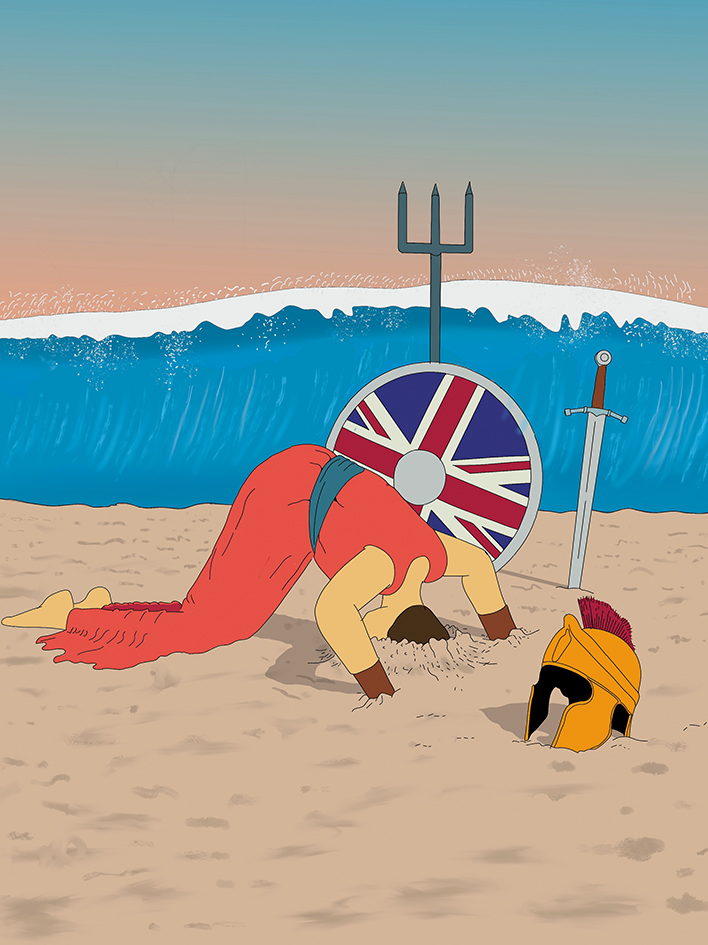
Covering British politics today is to be trapped somewhere between despair, horror, outrage and intrigue. We have been in this position for ten years, rotating our cast of premiers, each thrust into the same tempest, each unable to calm it. Perhaps this is nothing new, even if it seems more intense. In 1980, the soon to be leader of the Labour Party, Michael Foot, noted how susceptible the House of Commons was to “those swelling tempers when it converts itself into a mob”. It has been hard not to think of Foot’s insight as Keir Starmer became the latest prime minister to find himself clinging to power as another storm swept over Westminster. Parliament, it seems, remains just as Foot described: “The most unforgiving and ungenerous assembly in the world.” Speaking with ministers this week, it has been striking to witness the sense of bemused impotence in the face of what is happening around them.
Yet, for Foot, the greatest politicians do not simply possess enough courage to stand against the parliamentary mob, but are able to comprehend the revolutionary ferment in the country at large. This, after all, is almost always the cause of the agitation within the palace walls. Benjamin Disraeli was one such figure for Foot, “the Good Tory” who stood alone in defending the great working-class cause of Chartism in the 1830s and 1840s when others saw only “riot and disorder”. “Nobody can deny that the Chartists labour under great grievances,” Disraeli declared to overwhelming hostility in 1839. “Look at the House, it has been sitting now for five months,” he continued. “What has it done for the people? Nothing… The government is busy making peers, creating baronets, at the very moment when a social insurrection is at the threshold.”
The parallels with the 1840s – that time of radical unrest, political, economic, social and technological – have already wormed their way into our collective consciousness through the warnings of those such as the Cambridge historian Christopher Clark and that anarcho-prophet of the right, Dominic Cummings. It is certainly difficult to read Disraeli’s lamentation and not be struck by the similarities with today. Since 2016, parliament has been gripped by surging tempers, running this way and that, combining to overwhelm successive governments. Throughout this period, no government managed to achieve much of lasting consequence, bar Brexit itself; each busying itself instead with trivialities as the social turmoil grew. What marked out Disraeli as a man of history, in Foot’s view, was that he had the political imagination to understand the conditions of his revolutionary age – and to grasp that they could not be “skirted or sidestepped” but had to be dealt with head-on. “I have been of the opinion that revolutions are not to be evaded,” as Sidonia ventriloquises for Disraeli in his 1844 novel Coningsby.
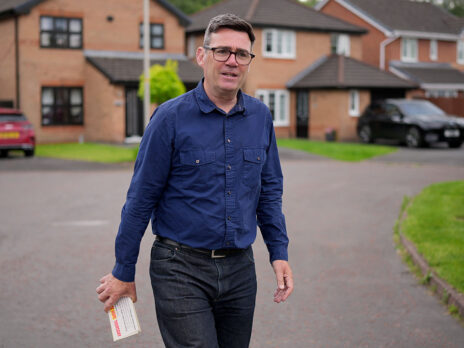
Yet, here we are again, trying to avoid the upheaval even as it intensifies beyond our control. Everywhere we look, it is clear – from Ukraine to Iran, Silicon Valley and Taiwan. Back home, the situation is not as world-historic, but forces are in play which are upending much that we have taken for granted in our own politics. But in Westminster, our political class descends ever more farcically into their own intrigue, consumed by that potent combination of fear, sincerity and self-interest as Whitehall grinds to a halt. This past week alone I spoke with ministers who either did not know whether they could – or should – campaign for Andy Burnham, their own parliamentary candidate in the coming by-election, or whether they could – or should – hope for him to suffer such a humiliating comeuppance in his battle to hold off Reform that he could not win the resulting civil war for control of the party. Few believe he can solve the country’s problems.

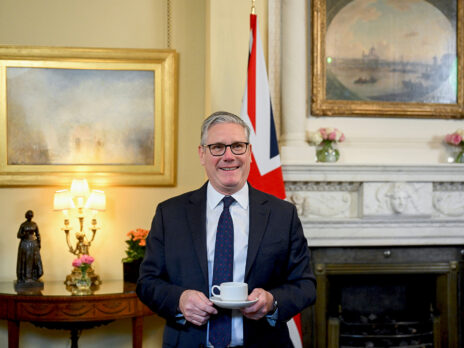
Having already witnessed the long, painful indignities of the Conservative Party’s implosion, it is now clear that we face the very real prospect of the Labour Party following suit, as rival camps form behind the Prime Minister, his northern challenger and potentially a handful of others. A veteran of similar Tory intrigues assured me recently that there was no prospect of Starmer standing in a leadership contest triggered by Burnham or Streeting. To do so would be an act of such obvious self-harm that it would not happen. Perhaps. And yet I have been assured this is exactly what Starmer intends to do, because he believes he has every right to do so given he led the party in a general election he won only two years ago.
The prospect of this coming battle even seems to have galvanised the Prime Minister after an initial wobble. In parliament, he has appeared more relaxed than usual, as if liberated by the scent of death, “a final flood of colours [that] will live on,” as Clive James wrote of what he thought would be his final months alive. A splurge of initiatives has poured forth from across Whitehall in recent days: tax breaks for family excursions over the summer, free bus rides for children, cuts in tariffs to reduce food costs. Smart politics? Maybe. Coming on the heels of welcome news on economic growth and falling net migration figures, it seems to have given a few wobbling Labour MPs pause for thought. But as the economist Paul Johnson put it, what does it amount to, really? The food subsidies come at a cost of £150m per year. Spread between 30 million households, the average family will save 10p per week.
Westminster has often felt detached from events. Yet I have never experienced such intense whiplash as I have this week, moving between conversations about political sleights of hand and private warnings from those at the highest levels of our national security apparatus about the situation in Ukraine – demanding an adaptation of our own defences that is not forthcoming – as well as those on the front line of the coming AI revolution, who insist with alarmingly certainty that everything in our lives will soon change.
Across Whitehall, the rigid inability to respond to such changes is staggering. Take three examples. It now costs more to build here than in almost any other country in the world. HS2 is expected to cost £100bn – more than Nasa expects to spend establishing a base on the moon and up to ten times more than similar high-speed rail routes cost in Europe. Secondly, it costs us more to borrow here than for almost any of our competitors. In 2020, the UK government paid around 0.5 per cent more on its debt than the French government, but today that gap has risen to nearly 1.5 per cent. Third: it costs us more to power our economy than almost anywhere else. Britain now has the highest industrial energy costs in Europe because we do not produce as much electricity domestically as most other countries and are therefore far more dependent on the import of gas from abroad. We have become a poor country where everything is expensive because we produce so little ourselves.
The effect of this is now obvious. Economic growth has remained weak for almost two decades. For much of the north, Wales, Scotland and Northern Ireland, of course, the economic slump has lasted twice this long. The number of people not in education, employment or training rises and rises, now close to one million, including one in seven of those aged between 16 and 24. Unemployment has risen to 5 per cent. And yet as grim as all this sounds, it is striking how many conversations in Westminster now start with a warning about how dire the situation is about to get because of the stand-off in Iran. One senior figure told me last week that the coming storm could be as bad as the pandemic. Add into this mix the continuing unrest over small-boat crossings, asylum hotels and migration, and it is not hard to see why there is now fearful discussion among even the most sanguine of seen-it-all characters in politics about the prospect of coming social strife in the event of a Reform victory – or indeed a Reform defeat.
In February 1844, Disraeli delivered a speech to the House of Commons on “the Irish Question”, exposing the extent of his radical imagination. What is the Irish Question? “One says it is a physical question, another a spiritual… Now it is the absence of the aristocracy; now the absence of railways. It is the pope one day and potatoes the next… A starving population, an alien Church, and in addition the weakest executive in the world.” But given all these competing explanations, most holding some truth, what possible remedy could there be, he asked? “Revolution”, came the answer. And yet, the Irish could not successfully revolt because they were bound to another, more powerful country: England. And so, what conclusion should England draw? “If the connection with England prevented a resolution and a revolution was the only remedy, England logically is in the odious position of being the cause of all the misery of Ireland.”
I have always thought this speech extraordinary: far more radical than almost any given in the House of Commons in my lifetime. And yet, so much of it translates. So perhaps we should be asking: what is the British question? What is the cause of our malaise? Is it physical, our detachment from the Continent and the new Asian heartland of world commerce? Or is it spiritual, a crisis of confidence in ourselves, in our history, our mission, our purpose, our character? Or perhaps the absence of an aristocracy in the classical Aristotelian sense – a capable elite? We certainly seem to have acquired one of the weakest executives in the world. The absence of railways feels a little too on the nose. But the presence of the Pope? Well, no, but the presence of a mad Caesar, yes. And potatoes, no, but oil and gas, yes.
What of the Disraelian remedy: revolution? Are we able to successfully revolt in Britain today? We have tried, it seems, for the past decade, without much effect. For Anthony Barnett, Tom Nairn and the modern-day Chartists, the answer is obvious: it is no longer Ireland’s connection to England, but England’s connection to Britain, that anachronistic prison-state for independent nations in need of liberation from the hubris of caring about the Donbas, Washington or Beijing. Without England the UK would fall apart, freeing Scotland, Wales and Northern Ireland too – so goes the argument. I see the merit in it, but why is Britain different in this regard to Spain or France or Germany or Italy? The crisis is simpler and more profound. It is not the UK which is in the odious position of immiserating the people of this country, but the British state managing its affairs.
When Disraeli set his Irish challenge in 1844, he asked what the duty of an English minister should be in such a situation where he held the future of another country in his care. “To effect by his policy all those changes which a revolution would affect by force,” Disraeli answered. Surely the same is true today. And yet, it is hard to ask this question and not despair. Does the Labour Party – whether under the current Prime Minister or any of his rivals – really have a coherent plan to effect by policy what a revolution would affect by force? Does any party in Britain? Starmer’s incrementalism has so far proved insufficient, but so will Burnham’s “Manchesterism” if it is not quickly developed into something far more profound.
It is sobering to remember that there have only been two significant upheavals in Britain’s political economy in the past century: the first the consequence of war, the second of crisis. The first came in 1945-51 and was the product of the greatest conflagration in world history, which created the conditions for Britain’s social democratic postwar settlement. The second came in the 1980s after a decade of disorder and decades more intellectual opposition to the postwar consensus. When Margaret Thatcher slammed Friedrich Hayek’s The Constitution of Liberty on the table before her colleagues shortly after winning the leadership and declared “this is what we believe”, she was acknowledging the intellectual roots of her programme. Hers was not a revolution which began in 1979, but one that stretched back through the years. Hayek published The Constitution of Liberty in 1960, but created the Mont Pelerin society for free-market economics in 1947, a few years after his masterpiece, The Road to Serfdom, published in 1944.
Where are the equivalent intellectual challenges of the status quo today, or indeed the equivalent Chartist challenge of the 1840s? As one figure put it to me recently, so much of what we hear instead is a kind of lamentation for the lost world before Brexit or before the crash, Iraq and 9/11 – a world of progress and hope, free from the shadow of menacing violence and foreboding that has steadily grown throughout this century.
One problem for both progressive politics and self-styled centrism at the moment is that the closest thing to a radical intellectual challenge to today’s political settlement appears to come from the populist right, not the left. Among the young Faragist Reformers today, their great intellectual lodestar is not Thatcher, but Enoch Powell – the man they now see as their prophet for opposing everything from international law to immigration, Europe and the West’s dependence on America. But who is the left’s?
Farage himself remains something of a Powellite by instinct, if not intellect. Yet he is also too much of a Thatcherite to be able to sit at the head of an intellectual challenge to the governing consensus. He is, at heart, a pre-Maastricht Tory: Edward Leigh with a smartphone, aping Powell’s working-class communing but without the intensity of his reactionary mysticism. Upon arriving in England, Karl Marx described Disraeli’s Tory radicals as “half lamentation, half lampoon; half echo of the past; half menace of the future; at times by its witty and incisive criticism, striking the bourgeoisie to the very heart’s core”. Much of the same could be said of Reform.
Yet, beyond that, where is the plan, the programme? It is not there. And where is it from Labour, from Burnham, or Streeting? Is there a plan for a new political economy? It is hard to argue any individual or movement in Britain today has even begun to answer these questions seriously. Even loyal ministers admit the government has no real plan for or analysis about the country’s underlying problems. In mitigation, they now say that no governments ever really do and they must be given the space to “learn on the job”. It is not good enough.
By the time they have come up with some answers, the world will have changed again. I spoke with one figure at the heart of the approaching AI boom who said we were already in another industrial revolution. Where the industrial revolution created abundant power of the sort unimaginable before, this one will create a similarly transformative abundance of intelligence. It is no coincidence that the political tumults of the 1840s, articulated by Disraeli and Marx, came at the culmination of this moment of industrial disruption. We are approaching something similar.
And who has a plan for any of it? To secure abundant cheap energy for British industry to compete; to ensure the British state can deliver something, anything, again; to ensure the country retains some control over its destiny in a world of artificial intelligence created, shaped and owned by oligarchs on the other side of the world? Who even has a plan to maintain the unity of the realm, to assert an idea of Britain that all who live here can call home; an idea that we are prepared to fight for; or for a greater idea of a civilisation to which we belong: Europe, the West, humanity?
It often feels today as though we are back in the tumult of the 1970s and 1980s, that age of Foot and Powell and Thatcher; of clashing ideas and approaching storms. But I wonder if Cummings and Clark are right and we are, in fact, closer to the age of Disraeli and Marx. Today, much like the 1840s, everything is in flux simultaneously: technology, capitalism, religion, democracy. And yet if the revolutions are now underway, who do we have to rise to the level of events? Where is our Disraeli? Where is our Marx? “They knew as little of the real state of their own country as savages of an approaching eclipse,” Disraeli observed in Coningsby of those trapped in their Westminster cage. Who can say with confidence anything has really changed?
[Further reading: Alarm clock Britain: a tale of two deprivations]
Content from our partners



Related

This article appears in the 27 May 2026 issue of the New Statesman, What Britain won't face
Join the debate
Subscribe here to commentGo Swiss.
Divide the country into federal regions, have (e.g.) a 7 member primeministership with rotating figurehead. Demolish regional parliaments (Holyrood etc)
Build a circular parliament building at the geographic centre of the country, turn Westminster into a museum. Whitehall to be converted to council flats.
The current parliamentary system has evolved for running an empire, that’s all gone and it doesn’t work anymore, time to be more like the Swiss.
Just a few ideas
Switzerland has a very good education system that caters for all and makes for a civilised society. An export driven economy for high value goods also helps. Add in the Swiss finance sector as the cherry on the top and the UK would have a long way to go to match our Alpine friends.
Maybe but their political system cobbles together a potentially explosive regional mix of different cultures and languages and makes it boring.
A boringness we desperately need.
The US is not offering boring right now.
And sends only around 25% of the relevant cohort to University (as opposed to 50% + in the UK) choosing to spend money instead on well resourced and capable vocational skills training colleges, a far better, and much more effective, strategy than the confused and diffused ‘apprenticeships’ model here.
Thankyou.
One might add the ecological crisis in its various aspects (mass extinction, soil exhaustion and more in addition to the climate) to the things we won’t face but I wouldn’t argue with what is included.
I find myself turning into a prepper.
Thanks for an incisive (and terribly depressing) analysis of where we are, and an antidote to various other centre left writers who appear to believe slogans (“Manchesterism”) are substitutes for the hard yards of actually thinking through our problems. No political party in Britain has anything like an explanation which thinking people can embrace for those issues – and I include the usual scapegoats – immigration, the oil industry, Brexit. If the problem is economic growth, then this government has made some marginal tweaks to a generally dismal climate, but that surely is where the focus has to be. And if that involves scrapping many of the left’s shibboleths around climate targets, regulation and welfare, that at least amounts to a strategy, which is more than we have now.
We, and our politicians, aren’t suddenly going to become better or wiser people.
Returning to the Christian faith would enable us to do so.
And certainly, nothing else will.
Christianity isn’t a magic wand for Britain’s problems – but it is the indispensable first step.
Agreed but other faiths are available. I find Tamil Hindu temples give me the same intense religous experience as my own Catholic churches. Different routes to the same goal.
I wonder whether many people would agree. Hard scientific rationalism seems to me to be a better approach than a set of beliefs which bear no proof of anything, and depend on a non-rational semi-fantasy.
An interesting article, but misses the real issue. You are not a meritocratic society. You are the only country where a network of private fee-paying schools (public schools!) provide the only entrée to your governing class. The chaps rule. So the cream does not rise to the top. Many, otherwise qualified people are excluded because they are not “one of us”. So don’t be surprised if you have low productivity, low growth etc.
You are totally correct on the intellectual state of affairs. There is a fascinating range of thought and discussion on the right. Whether one agrees with their analysis and program is another question but the depth of thinking is clear to see. I can’t find anything of equivalent on the left or the progressive side of politics. It’s all just empty declarations about fighting this or that threat to a way of life they seem unable to articulate coherently in the first place.
Refusal to face reality and an inability to get anything done seem to be the two major failings pointed out in the excellent and stimulating article above. It appears that Mrs Thatcher did not suffer from either failing, hence she is mentioned above in the context of two major changes seismic pivots in the last century.
I don’t subscribe to any comparisons with the England of the 1840’s, an era of mass illiteracy, mass starvation-level poverty and still no universal suffrage. The problems of today appear to be driven by a desperate drive to live beyond the country’s means, while still maintaining an almost colonial level of patronage to the rest of the world. Britain still thinks of itself as part of the top tier, the real problem is that it fails to recognize its own weakness.
I have been on the left all my life and for 11 years I have been a Councillor, initially for Labour, recently for Green.
I have seen how this country works from the outside – as a director of a large contractor who worked for Local government, police, HMRC, FCO etc – and as an insider – as CEO of a Quango and as a senior council member.
My instincrs are soft left, maybe a bit Old Labour.
But the more I look at the way things work I believe we are completely shackled by sacred cows and misunderstanding and dishonesty.
Take housing: I did a short paper a couple of years ago. A private rental of a 2BR flat where I live was about £20,400 pa. LHA (what central government will pay for rent for those on benefits) was £12000 pa. a Council rent was £6600 pa.
Both Labour and Green repeat the mantra ‘we need more council housing’. But those numbers are realistic. You cannot create, maintain and pay capital cahrges on a council dwelling for £6600 pa. I have tried, as a councillor, and found we could make the sums add up at LHA in parts of our borough where the dept assessed it as being in a more expensive area than the rest of our borough so could use the £12000 pa rent. So we managed to buy some slums off private landlords, fix them and let them at LHA level and, with the benefit of PSBR interest rates, just make the properties viable. Then Truss, Brexit and other factors made even that non-viable.
Our policy is driven by the sacred cow – we want more council housing, But council housing drives colossal subsidy when those outside that get none at all.
So there is corruption in council housing because who will voluntarily turn down that bonus.
And that is before we consider Right to buy. Until Angela Rayner acted and dramatically reduced the bribe to tenants to buy, you could automatically get much more back as a discount as you had paid as rent over 10 years.
https://manage.wix.com/dashboard/62b50394-8ef2-40c6-94e5-39ef12a8cd33/blog/14848f16-5d11-4339-8c31-4898c740d6c1/edit
Out of date, but the situation persists.
I could add another pack of absurdities – ‘consultation’ which does nothing, ever, to change anything except adding cost and delay, compulsory tendering which does much the same as consultation, complete lack of project management or commercial nous in the council and most public services across the board.
So what?
I confess that whilst I disagree completely with what Reform stands for, I have to oncede thay have a point about how public service is managed. Of course they have no idea how to improve that and their ideas will only make matters worse.
In a previous life I spent a spell as ‘European Cost Cutter’ for a multinational. I had radically reduced our costs of a 1600-car UK fleet and of our costs for hiring temporary/interim staff.
I failed miserably on cars, because France could only buy REnault or Peugeot for political reasons, Germany could only buy Mercedes or BMW for prestige or HR reasons. Nordics could only buy Volvos because of snow. Italy were happy because the winners were Fiat and Ford.
The Great Hunger that lasted in Ireland from 1845-1852 resulted in 1million deaths and by 1857 2million had emigrated. It is the reason Glasgow and Edinburgh have football clubs of Irish origin – Celtic and Hibernian. Prior to 1845 the British state had done nothing to alleviate the problems of Ireland but had predicted disaster. Even when the disaster arrived the British state did nothing and Ireland was forced to export food even at the height of the famine. There was another famine in 1879. Fast forward to 2026 and the British state is equally ineffective – it knows what the problems are facing the UK but is incapable of solving them because of a lack of political will. Ireland suffered from malign neglect at the hands of the British state in 1845 but in 2026 the British people suffer from benign neglect. The UK is in decline but there are government handouts to paper over the cracks and try and make sure that people are not destitute. For example the UK state pension is not a pension but rather a social security benefit to prevent destitution. There are lots of other examples. The UK will not suffer like Ireland but the same incompetence will result in decline such that the UK will be a failed state – the government will not be able to do anything to prevent the impoverishment of the general population. I think the best solution will be to become the 51st state of the USA – many Irish went there to escape poverty. How ironic but at least we don’t have to do anything…….just sign the legal document transferring title. I’m sure the British state is capable of that……or is it?
But the USA is in most respects, in an even worse state than we are.
The USA has more fat to lose before cutting into the flesh – we’re close to the bone!
Thank You for an interesting and educational article. I know you are not blaming anyone but my latest mantra is ‘who you gonna blame’. Trump, Putin, world affairs, the economy, politics? How about Democracy? ‘Is Democracy A Religion’ goes my latest essay. Adding the world science to economics and politics doesn’t make it scientific. Here is Bucky Fuller: To have Democracy we must first discover its true principles, just as we discovered the true principles of gravity and electromagnetism. It is not economical growth, it is Equality and Justice, even though such words have by now totally lost their meaning. Here is my early essays from 2013: Illusion of Justice and the Fallacy of Freedom. I am afraid I will have to include the first paragraph:
How to free ourselves from the futile quest for justice? Can anything be done? Is this the best we can do? Are such turmoils inevitable much like earthquakes and super novae? Have our laws become ineffective similar to overuse of antibiotics? How can we avoid depression due to futility of our quest? The goal here is to stop my own ongoing internal dialogue. I need to stop this great longing for justice, this “Waiting for Godot” so to speak and finally put this quest to rest. Can novel biological interpretations of social problems resolve ambiguities and reveal the inadequacies of political and even scientific arguments?
I have no political solutions. I only search for novel way of observing things. Here is my first one:
Can we equate, ‘correlate’ political lobbyist with viruses who inter a host in disguise and use all the resources of the host for their own propagation. Of course such observation will not prevent the lobbyist the way antibiotics can stop the virus, but it can totally brings in a novel paradigm to the game. Correlates is my game. Here is another one: Can we equate, correlate plate tectonics with wars where one recycles continental plates and the other continental culture, language and genes.
Humanoids have been at wars since their inception and have developed lengthy complex narratives aka justice, religion and freedom to justify them. Here is Fuller: In the old days a bunch of coolies come to town and tell the chief that they have spotted bandits lurking around their town. They promise protection if they are compensated with goats, sheep and other provisions. Does that sound familiar? Are the corporations the coolies of today?
We, I, need to get away from humans to discover new ways of seeing. There is lies the ‘solution’. However, unbiased observation away from the humanness is the solution.
Such mode of enquiry/observing will not cure the disease but help us observing without desire.
Wu-Wei acting without desire… non-action in action
Every undertaking should be free from desire
It is not acting that enslaves, but rather the thought that one is the agent.
Two problems the West faces. One, a tsunami of propaganda masquerading as intelligence so that populations are swayed in a moment by powerful forces (AI or no). Present company excepted. Second, historically high and continuous hate on most of the West’s leadership. France, Britain and Germany leaders are below 20% approval for years, reported by Statista. The rest of Western Europe closely follows. This arthritic “democracy” cannot last. From the US, this looks like an end game pushed by Brussels.
The US is a strange outlier. The blowhard, billionaire womanizer from Queens actually leads most of the West in approval ratings despite his opponents garnering 90% support among academia, media and educated women. We use to call these latter groups the intelligentsia, and look where that got us in post Wiemar Germany and post Romanov Russia. It begs for a new construct for post industrial and post commercial society rather than communism, fascism or socialism.