
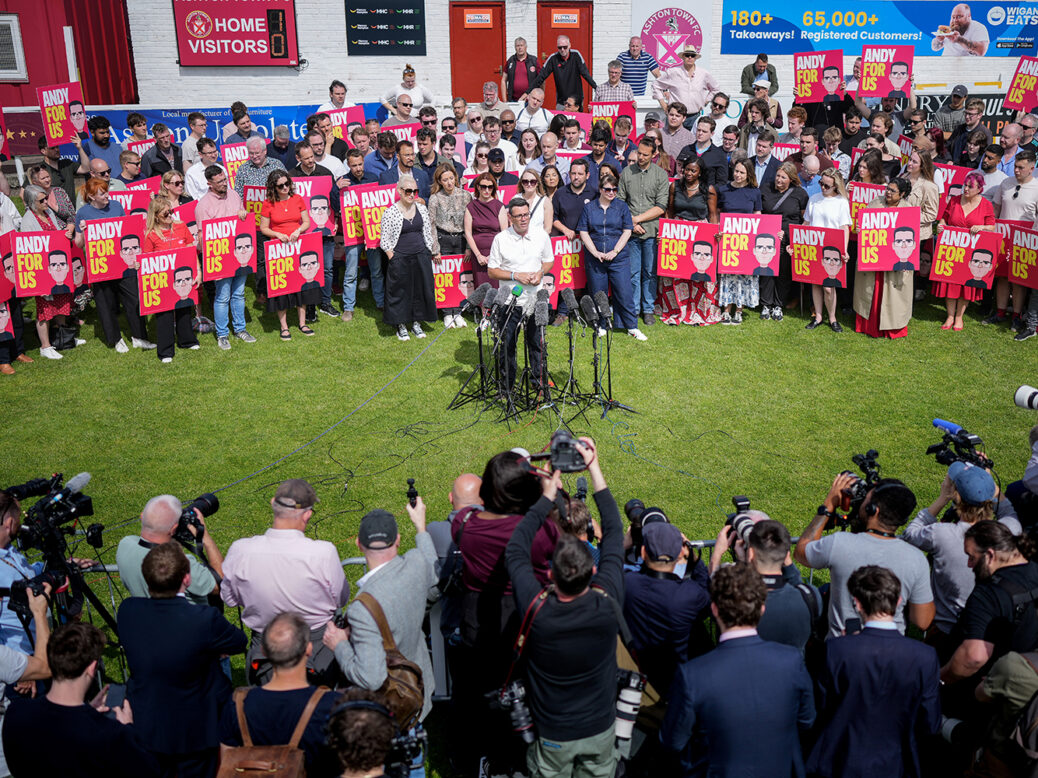
If you wanted to design a drinking game based on analysis of Andy Burnham’s campaign in the Makerfield by-election, mention of the phrase “King of the North” would be the prompt to get everyone absolutely wasted. An extra sip of beer when KOTN is prefixed by “so-called”, three sips for “self-styled”, and a shot of tequila when it’s delivered in a patronising northern accent by a centrist comedian belatedly discovering what authentocracy means. On the one hand, skewering Burnham’s man-of-the-people regionalist schtick is fair enough. It’s incumbent on commentators to pour scorn on the airs and graces of our putative leaders (Though I was often tempted, through endless sneering over the last few weeks about Burnham’s “vibes-based” and “egocentric” approach, to scream: have any of you ever met… a politician?)
But while healthy scepticism about performative bluff is all well and good, it’s important to note that Burnham’s investment in what might be called the Idea of the North is no mere PR gambit. Indeed, the Makerfield saga – and the Burnhamite rise to power that seems certain to follow from it – is surely the most significant event in the history of British regionalism since the fabled collapse of the Red Wall in the 2019 general election. Can we sift through the professional northernisms and their parodies to uncover a more serious side to Burnham’s regional bluster, one that bears profoundly on questions of devolution, identity, and popular sovereignty?
To begin at surface level, it’s true that there was plenty of windy pro-North rhetoric in the Makerfield campaign (as indeed there has been over the last decade of Burnham’s Greater Manchester mayoralty). Early on, Burnham’s team worked up a graphic based on the classic Northern Soul “Keep the Faith” logo, with “CHANGE LABOUR” replacing the original slogan. Meanwhile, some Labour leaflets came in the form of a cardboard 7-inch vinyl record, with a Burnham caricature on the front, and “NORTHERN SOULS STICK TOGETHER” on the back. As if to dispel any lingering ambiguity, on the eve of polling day itself, Burnham released a video with the caption “The North is rising again! [strong arm emoji]”, and a series of talking heads riffing mawkishly on his opening cue: “The North Star leads the way”.
But branding is branding, and however hackneyed it may be, it is always responding to more meaningful impulses in the popular imaginary. As well as channelling a very un-Starmerish sense of fun – what the sociologist Paul Gilroy calls a “convivial” political culture – Burnham’s Northern Soul routine was harnessing a mixture of anger and hopefulness about regional inequality and its remedies that is deeply felt in the Wigan area and further afield. Indeed, it was when first Burnham tapped into this emotion, in his rousing St Peter’s Square speech of late 2020 (“The North is fed up of being pushed around… we aren’t going to be pushed around anymore”), that he first acquired his “King of the North” soubriquet and began to be seen as Labour’s coming man.

Crucially, beneath the sloganeering, there is an unusually solid, well-worked underpinning to Burnham’s regionalist vision. Whereas commentators are still trying to work out whether “Starmerism” even exists almost two years into a Starmer premiership, we can clearly discern the outlines of Burnhamite regionalism by reading the impassioned, opinionated, often idiosyncratic arguments in Head North: A Rallying Cry for a More Equal Britain, the book-length manifesto Burnham published in collaboration with Liverpool metro mayor Steve Rotheram in 2024.
Though it is no work of literature, Head North ventures far beyond the formula of the typical politician’s “ideas book”, to offer a series of radical proposals for constitutional reform. Acknowledging the full extent of the North-South divide and its damaging impact on British socio-economic development, this combative text culminates in a ten-point plan that calls for the abolition of the House of Lords and its replacement with an elected Senate of Regions and Nations, the introduction of a German-style “basic law” to guarantee fair distribution of funding throughout the regions, a written constitution, overhaul of the voting system, and the empowerment of regional leaders to shape fiscal policy.
Whether or not such policies, if implemented, will be capable of reversing Labour’s ongoing decline in post-industrial areas of the North and Midlands is the proverbial million-dollar question. Combined with Burnham’s rhetoric during the Makerfield campaign about the need to firmly reject neoliberalism and its apocalyptic “four horsemen” (deindustrialisation, privatisation, deregulation, and austerity), these recommendations do at least acknowledge that a collapse in living standards and a long-term crisis of sovereignty in the British regions is the root of the problem – and that tackling such issues head-on is the key to national and party revival.
But it may be that a Burnham premiership will arrive too late in the day to stop the rot where Labour and its erstwhile northern heartlands is concerned. Even though he ended up with a larger majority in Makerfield than many expected (suggesting that the Reform surge in the North has clear limits), commentators are surely right to suggest that Labour will still likely struggle to fend off Reform in Makerfield-style seats, even in a successful general election campaign.
An early test of the outlook for Labour’s northern revival will, of course, arrive with the Greater Manchester mayoral election next month. With Burnham’s highly effective personal brand out of the way (unless a fellow Northern Soul can quickly be found to replace him), both Reform and the Greens will likely improve on their performances in Makerfield. And that contest will be in classic Burnhamland. Away from the metropolitan North West, where Burnhamism is the political terroir, Reform have been building up a perhaps immoveable hegemony in much of the postindustrial North and Midlands for some time now (for example in County Durham, where polling points to a likely total Reform takeover at the next general election).
All of this is without even mentioning the formidable difficulties Burnham will face in manoeuvring a radical regionalist agenda through parliament when – or rather if – he becomes prime minister. It would seem a long shot that replacing the Lords with a Senate of the Regions and Nations, for instance, will pass without a hiccup. Never underestimate the power and the instinct for self-preservation of the English establishment (or, for that matter, the pettiness and conservatism of the Burnham-sceptic Labour right).
And yet it would be equally foolish to let scepticism take centre stage at what is ultimately a moment of great possibility for the North, and for the country as a whole. Barring a major upset, in a shortish interlude the UK is likely to have its first thoroughgoing northern prime minister since Harold Wilson. That is a significant fact in itself, of course. But bearing in mind Burnham’s evident commitment to some form of major overhaul of Britain’s archaic national structures, it begins to look like a rupture in the ages-old Ukanian regime. Feel the vibes, and the real world moving beneath them.
[Further reading: Makerfield days]
Content from our partners



Related
Join the debate
Subscribe here to comment