
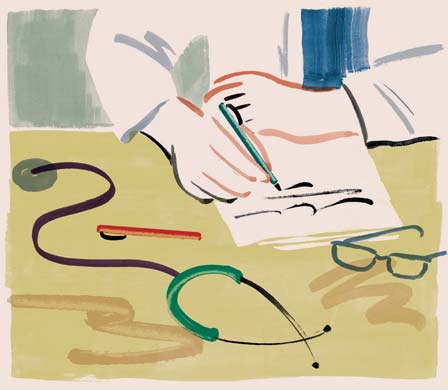
Jean-Luc is an academic GP. We live in different parts of the world, but we’ve corresponded over the years, connected by a shared belief in the importance of patient-centredness in medicine. He emailed recently to tell me about a battle he’s having over terminology. The process by which a patient seeks care from a doctor has traditionally been known as a “consultation”. Now the high heid yins of medical education in Jean-Luc’s country are wanting to rebrand it as a “clinical encounter”.
This might seem a storm in a semantic teacup, but it instantly struck me as a bad idea. At first, I couldn’t pinpoint why but the dictionary helped. The word “encounter”, I read, has connotations of unexpectedness, casualness, brevity and often adversity. A “consultation” on the other hand is defined as the act of seeking advice or information from someone, especially an expert or professional with specialist knowledge.
The more I thought about it, though, the more that definition felt inadequate. Consultations were like that for much of medical history, when doctors were the sole possessors of knowledge about the workings and diseases of the human body, but the internet and AI have dramatically democratised medical information. I’ve been struck, over the past couple of years, by how often patients not only describe their symptoms but sound frustrated, even apologetic, because they haven’t been able to work out what’s going on. This has become such a frequent occurrence that I’ve developed stock phrases to defuse it: don’t worry, that’s my job: you just tell me what you’ve been noticing, and I’ll help you figure out what it means.
The importance of discovering patients’ perspectives has been appreciated by doctors for decades. Pre-internet, people’s efforts to understand and explain changes in their health were informed by the views of family and friends, by similarities with illnesses suffered by people they knew, and by things they’d read, watched or listened to. Discovering and negotiating these notions has long been central to good medical practice. David Tuckett and colleagues defined this in their 1985 book Meetings Between Experts – the doctor an expert in biomedicine, the patient the expert in their own beliefs, values and circumstances. The internet and AI are skewing this dynamic, creating the sense that patients should be their own single joint expert, but Drs Google and ChatGPT are frequently hopeless at context. There are around 200 symptoms a human can experience, yet some 6,000 diseases (and 4,000 medication side effects). Simple maths explains why any symptom entered online will return the answer that it just might be serious.

Earlier this year, Chris Whitty, chief medical officer for England, expressed concern that having to dismantle internet-generated alarm was consuming inordinate amounts of GP time. But it’s simply a new iteration of something that’s long been an important aspect of practice. Patients with a headache will fear a brain tumour, those with chest pain will worry about their heart. It doesn’t much matter if those concerns have come from ChatGPT or their mum.
Looking up words following Jean-Luc’s email, the Cambridge Dictionary suggested a better definition of a consultation: a process involving the exchange of information and opinion between doctor and patient, through which an understanding of the patient’s health is developed, and decisions reached on how to improve it. Exchange involves time, genuine curiosity about others’ experiences and how they see the world, and trust that one is being heard and understood. All this is augmented by an ongoing relationship between doctor and patient – the continuity of care that has been virtually extinguished in the NHS. Medical care is becoming ever more fragmented, disjointed and impersonal. Jean-Luc is resisting this “encounterisation” in his country. It’s an example the UK would do well to follow.
[Further reading: Assisted dying: an autopsy]
Content from our partners


Related


Join the debate
Subscribe here to comment