
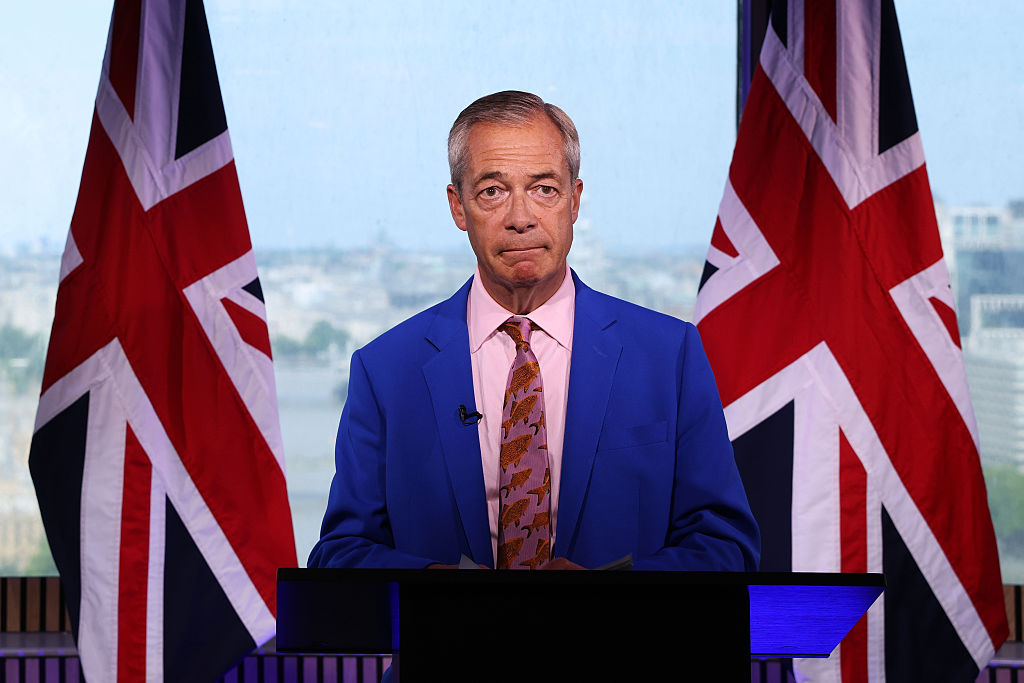
Nigel Farage has triggered a by-election in his Clacton constituency as he attempts to outrun press questions about his finances. The Reform leader gave an angry press conference on Tuesday afternoon in which he claimed newspapers and mainstream political parties were using underhand tactics to undermine him.
“The establishment have now decided that they can’t beat us fairly, so they’ve chosen to use foul means,” he said, referencing a series of newspaper investigations into his wealthy backers. Farage said he was resigning his Clacton seat but would stand in the subsequent by-election. “This will be a people vs the establishment by-election,” he said, setting the tone of the contest before it has begun.
The timing of Farage’s decision means the by-election could take place during the summer recess, if the writ for the by-election is moved before the House of Commons rises on 16 July. The Makerfield by-election took place just a month after the incumbent MP resigned. While by-elections are rarely able to be triggered when parliament is in recess, unless under extraordinary circumstances, they can still take place when the House is not sitting if the writ is moved before recess began. In short, this means the seaside by-election in Clacton could take place as soon as early August.
While Farage did not say it explicitly, he has triggered this by-election in an effort to outmanoeuvre the ongoing investigation into his affairs by the Parliamentary Commissioner for Standards, Daniel Greenberg, an independent lawyer who is an officer of the House of Commons.

One major benefit of this by-election for Farage, if he wins, is that it will reset the window of declarations required by the House of Commons authorities.
Farage has been in trouble in recent weeks because of his alleged failure to properly declare gifts and registerable benefits worth millions that he received in the 12 months before he became an MP, as required by Commons authorities.
If his term as MP for Clacton begins again following a by-election later this year, the relevant window for declarations will be more recent and might therefore dampen questions about his financial relationships before the 2024 general election.
However his re-election would not end the investigation that has already been opened by Greenberg and Farage could still face a sanction if he is re-elected. The highest possible sanction would be a long suspension that could then trigger a recall petition which would result in yet another by-election.
At the press conference on Tuesday Farage repeatedly attacked the reporting about his finances. “Let me be absolutely clear, I’ve done nothing wrong. I have not broken the law in any way at all. I have not misused public money,” he said.
Farage will also hope that a by-election win could have a Makerfield-style effect, consolidating his position as the preeminent figure not just in the Reform party but on the British right as a whole.
Wary of criticism that the election will be a waste of public money, Farage has said that Reform UK will offer to cover the cost of the contest, which could run up to a quarter of a million pounds.
He is personally popular in the Clacton constituency and won nearly half of the vote at the last election, outperforming Reform’s national vote share by a considerable margin. The party has only grown in popularity since, and he will likely win the contest by an increased margin as the nation’s media descends on the town.
While Farage is likely to win the seat, he will face a robust challenge from opponents hoping to end his parliamentary career.
His decision to trigger the contest in an effort to crush press questions about his receipt of gifts worth millions of pounds will be harshly criticised by the other parties, as will his framing of the race as a fight against “the establishment”.
The Conservatives were second-placed in Clacton at the last election and the combined resources of the party could be marshalled in an attempt to undermine Farage’s theatrical move.
Meanwhile Restore Britain, the far-right challenger party set up by disgruntled ex-Reform MP Rupert Lowe, may stand in an effort to hurt Farage.
We’ll have to wait and see whether other political parties will come to any formal or informal agreement about standing aside or stepping down campaigning in order to give the strongest contender a better chance of beating Farage. Any such arrangement might simply play into Farage’s claim that he is being stitched up by “the establishment”.
If his opponents decide to attack Farage on grounds of propriety, we could be about to witness something analogous to the 1997 parliamentary election in Tatton, where other parties withdrew in favour of the independent candidate Martin Bell, who defeated incumbent Conservative MP Neil Hamilton on an anti-sleaze ticket.
[Further reading: Is there any scandal that can stop Nigel Farage?]
Content from our partners



Related

Join the debate
Subscribe here to comment