
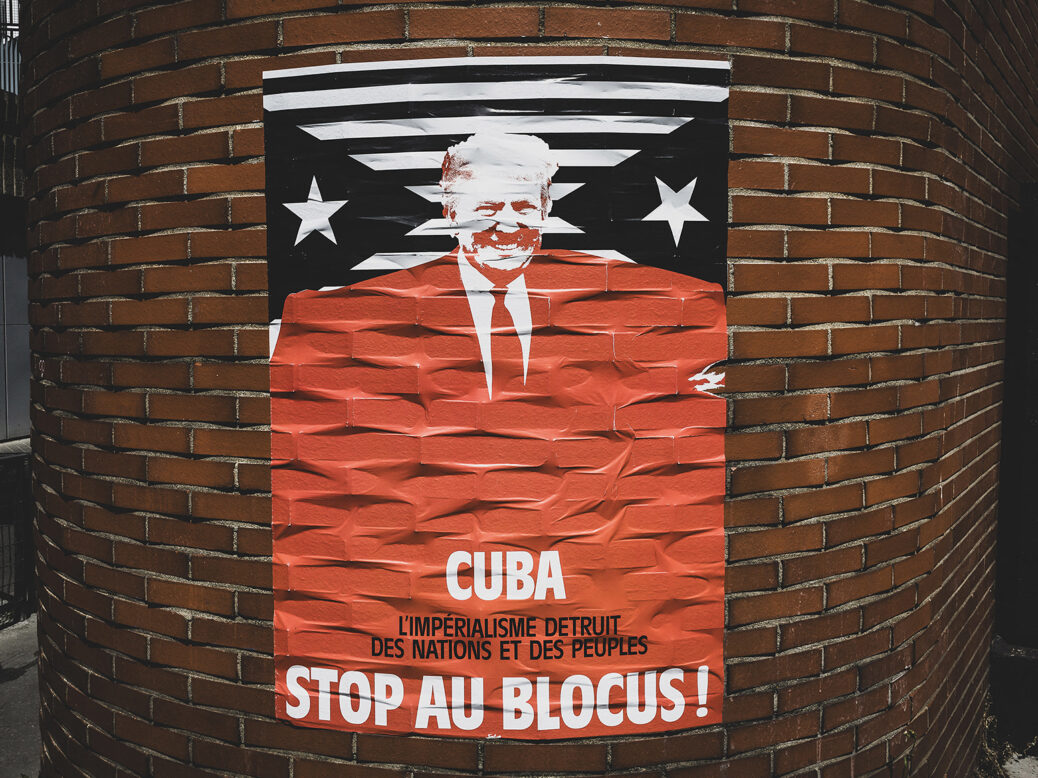
Back in March, two months after ordering the capture of Venezuela’s president Nicolás Maduro and three weeks into his war with Iran, Donald Trump mused about the possibility of turning the US military on Cuba. “Whether I free it, take it, I think I can do anything I want with it,” he told reporters in the Oval Office.
The White House has been steadily increasing pressure on Cuba since January, when Trump declared that “NO MORE OIL OR MONEY” would be permitted to flow from Venezuela following the military raid to seize Maduro, a long-time ally of the Cuban regime. The US blocked oil shipments, meaning the island ran out of fuel oil and diesel on 14 May, according to Cuba’s energy minister. Blackouts in Havana now last for up to 22 hours a day. Hospitals are struggling to maintain services and there are widespread food shortages.
On the same day that Cuban officials announced that the country had run out of fuel, the director of the CIA, John Ratcliffe, arrived in Havana to “personally deliver” a message from Trump that the communist government must make “fundamental changes”. On 20 May, Cuban Independence Day, the US announced criminal charges against Raúl Castro, the 94-year-old brother of the late Fidel Castro, who led the Cuban Revolution that overthrew the Batista government in 1959. Raúl served as defence secretary, then president from 2006 until he stepped down in 2018, although he remains the country’s most powerful political figure.
He is accused of committing murder, conspiracy to kill US nationals, and the destruction of aircraft during an incident in 1996 when two airplanes flown by a Miami-based Cuban exile group, Brothers to the Rescue, were shot down, killing four people. The US acting attorney general, Todd Blanche, has insisted this is not merely a symbolic indictment, with an arrest warrant issued for Castro, as it was for Maduro. Cuba’s current president, Miguel Díaz-Canel, dismissed the charges as a “political manoeuvre” to “justify the folly of a military aggression against Cuba”.

Marco Rubio, the US secretary of state, whose parents fled Cuba before the revolution and who has long been a vehement critic of the Cuban government, delivered a video message, in Spanish, addressing the people of Cuba directly. “The real reason you don’t have electricity, fuel, or food is because those who control your country have plundered billions of dollars,” Rubio said. “In the US we are ready to open a new chapter in the relationship between our people and our countries,” he continued. “The only thing standing in the way of a better future are those who control your country.” It sounded a lot like a call for regime change.
When US special forces stormed Maduro’s compound in Caracas on 3 January, they killed an estimated 32 Cuban security personnel in the process. (Cuba has long provided security and intelligence support to the Venezuelan government in exchange for oil.) Before Caracas, the idea that Trump might order a similar assault in Havana would have seemed fanciful. The last large-scale US-orchestrated military incursion into Cuba during the Bay of Pigs debacle in 1961 ended in ignominy. But Trump has revelled in the success – and sheer violence – of the Maduro raid.
This emboldened the president to launch his calamitous war on Iran, which succeeded in killing the previous supreme leader, but has since devolved into a ruinous stalemate that has only strengthened the Iranian regime, demonstrating its ability to close the Strait of Hormuz and hold global energy supplies hostage. And yet the Trump administration has now embarked on a familiar rhetorical build-up, this time targeting Cuba.
In recent weeks, US officials have emphasised the purported national security threat from Cuba. A leaked intelligence report that surfaced on 17 May warned that Cuba had acquired more than 300 military drones that could be used to attack the US base at Guantanamo Bay, or even Florida. Cuba has long-standing relations with Russia, dating back to the Cold War – and more recently with China – and has been accused of facilitating intelligence gathering activities by both powers.
The US Navy’s Nimitz aircraft carrier and its accompanying strike group entered the southern Caribbean Sea on 20 May and the US has stepped up reconnaissance flights over Cuba. This may well be brinkmanship, intended to strengthen the US position in talks that have been under way with the Cuban government since February. Cuba is not Venezuela. A military operation to seize Castro, or attempt to topple the regime, would be a massive gamble at a time when American forces are still tied down in the Middle East. You might think that debacle would make Trump wary of embarking on another neo-imperialist adventure. But that would be to fundamentally misunderstand Trump.
His failure to secure victory in Iran, combined with his falling approval ratings, may well make him even more determined to double down on Cuba in search of a quick win. Rather than being remembered as the latest US president to blunder into an unwinnable war in the Middle East, he would prefer to be known as the leader who finally “liberated” Cuba. “Other presidents have looked at this for 50, 60 years,” Trump said on 21 May. “It looks like I’ll be the one that does it.”
[Further reading: Donald Trump’s media sewer]
Content from our partners

Related
This article appears in the 27 May 2026 issue of the New Statesman, What Britain won't face
Join the debate
Subscribe here to comment