
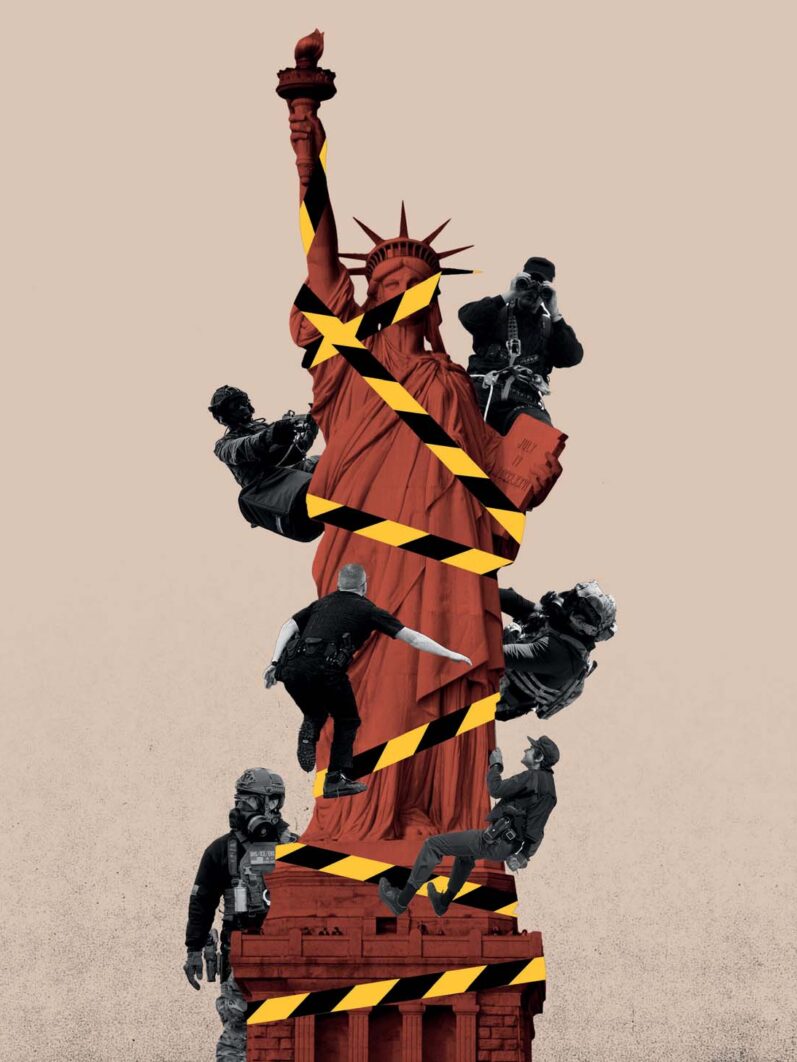
Looking around the US, as we mark the one-year anniversary of Donald Trump’s second inauguration and in the 250th year since the country’s founding, you feel that we have inverted our essential nature. The wild tension of American life, the sheer unprecedentedness of onrushing American minutes, used to occur alongside an evolving national story. But something has utterly changed.
The entire country is disintegrating as its first principles are ground, day after outrageous, incredible day, into dust. Americans watched helplessly as masked federal agents murdered, in cold blood, two innocent American citizens within the space of three weeks in Minneapolis. Then there is the lawbreaking at the highest levels of power, the dismantling of American health, education and welfare, the ruination of decades of American foreign policy, the cosy appeasement of the US’s enemies, the abolition of American foreign aid, American troops in American cities, the arrest and detention by Ice (Immigration and Customs Enforcement) of children as young as one, and Trump’s criminal prosecution of a Federal Reserve chairman, Jerome Powell, who refuses to lower interest rates. And with the exception of protests in Minneapolis, the US’s historic centre of progressivism, nothing brings Americans into the streets en masse. Instead, in response to embittered right-wing nihilism, most Americans have withdrawn into a bitter, helpless cynicism.
The Republicans are, mostly, spineless, self-interested traitors. The Democrats are, mostly, spineless, self-interested windbags. Sometimes it seems that the only change on the political horizon is that Trump’s vain coiffure might be replaced by Gavin Newsom’s vain coiffure. The frauds and impostors Trump has placed in power remain. He runs the justice department and the FBI. He keeps elite universities, powerful law firms, vast entertainment companies and major American cities in a state of terror. The Supreme Court submits to him. Trump is choking democracy to death by forcing democracy’s precious mechanisms down its throat. Giant images of his face hang from government buildings throughout the capital. Previous administrations would never have included a figure like right-wing extremist Stephen Miller, who declared, “To all Ice officers, you have federal immunity in the conduct of your duties,” or Ice commander Gregory Bovino, who was accused by a federal judge of “outright lying” about Ice’s use of force. Bovino has since been withdrawn from Minneapolis.
Prices for some things are rising, as they have been steadily doing for the past 50 years, but most Americans are doing pretty well. The economic emergency some liberals pray for is not on the horizon. Capitalism’s true crisis is not unaffordability. Unattainability is the curse of Americans: the unattainability of a life that has value beyond the normal fluctuations of net worth and social status. The modern conservative genius, spelled out by the Catholic philosopher Michael Novak in his 1989 article “The Gramscists are coming”, was to realise that the true conflict was not electoral, but cultural. People choose their values at home; then they draw from their values when they vote. But for the left, it is always the economy, stupid.

Before the Age of Trump – 2016 to present, making this year another, more modern anniversary – the country moved on from its crises, recovered its stability in the ongoing public tale of a positive arc. Walter Benjamin’s concept of history as “one single catastrophe which keeps piling wreckage” seemed a quaint European pessimism. America rose again and again from catastrophes of its own making and shook its golden locks. “The arc of the moral universe is long, but it bends toward justice,” said Martin Luther King Jr. As a black man, he knew better than others the selfish hidden face behind the big American smile. But he said it, and believed it, and for generations, justice and public harmony existed as an intermittent but actual American reality.
We can still read the words that formed this reality. Thomas Paine published his pamphlet Common Sense on 10 January 1776, arguing that the 13 British colonies should break from Britain. The Declaration of Independence was signed seven months later. Paine wrote: “Society is produced by our wants, and government by our wickedness; the former promotes our happiness POSITIVELY by uniting our affections, the latter NEGATIVELY by restraining our vices. The one encourages intercourse, the other creates distinctions. The first is a patron, the last a punisher.” For 250 years, broken by momentous convulsions, society moved in mutual friction and fruition.
The repeated, disorderly re-establishing of order unfolded throughout my American life. John F Kennedy’s assassination in November 1963: we were herded, in hushed emergency, out of our suburban New Jersey classroom and lined up in the hallways while our teachers stood quietly weeping. Four years later, Newark erupted after two white policemen beat a black jazz trumpeter working as a cab driver. I sat with my parents and brother, watching on the flickering screen police shoot into and attack crowds of black people. “You break the nose first, and then knock it up into the brain, like this,” a recently discharged Green Beret – working as a carpenter in our house at the height of the Vietnam War – told me some time later as he split a thick plank of wood with his fist.
In August 1974, I perched on the sofa beside my high-school girlfriend, her mother sitting on the other side folding freshly washed, fragrant towels and sheets with meticulous care, as we watched Richard Nixon announce his resignation on TV. The day after 9/11, in a tavern in Park Slope, Brooklyn, the room seemed to contract into one figure as a faintly heaving hulk collapsed onto the bar. “Who is he?” I asked. “A firefighter,” the waiter whispered. “Everyone in his stationhouse is dead.” You knew why you wept, why you sat transfixed, why you became enraged, hurt, frightened. The US is the most teleological country in the world; the belief in a positive outcome, the belief in destiny, is its national poetry. A moral light – or “pay-off” – at the end of every ordeal got the country through its travails.
After Kennedy’s assassination, Lyndon B Johnson’s Great Society. After Nixon’s soiled presidency, the clean American laundry of a new beginning. After Vietnam, the Sixties and Watergate, an expansion of civil rights for black people, women, gay people; of economic rights for those struggling at or near the bottom – even the so-called Ronald Reagan revolution could not stop the liberalising arc. Following 9/11, the Iraq War and an iron atmosphere, an imperfect Obamian calm. Now, neither right nor left or anyone in between harbours the barest hope of a positive outcome. The right promises nothing more than an extinction of liberalism, at home and abroad; the left, nothing more or less than the vanquishing of the right. But this struggle is taking place in American culture and society. Politics is almost an afterthought.
The roles Paine assigned to society and government (patron and punisher) had, by 2016, been reversed. This was the result of a generations-long process. Paine’s American suspicion of government, heightened by his goal of throwing off British rule, began a long contest between American civic life and American politics. In Democrats’ hands, beginning with the New Deal, government started to take on the character of society. Rather than limiting itself to “restraining our vices”, it sought to “unite our affections”. Social security, Medicare and civil rights were attempts to bring Americans together in a common humanity.
But by 2016, the government’s expanding civic role had metamorphosed into federal attempts to entitle each American’s uncommon individuality. Civil rights, by definition a unifying project, devolved into an internecine free-for-all. Social groups categorised by race, ethnicity, national origin, sexual identity and sexual preference were no longer defined by their often beleaguered relationship to society. Now, individuals were defined by their membership to social groups. This was not for the purpose of empowering the group’s place in society. Rather, membership of a “protected” group had the aim of powering the individual’s advancement through society.
This was not merely rubbing salt into a class wound; it was inflicting another wound on top of it. The white middle class felt the wounds of Vietnam, Afghanistan and Iraq, and kept the scars. It had lost the economic stability and the sense of stable identity that came with generations of manufacturing jobs. Globalisation took their work; the recondite skills required by the information age and then the digital age crushed their self-esteem. And all the while culture – TV, movies, high school and college curriculums – enabled by commercialism’s endless corrosions and erosions mocked whatever was left of religion, tradition and civic pride. In this way, and at the very moment the left seemed to have won the culture war by means of its long march, it lost the culture war. The right-wing Gramscists swooped in. Culture – the culture of everyday life, not of the seminar room or the Hollywood boardroom – was theirs for the taking.
When Trump grotesquely says that since the passage of the Civil Rights Act in 1964, “white people [have been] very badly treated”, he is disparaging a miracle of humane social legislation. He is also – and this is the invincible nub embedded in his most atrocious policies – fractionally accurate. Even before the Age of Woke, the basic American right to equality – to the “equal station” enshrined in the first sentence of the Declaration of Independence – had been reframed as “equity”, the equity of the DEI (diversity, equity and inclusion) that Trump attacks. In a hyper-capitalist society where, as a despairing Willy Loman cries, “the competition is maddening!”, any competitive advantage grounded in identity rather than merit takes on the force of religious blasphemy. Identity acquired a punitive function. Trump became the voice of a wounded, white America.
The US has never known a conflict as bloody as the Civil War. Yet there is something about the country’s present crisis that has elements of a worse deterioration. North and South were at war, but within each, society was intact. Each side had a unifying objective, admirable or not. Vietnam – the country’s most divisive historical convulsion since the Civil War – was at the same time its most unifying. Opposition to the war came to embrace fights against poverty, racism, misogyny and homophobia. The effect was to compel the Republican president, Richard Nixon, to pass some of the most liberal legislation since FDR – he created the Environmental Protection Agency, signed the Equal Rights Act into law, and expanded the Food Stamp programme. As for the delinquent Nixon, Watergate united liberals and conservatives. The moral arc leading to a positive outcome held, just.
That old American teleology has been replaced with a purposeless militant dread. The stunned left cannot move on from its degradation of a uniting society to a punishing society. The Democrats present a disoriented and discombobulated shambles. During earlier phases of political exile, such as the Reagan revolution, or Bush’s eight years in power, liberals could at least retreat to their redoubts in the culture: the universities, entertainment, serious literature and theatre. An adversarial energy accumulated in those places and finally overflowed back into politics. Not any more. The universities are using Trump’s threats as pretexts to reduce and, in some cases, eliminate humanities programmes. Yale’s graduate school is reducing enrolment in the humanities by 13 per cent, and Brown is suspending admissions in at least six humanities programmes. Entertainment – along with the rest of the country – is being swallowed up by billionaires driven only by profit. Trump allies Larry Ellison and his son, David, bought Paramount, which owns CBS, and they are seeking to buy Warner Bros, which owns CNN; Musk bought Twitter, now X, and another tycoon has pocketed the LA Times.
Meanwhile Trump is planning a spectacular Ultimate Fighting Championship event on the White House Lawn in July to commemorate the US’s founding anniversary. He seems to be aiming to accustom Americans to incredible violence, to inure them to it. Abductions, assaults and killings by Ice advance this purpose, even as they add to the general gladiatorial atmosphere. Trump will not make himself vulnerable to impeachment again if the Republicans lose the House, and perhaps even the Senate, in November. He, and the criminals around him, are all in.
Where does the ageing Trump get his preternatural energy? What is the source of his astounding hold on the US? Partly he is the terminus point of the American knack for self-creation. As Hegel said about Shakespeare and his characters: “He makes them free artists of their own selves, and thereby… can interest us not only in criminals but even in the most downright and vulgar clowns and fools.” In America’s mass democracy, there is a premium on originality, all the more so as the rewards of mass conformity grow greater. Emerson crowed about the “magnetism which all original action exerts”. Trump is both the apotheosis and the decadence of the self-created American personality.
In this sense, the source of Trump’s appeal is that he is a pure American energy. Having mastered capitalism’s subtle underminings of a shared social existence, Trump is in fact now reshaping the US along the lines of its once-hidden dynamics. This is why the brute, vulgar, radically selfish condition Trump has created is, in one degree or another, here to stay. It is not a condition that is alien to American life. It is the Luciferian side of American life, the country’s dangerous subterranean force that has always exerted a powerful gravitational pull on Martin Luther King’s moral arc. And so Trump declares his admiration of Al Capone, and of gangsters in general. He celebrates the criminal element because he has grasped, more clearly than any Marxist, the criminal logic of pure, unregulated capitalism – the only real “policy” he pursues: extortion disguised as tariffs; embezzlement masked as the withdrawal of public funds in the name of preventing “waste, fraud and abuse” (Trump’s three muses); and robbery repackaged as drastic tax cuts for the wealthy.
He publicly adores law-breaking autocratic foreign leaders and corrupt foreign leaders. He habitually pardons white-collar criminals; he gives a pat on the back to his very own war secretary, Pete Hegseth, who has defended war criminals, and is now accused of committing war crimes against drug smugglers himself. Out of the depths of US iconoclasm, out of America’s outlaw vitality, has slithered the American nightmare itself. A collective inhibition, the result of customs and tradition, once kept that diabolical brio within the realm of collective art and entertainment. The erosion of American inhibition – hastened by the commercial corrosion of custom and tradition – moved it into everyday life, where people now compete for outlaw vitality the way they used to vie for the appearance of respectability. Trump has liberated, if that is the right word, the US’s darkest energies.
Democracy is built on shared feelings, and the inability to share another’s pain – the most destabilising feeling, and the most challenging for people to experience vicariously (the ancient Greeks had no word for “empathy”) – is fatal to democracy. (Trump’s lack of empathy is shocking. When told that the father of Renée Good, murdered by Ice, was a Trump supporter, the president said, “I hope he still feels that way.”) The police slaughter of striking workers in the 1930s horrified the country into labour reforms a few years later. The murder in Mississippi in 1964 of three civil rights workers knows as “Freedom Riders” was the catalyst for the passage of the Civil Rights Act a few months later. The beating of anti-war demonstrators during the March on the Pentagon in 1967; the police violence against protesters and bystanders at the Democratic Convention in Chicago in 1968; and, most consequentially of all, the killing by the Ohio National Guard of four anti-war protesters at Kent State University – all these perversions of power were spectacles of pain that appalled, enraged and finally healed the country. Democratic feeling rose, steady and true, from private experience. The pleasure afforded by a collective sympathy was still a central part of the American nervous system. Now, pleasure is a strictly private affair, its neurotransmitters stimulated by ever-more-refined anathemas upon whatever discomfits one’s own private morality. Decades ago, the Ice murders in Minneapolis would have convulsed the country. For now, only Minneapolis grieves and shouts.
In our moment, a pandemic that killed well over one million Americans set neighbour against neighbour. The police killing of an unarmed black man, George Floyd, arrested for allegedly making a purchase with a counterfeit bill, made us explode into conflicting rages and resentments. Ice’s killings have inspired not a solidarity of sorrow, but accusations, anger and recriminations. Incredibly, there no longer seems to be any agreement about what constitutes simple human pain. Had he been able to see what has become of his beloved colonies, Thomas Paine might have thought it common sense to urge them to stay right where they were.
[Further reading: The special relationship is dead]
Content from our partners


Related

This article appears in the 28 Jan 2026 issue of the New Statesman, How we escape Trump
Join the debate
Subscribe here to commentIt seems fitting to me, given Mr Siegel’s perverse, one sided, simplistic diatribe, that he cites two highly disreputable characters like Tom Paine and Walter Benjamin. Albeit hero’s of the Left. Locking up Paine was about the only thing the terrorists of Paris 1793 got right, if for nothing else than Paine’s arrogance that he could be seated in the French National Assembly while not speaking French. And anyone interested in Mr Benjamin’s character should study his life in more detail than the standard academic glorification
Tom Paine’s arrogance (if such it was) doesn’t make him wrong. And Walter Benjamin is disreputable? Looks like Mr Seigel’s ‘diatribe’ has struck home, and some.
Back To The Future Part 2
w hile reading the article I kept hearing the closing lines of Bob Dylan’s As I Went Out One Morning: ” Just then Tom Paine himself came running from across the fields , . shouting at this lovely girl and commanding her to yield ; As she was letting go her grip VP Tom Paine did run , I’m sorry sir , ” he said to me ,” I’m sorry for what she’s done.