
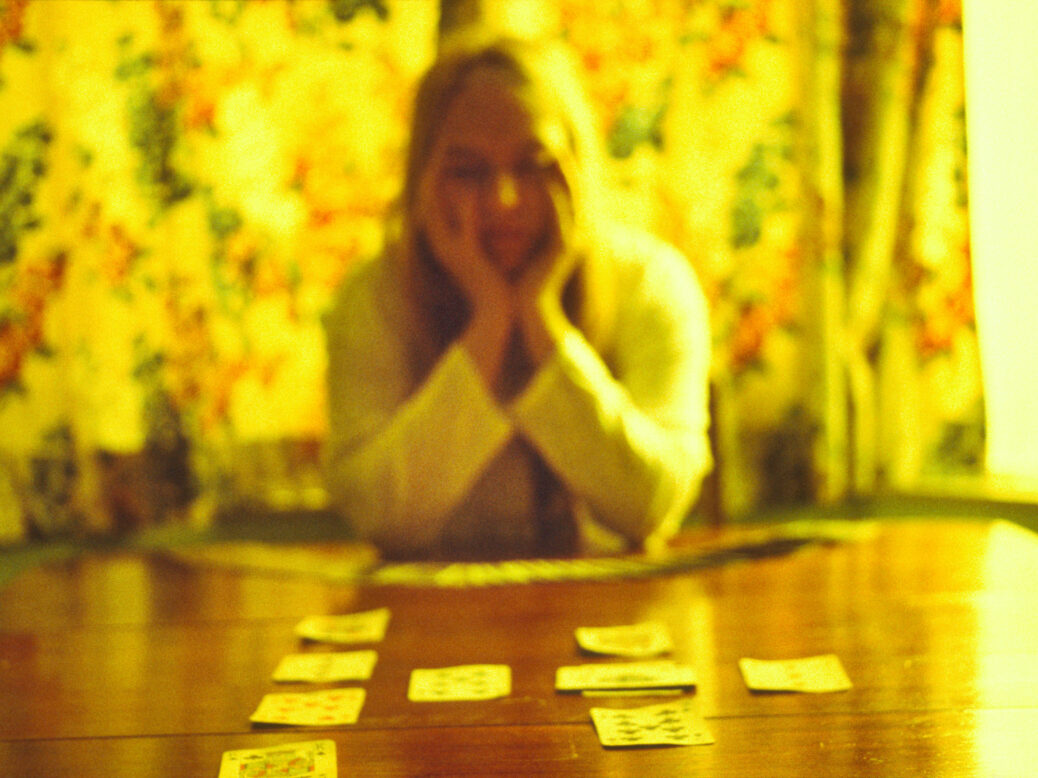
“I can see you. Walk straight ahead.”
I have gotten lost on the way into the psychic’s flat. Angela Jensen is standing on an upper balcony dressed in black. Since she was a child, Jensen has received messages from her guides about what will happen to her and the people around her, manifesting as voices, flashing lights or physical sensations across her body. The only time that her guides stopped speaking to her was when her brother fell into a coma.
“I’m used to my guides speaking in my ears,” she says. “Then suddenly it all went black. I’m hitting my ears thinking they’ve left. But they told me: ‘Angie, we have to go and look after your brother.’ They said he would come through. And he did.”
Jensen pauses. “It was the first time in my life it felt strange not being me.”

Once, at the Playboy Club in Mayfair, Jensen was introduced to a man and shook his hand. Immediately, she knew.
“You’ve buried bodies.’
He didn’t flinch. He had spent time in prison and made no effort to hide it. Jensen shrugs. “I don’t mind being a witch. I’ve got Romany blood in me, I’m not bothered about it.’
Psychic readers claim to see our future, talk to the dead and sense shifts in the world order. Throughout history we’ve sought them out, from medieval royals flocking to Nostredamus, to punters down Brighton pier and actors consulting mediums to contact dead characters (Helena Bonham Carter for Princess Margaret in The Crown, obviously). In the 1970s, the US army established the Stargate Project, investigating the use of psychic arts in gathering military intelligence until they were called off in 1995 due to lack of “concrete findings”. Even so, members of the team criticised the CIA for never taking Stargate seriously.
But beyond the reach of the CIA, there is a lot of new Western funding for projects investigating clairvoyance. In 2024, the Institute of Noetic Sciences in the US announced an annual $100,000 research prize to support work exploring theories of non-local consciousness and psychic abilities. In the UK, a newly developed Masters programme at the University of Exeter entitled “Psychedelics: Mind, Medicine and Culture” looks at similar psychic areas of belief.
And consumer appetite for clairvoyant services is stronger than ever. The global online psychic-reading market alone is projected to grow from about $2.1bn in 2024 to more than $4.5bn by 2033, while astrology apps – once niche curiosities – are forecast to expand from roughly $3bn in 2024 to $9bn by 2030.
Inside Jensen’s flat, the blinds are drawn and the walls are lined with mirrors, with the clean, floral smell achieved with candles and regular vacuuming. Paintings of female forms and goddess statuettes intersperse family photographs of Jensen and her children.
The reading is in her bedroom, two chairs arranged beside the bed facing one another. I ask whether she minds if I record the interview, wondering if the frequency of my iPhone might interfere with her psychic ability. Apparently not. She tells me she can extend her mediumship over the telephone too, for a set fee.
When Jensen begins the reading, she closes her eyes. As she speaks, her hands move constantly, miming scribbling with a pen, tracing crucifixes to ward off energies I should avoid – America, in my case. She knocks on her chest and moves her hands in breastroke when she describes the act of cleansing. A few times, she mutters phrases in a language I don’t understand. She talks quickly, hurtling from one topic to the next. She tells me I really do need to get my teeth checked, that they’ll say something about my gums, but it won’t be too much to worry about; I should expect the unexpected next November; and in her witchiest pronouncement, I will be glad that I turn left in an old car on an old patch of land in five years’ time. At times, she takes my hands in hers. When she sees me out, we hug twice. As I am going she says, “You’ll love Edinburgh.” She doesn’t know that I’ve been thinking about moving to Scotland, specifically Edinburgh, for months. It is a few hours before I climb down from the excitement she has left me in. Later that evening, when my brother asks how it was, I struggle to put into words the astonishing intimacy and reassurance I felt with her. I feel embarrassed to say the trite, new age adage that comes to mind: I felt seen. My brother raises a skeptical eyebrow. An annoying smile tugs at the corners of his mouth. “You’ve been had.”
In philosophical terms, scepticism about psychic or telepathic claims is usually grounded in materialism. This outlook holds that consciousness is a product of neurological activity in the physical brain, contained within it. Other philosophical traditions offer a different picture. Panpsychism, monism and dualism all treat consciousness not as something sealed inside individual minds, but as something shared or universal – a view more hospitable to metaphysical systems that claim to explain psychic phenomena. The unexplainable in quantum mechanics is often used as a catch-all for proof of the unprovable. Proponents of the psychic and psychedelic sciences maintain that if physicists can hold their hands up and admit there’s something else going on beyond our comprehension, this could leave space for the unexplainable phenomena instances of clairvoyance fall under.
The psychic industry in Britain has gone far beyond one-to-one readings in a stranger’s home. In 2023, Jayne Wallace, founder of Psychic Sisters, secured funding on Dragon’s Den as the first person in the UK to market wellness products with a New Age spiritual bent. (She was profiled by the New Statesman that year.) Known as a celebrity clairvoyant, her clients include Kim Kardashian, Kylie Jenner and Kate Hudson. Psychic Sisters have been pitched in swish digs in the basement at Selfridges for the last 20 years.
It’s Monday morning, teeming with the perfumed stragglers of London’s leisure class. “We’re next to Nespresso,” Wallace’s receptionist had assured me on the phone. With a reception desk manned by a smiling young woman, the unit has the atmosphere of an airport nail salon or spa. I am ushered into a closed room. A loud extractor fan blares, presumably because this is a small room with no windows. There are no crystal balls, draping shawls, not even a wooden elephant. But there is an unframed photo of Wallace and Kim Kardashian on top of a cupboard. (Wallace is not one of the psychics Kim called “full pathological liars” last November for erroneously predicting she would pass the bar exam to qualify as a lawyer.)
Wallace has seen an uptick in individuals seeking her services. “People are looking more at where’s my life purpose? With AI, they’re asking more questions. It’s frightening and people are unsettled.” Her repeat clients, she says, seem more anxious about life’s pressures than they have in years past.
Without thinking about it I have taken off the three silver bangles I wear. “I’m going to need those,” she says. “Do you wear them a lot?” I do. ‘Good.” Her Essex cadence is friendly but brisk. Throughout her reading, she passes my bangles from one hand to another.
She asks me to shuffle a pack of tarot cards. I begin to shuffle them like a deck of playing cards. “No,” she says. “Not like that. Gently.”
“There is a very strong mother standing behind you.”
Jayne begins my reading so quickly I am not aware that’s what’s happening. She splits her insight into career, family and romantic success, weaving in between these themes. I am, she tells me, destined for something in media or television. “The BBC,” she says, with particular emphasis. Do I know anyone there? As it happens, yes: my twin brother is a researcher on the One Show. The same brother who, she tells me, is finally with a lovely girlfriend. All true. And will have a baby in the next two years. I should be excited, she says, to meet my niece.
Taking an admonitory tone, she tells me it’s imperative that I put more effort into growing a following on social media and why, oh why, for goodness’ sake, am I not on contraception?
She is obviously intuitive, sublimating my character into casual, offhand remarks. “You don’t do people very well.” The only thing she gets wrong about me is bizarrely the one comment she makes about my physical appearance. “You have brown eyes.” It feels childish to say, “Actually, they’re blue.” By that point I’m already in it; involved in the bright, busy future she’s dealing out in front of me. Children. House moves. Career success. Romantic intrigue. It was my life, the movie, and I wanted to star in it. Sure, my eyes could be brown.
Wallace has to end our interview promptly; readings with her cost £150 for 40 minutes and she has another client. In the same efficient motion she presses three small crystals into my palm like lucky coins. “One for career, one for family, one for love,” she says. And then I am out again, blinking under the bright white retail light of Selfridges, momentarily disoriented beside a gleaming display of Le Creuset casseroles.
Psychic Sisters numbers 20-odd women, all hand-picked by Wallace because she intuited they had the abilities she was after, even once employing a woman she met at a dentist surgery on the spot. A surprise then, and possibly an opening for scepticism, that clairvoyance is purportedly a skill you can learn. But there are classes to learn psychic mediumship from the ground up. Aude Firmin is a psychic who has pivoted her insight to holistic business coaching after more than a decade in the corporate world. Every single one of her 156 Google reviewers has given her five stars. One called her work “transformative”.
Firmin runs psychic classes, teaching £160-an-hour sessions on enhancing intuition and learning practical psychic tools. One of her students, Rajan, found her when he was going through a complicated divorce. Rajan had a bad experience with another psychic who had colluded with his soon-to-be ex-wife, claiming to have a psychic awareness that Rajan had a secret bank account he was hiding during his divorce proceedings. But after rolling the dice one final time on Firmin, he felt an immediate connection with her insights. He tells me he struggled to believe he could hone his own psychic capabilities, but by the second session something had shifted. During an exercise he found himself describing the appearance and clothing of a woman he had never met, sensing her beside a woman’s shoulder.
Across from him, the woman he was reading started to cry. “Oh my God,” she said. ‘That’s my sister. She died 20 years ago.” The moment, he says, forged an unexpected bond between them. Years later, they are still in touch.
The human instinct towards connection – belief in another person – seems both to draw people to psychics and to emerge from the reading itself. In my own readings with Jensen and Wallace, intimacy seemed to matter as much as the cards or predictions themselves. It’s a powerful thing to feel seen; or put another way, to feel as though we are prominent, relevant and respected figures within someone else’s consciousness.
These days, clairvoyants face a new competition in AI. While many remain resistant to claims of psychic perception, we appear increasingly prepared to entertain another possibility: that machines are on their way to achieving consciousness. Many of us are already asking machines the kind of intimate questions we would have once reserved for close friends or trained psychiatric professionals. We invite machines into the intimate spaces where we usually seek human judgement because the idea of a responsive consciousness is comforting. Without a crystal ball, the most important questions are never simple. To respect AI’s trite reassurance on parenting, whether to leave a marriage, quit a job or move countries, we have to persuade ourselves that it does possess consciousness – far more ridiculous, perhaps, than trusting a medium’s inner eye.
Besides, a machine’s consciousness, if it ever existed, would operate in a closed system, speaking back to us from a screen, never generating anything really, properly new. The appeal of psychic belief, by contrast, rests on the opposite idea: that consciousness might be shared, porous, capable of reaching between people.
After I leave Wallace at Selfridges, I call my brother. “Heard something about you today,” I tell him. “You’re having a baby in the next two years.” He calls across the room to his girlfriend. “Hear that? We’re having a baby.” I hear laughter down the line.
[Further reading: Silicon Valley’s “Get Rich University”]
Content from our partners
Related


Join the debate
Subscribe here to comment