
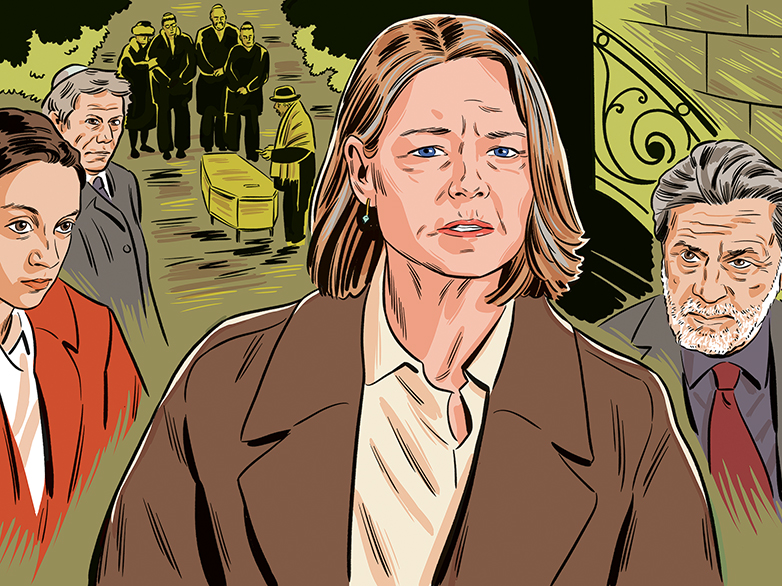
Jodie Foster has appeared in several French films. She speaks the language fluently, having studied at the Lycée in Los Angeles and lived in France for nine months after her breakthrough role in Taxi Driver in 1976. But Vie privée – A Private Life – is her first lead role in French, and it is her casting that makes the movie, a teasing melee of genres, work – more or less.
Foster plays Lilian Steiner, a bad-tempered Jewish American psychoanalyst, living in Paris, separated from her ophthalmologist husband Gaby (the ever enchanting Daniel Auteuil). She’s not on great terms with their son Julien (Vincent Lacoste) either, let alone with his new baby, her grandson, whom she can hardly be bothered to meet.
We first encounater Lilian in her elegant, bookish apartment, in a mood because her upstairs neighbour is playing music loudly – Talking Heads’ “Psycho Killer”, no less. She ascends the spiral staircase to complain but he shuts the door in her face with a muttered remark that she’s a “rabat-ouaj”, a slang version of rabat-joie. Back in her study, lighting a cigarette, she looks up the meaning of this term. “Cockblocker, old biddy, ball-buster, frigid, pain in the ass,” her phone comprehensively informs her. She sighs. It’s a performance completely without vanity by Foster, with wonderful intelligence and feeling throughout. Hearing more noise on the staircase, she charges out to attack, only to discover one of her long-term clients, Pierre (Noam Morgensztern), lurking. She’s been treating him weekly for eight years, since he came to her trying to stop smoking. He refuses to lay down on the couch and tells her that he went to see a hypnotist last Monday, paying €50 for a 20-minute session. “It’s been four days, I haven’t smoked, I feel freed from smoking and from you – I’m done,” he tells her, bitterly remarking that he has spent €32,000 there. Plus another €8,000 on cigarettes.
Worse follows. Lilian picks up a voicemail from the daughter of another client, Paula Cohen-Solal (Virginie Efira), saying her mother has died and inviting her to sit shiva with the family tomorrow. Lilian goes but is furiously thrown out by Paula’s husband (Mathieu Amalric) as, after being treated by Lilian for nine years, Paula committed suicide using the drugs Lilian illicitly prescribed her.

Lilian’s eyes won’t stop watering, prompting an old man to offer her a seat on a bus. She consults her ex, who tells her she’s fine. It’s the first time he’s seen her cry, he remarks. “It suits you.” We’re just ten minutes into A Private Life and so far it’s hugely enjoyable and promising, offering many possibilities – a satire on therapy? A family romance? A murder mystery?
Alas, the film can’t decide between these options either, and embraces them all while not quite fulfilling any. Lilian can’t believe Paula committed suicide and suspects first her husband and then her daughter, recruiting her ex to help with her dodgy sleuthing. They get on well again and the film seems to be switching into a re-marriage comedy.
She also goes to see Pierre’s hypnotist to try to stop the tears, and regresses into a weird past-life memory of being in an orchestra playing for the Nazis in wartime Paris alongside her lover, Paula, before she’s shot by the conductor – a sequence that belongs to Fellini or a Hitchcock film, like Spellbound, and doesn’t quite fit here. There’s never really a sense of menace and the film’s ending is anticlimactic, almost petering out.
What’s consistently rewarding is seeing Foster navigate French life and language so expertly while remaining aware she is not French and never will be, a fascination and plight for any Francophile. It’s the sixth feature by director Rebecca Zlotowski (An Easy Girl, Other People’s Children) and she has fashioned it entirely around Foster. As well she might – the actor has won two Oscars, three Baftas and four Golden Globes, after all.
The film is worth seeing for Foster alone, although the rest of the cast is excellent (including a final cameo from the great documentary maker Frederick Wiseman, who died in February at the age of 96) and the filming and editing a pleasure throughout. Alternatively, next week, Taxi Driver, in which a 12-year-old Foster was so astounding as the abused child Iris, is being shown in plenty of cinemas to mark its 50th anniversary. A double bill?
A Private Life is in cinemas now
[Further reading: Disclosure Day’s earnest hokum]
Content from our partners


Related



Join the debate
Subscribe here to comment