
Virginia Woolf’s second novel, Night and Day, was criticised by Katherine Mansfield for being out of date as soon as it appeared, in 1919. The prewar world it depicts is “so far away, so shut and sealed from us today”, she said in her review. The book, she insinuated, is “a novel in the tradition of the English novel… we had never thought to look upon its like again!” Ouch! Woolf was stung – but she never wrote so traditional a novel again, and later acknowledged it to have been “a mistake”.
Despite addressing the question of female emancipation, Night and Day is essentially a courtship comedy, pretty much “Miss Austen up-to-date”, as Mansfield said. Or, as we might say, it’s an attempted rom-com. Therefore, of all Woolf’s books, it might seem the easiest to adapt into a Merchant Ivory style period drama. Yet the problems with this long, verbose novel remain daunting. Woolf recorded in her diary that EM Forster, no less, told her it just didn’t work: “None of the characters in Night and Day is lovable. He did not care how they sorted themselves out.”
Night and Day has been radically revised by scriptwriter Justine Waddell and Iranian-born director Tina Gharavi (I Am Nasrine) for this adaptation – so radically that it has been thought necessary to assert in the title that it is still Woolf’s story. It is and it isn’t.
In London in 1910, the 20-something free spirit Katharine Hilbery (Haley Bennett) wants to study astronomy but is pushed towards marriage by her patriarchal father (super-grump Timothy Spall) and dotty mother (Jennifer Saunders). They want to see her engaged to a suitable family friend, William Rodney, a twerp who writes bad poetry and insists he was named after William the Conqueror (Jack Whitehall channelling Mr Bean).

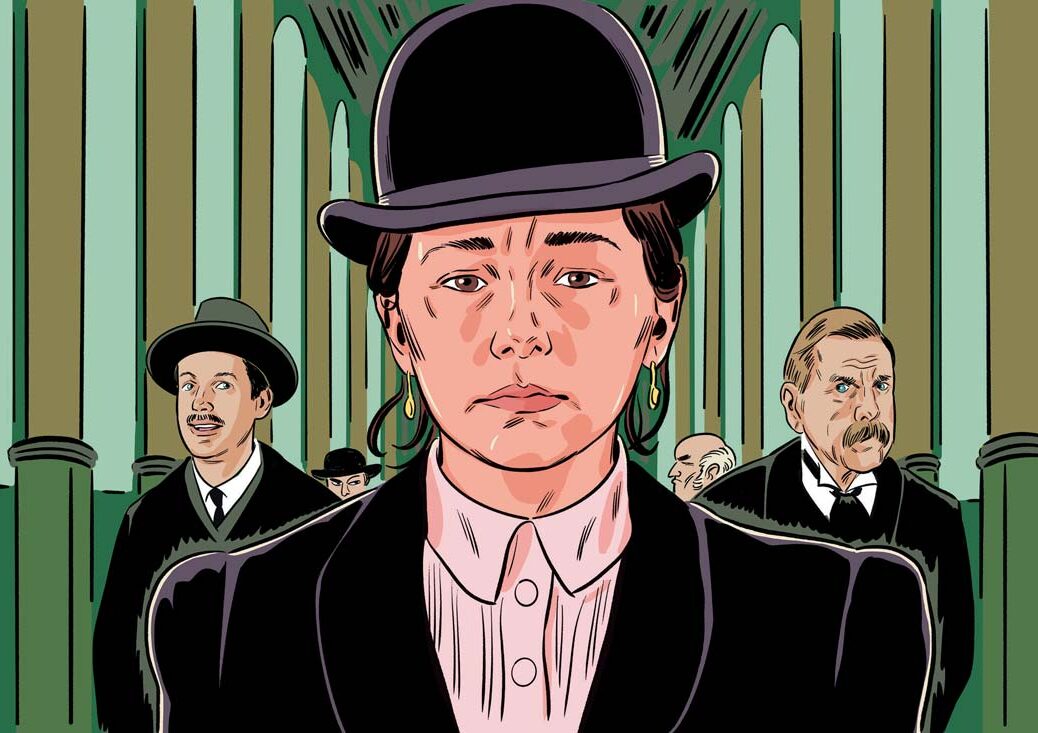
Supported by her more modern pal Cyril (the transgender actor Misia Butler), Katharine goes to meet the suffragettes, led by Mary Datchet (the explicitly modern, not to say punky, Lily Allen), and tries to get into Cambridge to study physics by pretending to be male (“Kit Hilbery”). Her father is enraged. Defeated, she accepts William.
When, however, Cyril is shockingly outed as gay at a family Christmas lunch (“a nancy at the table!”) and bravely protests that “we love who we want – only then shall we be truly free”, before toppling over from a surprise heart attack, Katharine realises she can’t marry William after all, especially after going to meet Cyril’s charming, bereaved boyfriend Laurie (Aaron Cobham), who is black. He tells her “he was magnificent in his love”. In the novel, Cyril’s originality is merely to have a lower-class mistress and children out of wedlock.
Luckily, Katharine has another admirer in the vicinity – the foxy Ralph Denham (the Austrian-Tunisian actor Elyas MʼBarek). A lawyer in the novel, Ralph here is a clever literary editor hailing from Iran who helps Katharine’s mother finally finish a previously interminable family biography she is writing, before respectfully offering himself to Katharine.
So Woolf’s characters have been thoroughly updated in sexuality and race, while remaining locked into the patriarchal, sexist injustices of 1910. This approach facilitates some telling remarks about the backwardness of then from the enlightened perspective of the future we inhabit now. So when the chauvinist dons at Cambridge ridicule Katharine at interview, she launches into a magnificent tirade: “There will be a new world and there will be women in science, and there will be lavatories too, and when there is, when we do, you will think back on this day and you will remember that you destroyed a talent, wilfully, blindly, because you would rather I get married!” I have always treasured such moments in historical dramas, my favourite coming in a Radio 4 drama about the last Romans leaving Britain in which a character thoughtfully remarked: “You do realise this is probably the last orange that will be eaten in these islands for hundreds of years?”
Stylistically, the film takes a similarly mixed approach, with full historical costumes and sets (filmed in and around Newcastle, with Ryhope Engines Museum serving as a mighty suffragette printing press) and lots of fast-moving handheld camerawork and quick cuts. The soundtrack features a few pop songs, too. “Though it’s a period film, it’s like a missile for today,” Gharavi has said, about “a struggle for women that’s still relevant today”. Particularly perhaps in, say, Afghanistan. Or Iran.
Virginia Woolf’s Night & Day is in cinemas now
[Further reading: Disclosure Day’s earnest hokum]
Content from our partners



Related



This article appears in the 17 Jun 2026 issue of the New Statesman, The Race
Join the debate
Subscribe here to comment