
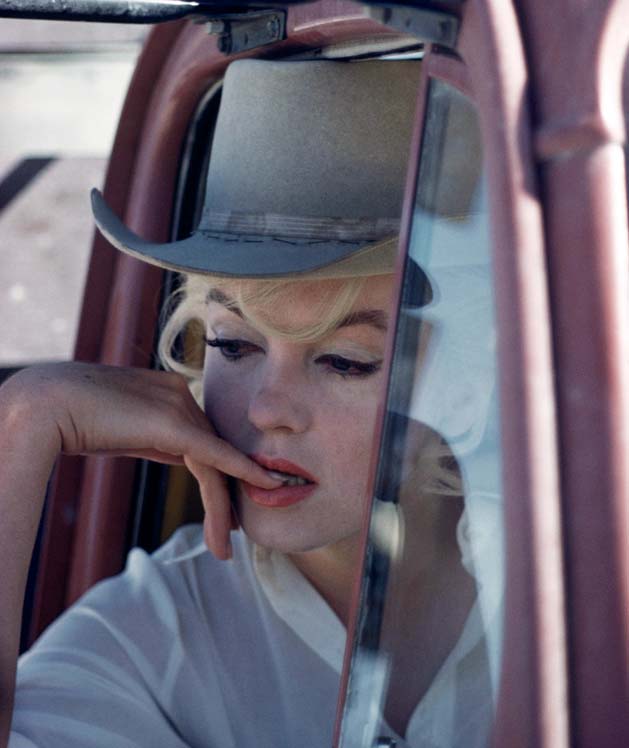
Marilyn Monroe would have turned 100 this month, and it is already difficult to approach her life as anything but an archaeological project. The actress exists in the public imagination as a surreal collection of objects. We remember all of them without knowing why; none has any particular focus or utility. The Warhol silkscreen paintings of her face sit alongside the white dress from The Seven Year Itch, the infamous Playboy centrefold, and the famous dance routine from Gentlemen Prefer Blondes, all dating from the decade between 1953 and 1964, only just within the world’s living memory.
In popular culture, the feeling is that the best response to the on-screen Monroe is to give dignity to an off-screen Norma Jeane – as she was born on 1 June 1926, in Los Angeles. Juxtaposing the real and the fake is meant to lead us to an ultimately liberatory truth. We imagine we might understand her by interrogating the intimate debris of her relationships with the baseball star Joe DiMaggio, to whom she was married for nine months in 1954, and the playwright Arthur Miller, from 1956 to 1961. Or by looking at the fabled photo of her reading Joyce’s Ulysses. But these slices of reality are just as random and incidental as the slices of fiction. They lead nowhere, and add up to no appreciable whole.
The BFI’s Marilyn Monroe season hardly helps. While her studio-era predecessors played versions of the same archetype on and off screen, Monroe might be the first major actress whose filmography stands at a sizeable distance from her own life. This predicament was a historical accident: our greatest symbol of Hollywood decadence was really a creation of Hollywood austerity.
Between, and during, the world wars, the most successful studios churned out upwards of 40 films every year. Their most important assets were their actors, and particularly their leading women. Publicists and executives collaged history, fiction and reality to create believable star narratives. These lavish practices were only economically viable because the major studios also had a monopoly over the exhibition of films. The most prominent owned their own cinema chains, and could force independent exhibitors to sign exclusivity contracts, “block booking” hundreds of films at once.

This was the world Monroe came of age in. She spent a considerable amount of her tumultuous childhood in Hollywood the town, but dreamed of being in Hollywood the industry. After a period of modelling, she spent 1947 on a low-level contract at 20th Century Fox, fell into a short period of freelance exile and then landed at Columbia, where she had her first main role in the 1948 musical Ladies of the Chorus. Unfortunately, she became a star at the precise point Hollywood’s star apparatus collapsed: film historians tend to point to 1948 as the beginning of the end. The United States Supreme Court broke up Hollywood’s theatrical monopoly, which made its business model unsustainable. Audiences moved from cities to suburbs, where neighbourhood cinemas were unprofitable. Television threatened to overthrow the whole industry, offering cheaper entertainment and a more attractive home for its established entertainers.
Studios cut back on films and talent. Columbia let Monroe go; Fox signed her back, this time for seven years. She borrowed her sensuous, bubbly screen persona from Jean Harlow, a 1930s sex symbol she later cited as her favourite childhood actress. Actresses of this era had to be witty and self-aware. Harlow and her contemporaries sold sophisticated lifestyles to their female audiences, wearing the newest clothes and smoking the newest cigarettes while wisecracking about the men in their lives. But Hollywood’s desperate economic conditions called for a new kind of star. By the early 1950s, those female audiences had gone home to watch television, and Monroe and her peers were on billboards selling sex.
The 1953 Technicolor extravaganza Niagara was a breakout role; Monroe starred as a femme fatale, in various stages of nudity. In the cartoonish Bus Stop (1956), she played a showgirl in Arizona with dreams of Hollywood. In The Prince and the Showgirl (1957) she played the same role, this time in Edwardian London. “Polyamorous-perverse non-acting,” said the film critic Pauline Kael, alluding to Freud’s theory of “polymorphous perversity”, which entails the capacity to find erotic gratification in “multiple forms”.
Monroe’s scriptwriters were doing her wrong. Much of her output relied on studied performances of naivety. This did not make her any less of an actress – her comedic timing barely faltered – but it did hinder her development as a consistent screen character. The “dumb blonde” is rarely an active agent in her own life; her own desires are generally subordinate to those of the man opposite. The situation is not conducive to an exciting three-act screenplay. The Seven Year Itch (1955) is about as dull as a film could be with its level of comedic talent. Monroe’s unnamed character is the opposite of an interesting woman. She comes out of nowhere, makes few of her own decisions, and exists to affirm an ordinary man’s ideas about himself. It is almost a surprise when she is upskirted by a subway grate, but the famous image passes almost without notice.
Monroe’s screen archetype is now shorthand for a loss of potential. To be a “dumb blonde” is to be cursed, off screen and on. Monroe had already put herself on thin ice by mimicking Jean Harlow, who outlived a particularly tragic husband but did not outlast the 1930s. The actress Jayne Mansfield mimicked Monroe’s image, parodied her in several cartoonish films and died in a car crash five years after Marilyn’s suicide. Sharon Tate’s murder was random, senseless, and marked the spiritual end of the 1960s. The examples keep stretching into the present. Hugh Hefner’s Playboy Mansion gave the public realm a boundless supply of Monroe-esque blondes, including Anna Nicole Smith, who died of a parallel overdose before she hit 40. Euphoria may be Sydney Sweeney’s final successful project for a mass audience: the actress began to inhabit the dumb-blonde archetype, with all its associated sexual humiliations, just as she lost the public over politics.
Midcentury Hollywood’s contempt for women has followed us into the present day; if you can’t live a full life in fiction, you won’t have it in reality either.
A quick survey of Monroe’s filmography will make you wonder how much more she could have achieved if she’d been born 20 years earlier. Her most successful films took cues from the fast-paced, cosmopolitan parlour comedies of the 1930s.
Billy Wilder’s crossdressing screwball caper Some Like It Hot (1959) is almost a penance for The Seven Year Inch: Monroe is portrayed to her advantage because she is never the most ridiculous person in it. In Gentlemen Prefer Blondes (1953), originally a novel by the screenwriter Anita Loos, Monroe appears alongside Jane Russell, another victim of sex-symbol typing. The film takes its comediennes seriously by submerging them in a world of equal eccentricity; the two women are more believable as co-conspirators than they are as fantasy objects. There are early threads of Sex and the City in the follow-up romantic comedy How to Marry a Millionaire.
Monroe’s final film, The Misfits, a western directed by John Huston in 1961, is getting a UK re-release. It belongs to a school of cinema you might call Middle Hollywood. It filled the gap between the 1950s and 1960s, giving mainstream American cinema its first hints of an independent aesthetic and ethos. It was the domain of the jazz soundtrack, the method actor, and the artisanal screenplay (this one by Arthur Miller). Its predominant narrative preoccupations were disillusion and grit. A wave of Tennessee Williams adaptations would soon search for the horror in rural America; an associated “hagsploitation” trend narrativised Hollywood’s decline by tormenting its ageing stars.
The Misfits combines both elements: Clark Gable stars opposite a horrified Monroe as a down-on-his-luck cowboy, killing horses for meat. It’s difficult to look at him without seeing a worn-out version of Rhett Butler, the antihero Gable plays in Gone with the Wind. Monroe plays her stock showgirl-naif role with a new depth, the result of years of training. Her sensitive performance is accentuated in classical soft focus. These final two hours on film are also the only two hours for which her entire career makes sense. Her real-life pin-up photos decorate the inside of a cupboard. A character tells her he wishes she will live forever. “You started out just wanting to dance, didn’t you?” someone asks her. “But little by little it turns out that people ain’t interested in how good you danced – they’re gawking at you with something entirely different in their minds, and they turn it sour, don’t they?” It is a belated attempt to create Monroe metafiction.
One shot, 18 minutes in, has Monroe standing in the doorway of a darkened house. We see her from behind, in the darkness; the Nevada desert glows before her. There’s a parallel shot in John Ford’s cowboy epic The Searchers. A decade earlier, in vivid CinemaScope, it stood for the pioneer ethos, for opportunity and exploration. Here it could mean desolation, boredom, and exile. It could also mean heaven.
The retrospective season Marilyn Monroe: Self-Made Star is at the BFI until 31 July
[Further reading: Lola Young isn’t messy on stage]
Content from our partners


Related

Join the debate
Subscribe here to comment