
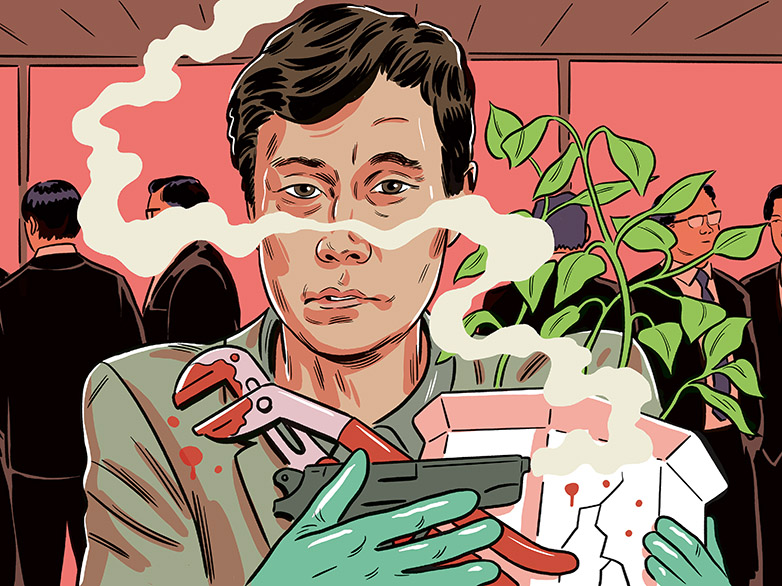
Just how much do you need for the good life? The bar is set high in the opening scene of No Other Choice, the new film by South Korean director Park Chan-wook (Oldboy, The Handmaiden and, most recently, the sublime Decision to Leave).
Yoo Man-su (Lee Byung-hun, the evil Front Man in Squid Game) has had a long and successful career as a manager in the paper manufacturing business, even winning an industry award: Pulp Man of the Year 2019. As we meet him, he is relishing his rewards. In the garden of his splendid gated house, to the caress of Mozart’s Piano Concerto No 23, he is holding a celebratory barbecue with his pretty, adoring wife, Mi-ri (Son Ye-jin), his stepson Si-one, and their young daughter Ri-One, a neurodiverse cello prodigy. Around them gambol their delightful Golden Retrievers, Si-Two and Ri-Two.
Man-su’s employers, Solar Paper, have sent him a prestigious gift of an eel, with a note thanking him for his hard work and years of dedication. The family come together for a group hug. “Know what I’m feeling now?” says Man-su. “I’ve got it all.” Pride before a fall.
The gift was a kiss off. Solar Paper has been bought by an American company and is laying off its staff, including Man-su when he refuses to produce a list of those who should be sacked. “Sorry, there’s no other choice,” the suits say. There’s a grotesque company therapy session. A big circle of redundant men repeat a mantra: “My loving family will support me fully while I seek new opportunities.” Man-su swears he’ll be hired again in three months.

Three months later, he’s working in a warehouse and completely failing during an interview for one of the few jobs left in his field. Mi-ri is realistic about what they need to do. “Everything non-essential must go.” Her car, the piano, the dining table, the dance lessons, tennis, the Netflix subscription, the house itself before it is repossessed – and the dogs, to the little girl’s great distress. Mi-ri returns to work as a dental hygienist. Man-su’s humiliation is complete.
Man-su then decides that he, too, has no choice but to create the vacancy he needs at a rival firm, Moon Paper. As he prepares to execute his plan, however, he realises he must also eliminate any other applicants more likely to secure the job. He therefore hatches a scheme to identify them by advertising a post at a fictitious company of his own, inviting CVs and applications on paper only. What follows is a Korean update of Kind Hearts and Coronets.
At this point, the film takes a comic turn without becoming any less nasty – a distinctively Korean mode also evident in Parasite and the scintillating zombie film Train to Busan (both being needlessly remade in the States). As a murderer, Man-su is about as competent as Mr Bean, relying on notes scribbled on his hand. He blunders his way through events, hopelessly queasy about knocking off men in the same predicament as himself. But on he goes.
No Other Choice is based on Donald E Westlake’s 1997 thriller novel The Ax, written in response to corporate downsizing. The novel’s narrator calmly introduces himself by saying: “I’d never actually killed anybody before, murdered another person, snuffed out another human being.” The Axe (Le couperet) was filmed in France in 2005 and directed by Costa-Gavras, to whom No Other Choice is dedicated. But the relocation transforms the story, adapted perfectly to the highly codified Korean business world of status, shame and ferocious competition – and it updates it too.
When Man-su finally makes it back into the paper business, he finds that he’s the sole employee needed, and not for long. “We need you to oversee the test run. It’s fully automated, that’s the whole point of the system. There’s no other choice.” Man-su enters the darkened factory (“AI doesn’t need lights”) to the sound of Marin Marais’s hypnotic piece for the viol, “Le Badinage”, played by his daughter. We then see monster automatons cutting down and processing trees without any human involvement.
No Other Choice, South Korea’s entry for Best International Feature at the Oscars, is made with all of Park’s manic energy and visual invention – he has said that if people want comfort, they might as well go to a spa – but its moral impact is blunted by its turn towards satire and even slapstick. In Parasite, the obvious point of comparison, that combination worked remarkably well. Here, it does not. No Other Choice is something of a disappointment after the classic, Decision to Leave.
“No Other Choice” is in cinemas on 23 January
[Further reading: Industry likes money too much]
Content from our partners



Related


This article appears in the 21 Jan 2026 issue of the New Statesman, Europe is back
Join the debate
Subscribe here to comment