
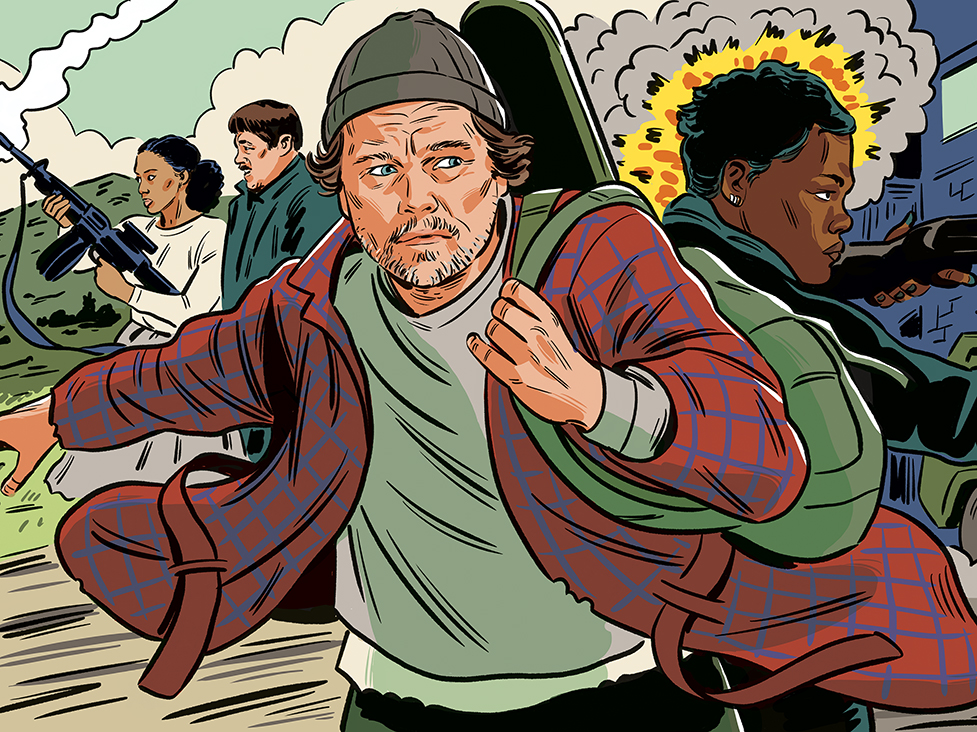
Another Thomas Pynchon adaptation from Paul Thomas Anderson? After the woozy muddle of his first, 2014’s Inherent Vice, the prospect seems daunting. One Battle After Another, however, turns out to be only loosely inspired by Pynchon’s 1990 comeback novel, Vineland, with Anderson taking just one thread of its story and making it entirely his own as both writer and director. Maybe Inherent Vice enabled Anderson to get Pynchon, if not out of his system, into the cinematic shape he wants.
One Battle After Another is an action film from beginning to end: relentlessly in motion, a comedy-thriller any viewer might enjoy. You don’t need to have seen his nine previous features (perhaps the most varied, demanding and vital body of work from any current director) to enjoy this one – but if you have, you’ll know its arrival is an event.
Pynchon’s novel followed Sixties radicals into the early Eighties of Ronald Reagan. Anderson has updated this drastically: the first act is set more or less now and the rest suddenly projected forward 16 years into a future little changed. At once, armed activists – the French 75 – are breaking into a detention centre for immigrants on the US-Mexican border. Dozy Bob (top doofus Leonardo DiCaprio) is setting off fireworks as a distraction, but his fierce girlfriend Perfidia (electrifying Teyana Taylor) is in the lead, holding an arrogant American soldier, Captain Steven J Lockjaw (a contorted Sean Penn), at gunpoint: an encounter that quickly becomes grotesquely sexual. “Sweet t’ing,” growls Lockjaw offensively. Perfidia responds “Since we playing, get it up, yeah up… good boy.” He does.
As the French 75 set off bombs and rob banks, Lockjaw, now obsessed as well as naturally vengeful, pursues Perfidia, manifesting in a pervy sexual encounter. Bob dotes innocently on the baby she has as a result, telling her: “You realise we’re a family now – you don’t have to do this any more?” But Perfidia walks out on them both. Captured by Lockjaw, she rats out her comrades and disappears, first into witness protection and then, to Lockjaw’s rage, to Mexico.

Sixteen years later, Bob’s an idle toper and toker, living off-grid in a shack in the woods, repeat-watching The Battle of Algiers to remind him of his revolutionary days to the despair of his sassy teenage daughter Willa (newcomer Chase Infiniti). “What are you, my babysitter?” he asks blearily. “Yeah,” she mutters. DiCaprio plays it for laughs, channelling the Dude.
Then Lockjaw – a fright of a man, strutting absurdly with muscles bulging, his face full of tics, a marvellous caricature by Penn – comes back on the scene. Lockjaw has been approached to join a secret white supremacist society, the Christmas Adventurers – creepy old men dedicated to racial purification. “If you want to save the planet, start with immigration,” they say. “Hail St Nick!”
Lockjaw craves superiority. But if it is true that he has had an “interracial relationship”, let alone a “half-breed” child, he’ll be rejected. So he sets out to find Willa, and kidnap and kill her using military resources – these have been acquired under the pretext of busting the “Underground Railroad” and the sanctuary cities that have been protecting immigrants and dissidents.
From this point the film is a furious chase as Bob, aided by Willa’s sympathetic martial arts teacher Sensei (Benicio Del Toro), tries to save her, running around in his dressing gown, failing to charge his phone, falling off a roof, but full of heart. Unfortunately, his brain is so fried he can’t remember the secret code that the surviving network of activists uses.
Anderson directs the action exuberantly, the kinetic involvement he always creates raised to a new pitch, the camera constantly in motion, melding intense close-ups and dramatic vistas. There’s a mesmerising car chase – just three vehicles in a line on a straight road bouncing over blind hills – that leaves an extraordinary sense memory. Everything is driven hard by a dominant, discordant score by Radiohead’s Jonny Greenwood.
At no point is there any mention of Trump, Maga, Ice or sending the National Guard into rebellious cities (the film was completed before Trump took office again), but there’s no need. One Battle After Another, for all its silliness and humour, is a film serious about racial politics, the demographic mingling in America that has its foundations in slavery and that some still seek to deny and undo. There’s almost none of this primal subject in Pynchon’s novel, yet it’s Anderson’s main theme. He’s a director whose films always come at you from a different angle. Don’t miss this one.
“One Battle After Another” is in cinemas now
[Further reading: The Booker Prize 2025 shortlist]
Content from our partners



Related



This article appears in the 25 Sep 2025 issue of the New Statesman, “Are you up for it?” – Andy Burnham’s plan for Britain
Join the debate
Subscribe here to comment