
What makes a western? There are composite elements on which we’d all agree: guns, a frontier landscape, a battle with the law, good boots. A soundtrack that entwines itself with the action – as film theorists might say, inter-diegetically – so that gesture blends into mood. Most crucial, though, is an understanding, shared between characters, film-maker, and audience, of the rules. An agreement on meaning strong enough that, more often than not, it does not need to be conveyed in words. The click of a heel, the swing of a saloon door or an unbroken stare will do.
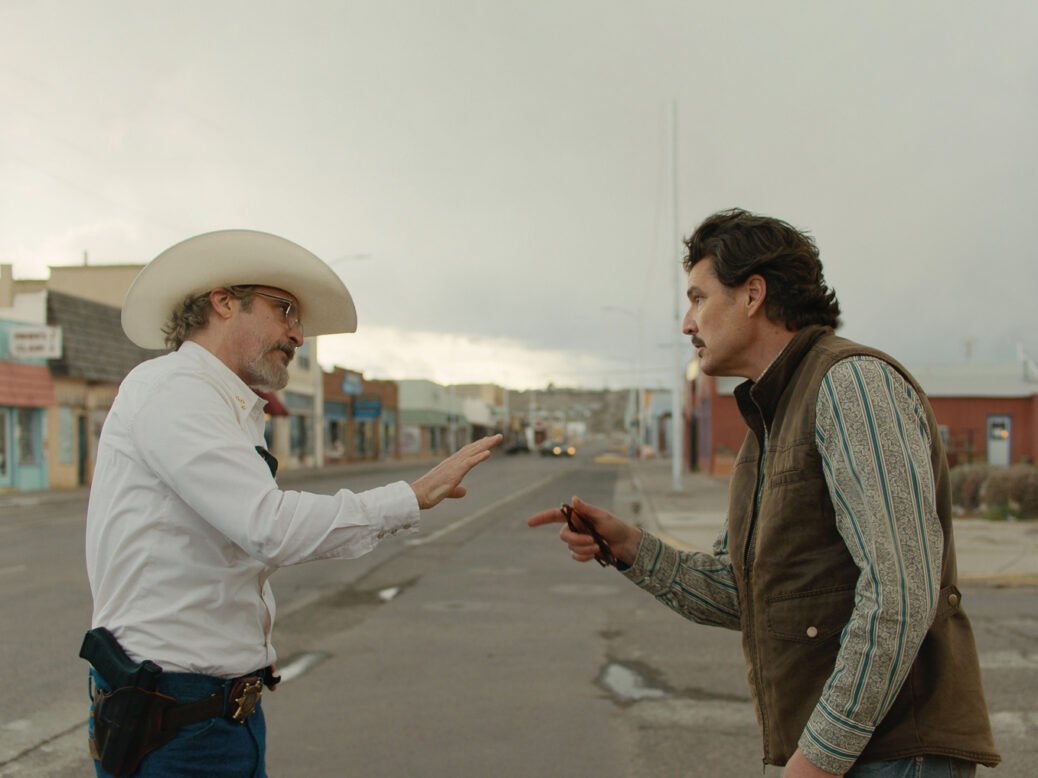
Eddington, the latest film by the 39-year-old cult oddball director Ari Aster, has been hailed variously as a “quasi-”, “neo-” and “the first truly modern” western. On the surface, it ticks all the boxes. Set in the film-maker’s native New Mexico, the story follows a beleaguered sheriff, Joe Cross (Joaquin Phoenix), in his bid to bring down the oleaginous mayor, Ted Garcia (Pedro Pascal). There’s a tussle over a woman (Louise Cross, played by Emma Stone), a barroom brawl, and a showdown on a deserted Main Street over which a prairie storm threatens to break, high winds forcing Cross to hold, quite literally, on to his hat.
The problem, however, with Eddington’s western classification arises from the movie’s main concern: the breakdown of meaning. Set in late summer 2020, as a contentious new biopolitical order rises from the spring’s panic-fuelled state of emergency, no one can agree on what is good or bad – mask mandates, cops, the younger (mostly white) generation’s attempts to “abolish whiteness”. Over two hours and 25 minutes, covering a month in the life of the town (population: 2,435), the characters’ only recourse is to a set of actions that become increasingly ugly. As the townsfolk’s consensus on reality shatters, Aster, rather than letting guns do the talking, stages a cross-fire of cross-purpose dialogue that, in the film’s last two acts, degenerates into a blizzard of bullets.
In the circus of interviews surrounding the movie’s premiere at Cannes this summer, Aster described the pandemic as an “inflection point”, a moment of convergence between previously distinct spheres of life brought to a crashing denouement from which we’re yet to emerge. The film opens with a raving homeless man staggering barefoot down a dusty road into the town – a Tiresias whose evident lunacy immediately suggests that he might well be the only sane character we’ll encounter – and a shot of a sign advertising the application to build a new data centre by a company called Solidgoldmagikarp (one of the film’s many “Easter egg” moments: the term is a Pokémon-themed instance of online slang that once sent large language models into a garbled tailspin). Succinctly, Aster has established the movie’s main line of argument: the arrival of the internet in our world has blurred the boundary between sanity and madness, reality and fiction, morality and power – oppositions subsequently played out in the conflict between Sheriff Cross and Mayor Garcia.

Cross’s cross to bear, we soon gather, is how much he loves his wife, Louise, whose awkward smiling face is the background to his work tablet, and whose failing business in weird cloth dolls he supports through reimbursing his deputy for covert online purchases, and who, two decades previously, went on a couple of bad dates with Garcia. Louise suffers doubly: from an unspecified mental anguish and a tyrannical mother – the latter, it’s clear, is the cause of the former – with a penchant for online conspiracy influencers. Their presence infects the household, just as Black Lives Matter protests, fuelled by Instagram hysterics, begin to break apart the town.
The movie is Aster’s fourth feature, all of which have been collaborations with the producer Lars Knudsen as well as projects of the voguish production company A24. He has established a core set of themes across his oeuvre: the problem of having a mother (Hereditary, 2018), the problem of being a child (Midsommar, 2019) the problem of being your mother’s child (Beau Is Afraid, 2023), though Eddington makes a little more hay out of the travails and betrayals of fatherhood.
He has also developed a distinctive aesthetic: his astute eye for interiors, with varying degrees of alienating domestic roominess or suffocating crampedness. A24 and Aster, together, have pioneered the use, rather than mere representation, of mobile phones as part of the toolkit of contemporary cinema (the company also produced Sean Baker’s Anora, 2024, and Janicza Bravo’s Zola, 2020, in which action is propelled via on-screen messaging). Eddington is the most pronounced and developed iteration of phone-led narrative in Aster’s work to date: the pings of notifications working as sonic jump scares, blocked numbers standing in for arguments, and live-streaming the only point of contact with the outside world.
If Eddington isn’t a western, what is it? It’s a period piece about the present; this means it’s a conspiracy thriller. Aster has admitted that the genre’s canon – Sergio Leone, John Ford and Clint Eastwood – wasn’t at the forefront of his mind while making the film. Instead, it was the unravelling chaos of Oliver Stone’s JFK (1991) that he hoped to emulate. The parallel is apt; unlike the 1970s forerunners of the conspiracy genre, in which unmasked malfeasance reveals something about the state of the world and the order of its powers, Eddington shows you roughly who’s doing what, but doesn’t interest itself in the tedium of why. No one cares. Or, if they do, they can’t agree on it.
[See also: Who’s afraid of YouTube Man?]
Content from our partners



Related



Join the debate
Subscribe here to comment