
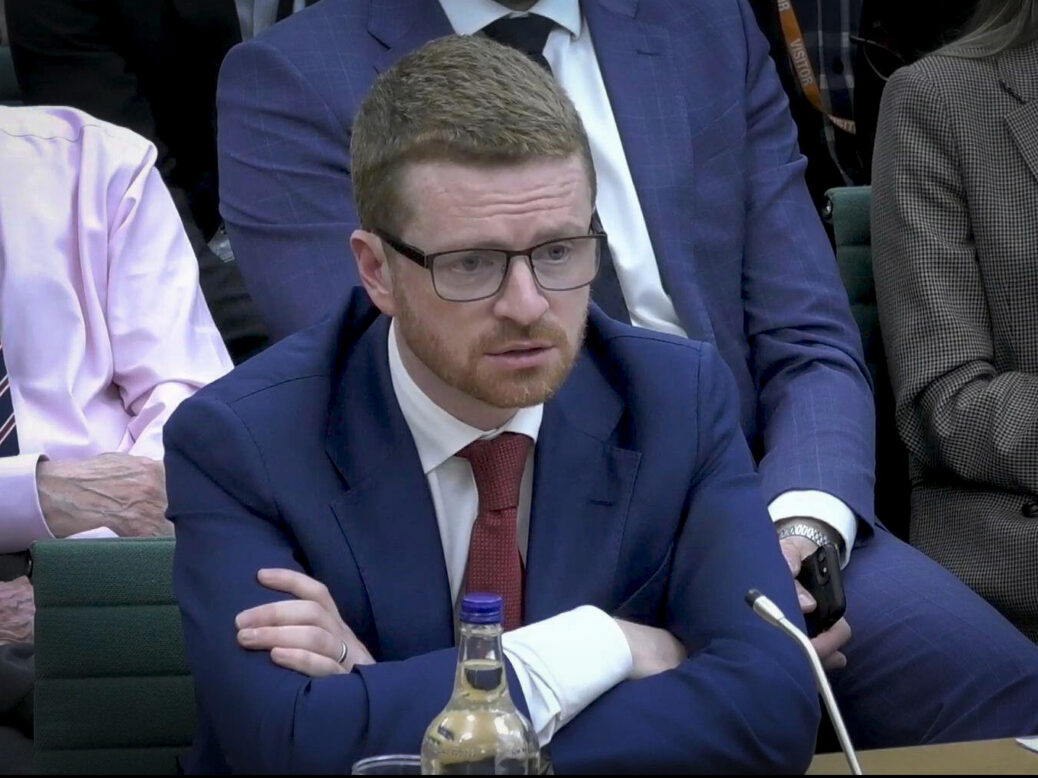
It is time to talk about Morgan McSweeney. Before his evidence session to the Foreign Affairs Committee on 28 April, he was treated as a semi-mythical figure, a shy, woodland creature occasionally caught by the camera with a phone glued to his cheek and a wary expression. Shy, but dangerous. For the left of the Labour Party, he was an existential threat with the potency of Georgy Zhukov and the guile of Machiavelli, the most provocative Irishman since Wolfe Tone.
McSweeney had been a reliable and useful contact of mine since well before the election. We spoke on the phone often, met occasionally over a coffee or beer; once, he cycled over to my house to fill me in. I heard him speak privately at meetings where he was by far the most eloquent, witty and persuasive exponent of the Starmer agenda I’ve heard – far more so than the Prime Minister. He was particularly ferocious about how Labour people had treated the grooming gang scandal.
It’s possible his enemies – including friends of mine on the left – will not believe this, but he never once, in all our conversations, slagged off any Labour MP. He was never sweary, never once mentioned Peter Mandelson, who he probably knew was no friend of mine, and was in general soft-spoken and passionate only about the rough deal working-class voters had been dealt by the metropolitan elite. He is probably now fixed in the public mind as a villain. But that wasn’t how I found him.
Only the essentials
Oatcakes. Proper, bitter marmalade – just oranges, sugar and water. Toilet paper. Alcohol-free Guinness. Toothpaste… Reading the bleakest projections of economic disaster coming from the Iran war, I’ve been asking myself what I would stock up on if facing a state of siege. Decent paint, canvases. I’ve got enough books, frankly, to last another 50 years. But, coffee beans, pencils, notebooks, dark chocolate, peanut butter…

Hoarding in preparation for the worst is, I think, a fundamental human trait – a slightly more sophisticated version of squirrels and nuts. Those readying themselves for nuclear war and societal collapse, whom the Americans call “preppers”, would be much more organised, storing water filtration systems, iodine tablets, cordless tools, stoves and so on. I am either too disorganised or too philosophical to go that way: a Russian missile heading towards London would find me outdoors, on the top of Primrose Hill, staring upwards with a large malt whisky.
But I am conscious of the possibility of harder times ahead and the fragility of the technology we depend upon. Everything I have earned in nearly half a century is just a series of numbers, sitting blinking I know not where, and could presumably be wiped out in an instant. Some people buy gold. But the idea of scraping off pieces from a bar and taking it to a street trader to buy bread makes me laugh. No, the only sensible thing is to focus on what you need for a few difficult weeks. Oatcakes, coffee beans, good books…
Tooting television’s trumpet
As a medium, television has this strength: it retains big audiences and heft. But it has this weakness: it’s almost instantly forgotten. In that context, can I toot a belated trumpet for Mackenzie Crook and his recent BBC comedy-drama series Small Prophets? Almost all telly drama seems founded on the self-hating assumption that we’re a violent, horrible, cynical and untrustworthy people who spent most of our time murdering one another. The real world is so very different, populated in my experience by amusing, decent, reflective and rather brave folk. This is that world reflected in Small Prophets. Thank you, Mackenzie.
Revenge of the exiles
Mark Sedwill. Jonathan Slater. Simon McDonald. Tom Scholar. Simon Case. Sue Gray. Chris Wormald. Tamara Finkelstein. Olly Robbins… That’s not an exhaustive list, but it’s some of the senior civil servants who have been fired or have resigned in the past few years. It’s not good enough: we need an effective government machine and, politician by politician, it is being destroyed.
A complete reform of Whitehall is urgent. But how do you reform a machine you are using for urgent purposes every day? It reminds me of something James Cleverly said to me when I was suggesting some wild course of action during the fall of Boris Johnson: “That’s like asking me to jump out of the plane and knit a parachute on my way down.”
I would start by bringing together most of the above – adding in Helen MacNamara, who was in Johnson’s Covid-era Downing Street – to build a kind of patriotic, experienced “revenge of the exiles” response. Any future prime minister of any party would be well served by listening to those who know, first-hand, what goes wrong. And, in honour of the greatest Whitehall journalist ever, I’d call it the Peter Hennessy Commission.
[Further reading: Morgan McSweeney can’t believe the Prince of Darkness betrayed him]
Content from our partners

Related
This article appears in the 29 Apr 2026 issue of the New Statesman, The cover-up?
Join the debate
Subscribe here to comment