
It’s an atmospheric kind of job, caring for very old books. Wreathed in the druidical fog of time, manuscript keepers on TV and in movies guard secret knowledge. In reality, in my experience, experts in the oldest treasures of literary culture tend to be practical people. You have to be: literary antiquities are delicate, but not that delicate, and heavier than you expect. Book work means washing your hands all day, because that “old book smell” is mould and dead skin. It isn’t that bibliophile fetishism is the opposite of librarianship, or that paleographers have a natural enmity for antiquities dealers. Rather, the cultural mythoi of books and their true historical selves are multiple, intertwining and completely specific to the time and place they occur.
For example, the manuscript authority Christopher Frances Rivers de Hamel has long toiled at Oxbridge libraries and put in decades with Sotheby’s Department of Western Manuscripts. He’s published more than a dozen books, from the niche (Syon Abbey: The Library of the Bridgettine Nuns and Their Peregrinations After the Reformation from 1991) to the mass market, as in the classy coffee-table tome The Book: A History of the Bible (2001). Everybody in the business knows his name.
His prize-winning book Meetings with Remarkable Manuscripts (2017) covered with easy erudition a group of famous books, each chapter a narrative essay on visiting it at its native library. In a review I wrote at the time, I now read that I used the word “easy” for his style there too, quoting De Hamel on the curves of a Gospel of St Augustine, like “those paper fish one used to buy in joke shops, which you placed on the warmth of your open hand and which then curled to indicate whether you were in love”. He makes his text readable, but the work is complex. It takes a long time to learn everything there is to know about medieval manuscripts, but somebody must, or Sotheby’s and Christie’s would have nothing to put in their catalogues.
In his absorbing and often unexpected new book, The Migrants: A Memoir with Manuscripts, De Hamel explains exactly how he came to possess the kind of mind disease required to do this work well. He was born in London in 1950 to English parents who put the family on a boat to New Zealand in search of work a few years later. Although The Migrants ranges widely across De Hamel’s life, the framing story begins there, on the remote Kawau Island where the family first lived, and leaves off in 1972, when De Hamel turned 21 and returned to England for postgraduate study.

In between, he describes a childhood and adolescence of deep, almost freaky attachment to the material past. He “collected things which were exactly dated, like bus tickets, and would tear out and keep the dated headings from newspapers, watching how they went within a day from being now to becoming history”. Longing for England, he began collecting stamps, then coins. “Arranging sets and looking for lateral patterns are the instincts of all collectors,” he writes. “I cut circles in cardboard and lined the apertures with red velvet. I enjoyed labelling things.”
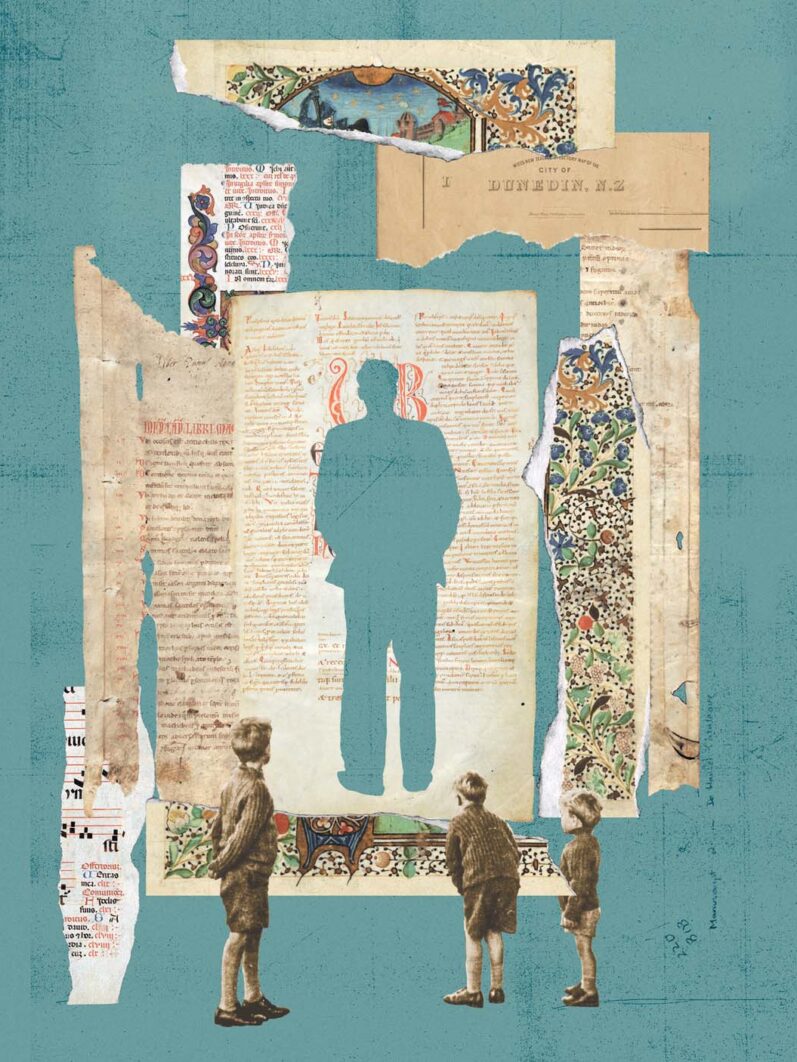
Then, at 12, he found himself confronted by a page of “an actual Gutenberg Bible”, hanging on the wall of his local library (the family had moved to Dunedin). He was “an impressionable 12-year-old, a schoolboy stamp collector”, he writes, “whose most precious and oldest possession was a penny black of 1840 and whose life in New Zealand until now had been entirely predicated around a sense of the country’s immense remoteness from Europe”. The penny black was the world’s first adhesive postage stamp; the Gutenberg Bible was the world’s first printed book. Looking at the page in the library, the young De Hamel was stunned by a sense of the object’s actuality, “the penny black of incunabula, printed in Mainz around 1454”. (The first generation of printed books are known in the trade as incunabula.) Print conventions whirled through his mind in a graphical dream, the page “crisp and black with white margins and an added dash of red rubrication, like the Maltese Cross postmark on my penny black envelope”.
Although the country farthest away from their manufacture on Earth, midcentury New Zealand was, it turns out, a natural place to become obsessed by old European books. There were a surprising number of such artefacts at his local library in Dunedin. They came at the order of Europeans who packed and shipped up the treasures of their culture for the edification of the white settlers. It’s an unthinkable crime now to cut up a medieval book (sellers at antiquarian book fairs often display signs noting that the leaves for sale were not dismembered by them) but De Hamel explains that it was quite common behaviour among patrons of the colonial arts.
Chopping up manuscripts and sending their mutilated leaves to the corners of the Earth was a way, as De Hamel describes it, of trying to fix and transmit an essence of England’s civilisation through the post.
When evangelical hotshot AH Reed bought and imported to New Zealand an early-14th-century Latin New Testament in the 1920s, for example, he cut it up. In 1965, the teenage De Hamel felt enchanted by the fragment’s beauty. He carefully copied its ornate initials in the Dunedin Public Library, communing with its “red and blue penwork initials”. Then he began copying entire leaves. It’s here, at the age of 14, that the obsessive little boy organising his stamps grows up into real anorak sweetness, a lonely but passionate young man. In September 1965, he writes, De Hamel was a good few pages into making his copy. He went to see Goldfinger in town, “which opens with a girl in a bath and features Jill Masterson in a black bikini, who is later covered in gold leaf (like a manuscript), and Pussy Galore in the cockpit and under a parachute”. After the film, he went back to the library. “Did a bit more of the MS,” he wrote in his diary.
As he grew older, De Hamel began to go questing. “There were two things any teenage enthusiast for manuscripts needed in New Zealand in the late 1960s: a sleeping bag and a copy of David M Taylor’s The Oldest Manuscripts in New Zealand (1955).” He followed Taylor’s index across New Zealand and later the world, like a wanderer following the type of medieval itinerary map that simply lists the towns on the way to your destination, in order, so that at each location one must ask directions to the next.
The particular forms of decorated penwork De Hamel fell in love with “seem to occur in an arc extending north-west from the region of Champagne (which might include Morimond) up towards Reims, Cambrai, Tournai and Lille, often in Bibles and service books, commonly but not uniquely Cistercian”. Shapes travelled as the leaves of books did 100 years ago, along channels of wealth and influence. “The migration of pattern,” De Hamel writes, “is as fascinating and mysterious as the migration of birds.”
The Migrants is about the books and pages that travelled to New Zealand and the young obsessive who reversed their path back to the metropole. Working at Sotheby’s in London in the 1970s, De Hamel learned how to fix the mysteries of history into a best guess. “You must come to a decision,” his old Sotheby’s boss Anthony Hobson “used to drawl wearily” in response to his hesitant attributions.
De Hamel has been famous in medieval manuscripts for a long time. It’s a different business to the one he met as a child, and he has done a lot of work in describing, regulating and pricing it. In a frothy press release announcing his hiring at the Chicago-based antiques and manuscripts dealers Les Enluminures about ten years ago, the CEO, Sandra Hindman, wrote the “niche that medieval manuscripts occupies in today’s art market owes a great deal to the incomparable talents of Christopher, who has made manuscripts accessible, interesting, increasingly valuable – and just plain fun – to an ever-widening audience”. Her implication was, I think, that in the many books that De Hamel has published, he has popularised medieval manuscripts in and of themselves and also helped, quite literally, to drive up their value.
Between 1975 and 2000 De Hamel worked for Sotheby’s, cataloguing an estimated 10,000 manuscripts. He handled some eye-watering transactions. In 1983, he sold the Gospels of Henry the Lion, a Romanesque stunner made for Germany’s Brunswick Cathedral in the 12th century, for £8,140,000 (the most expensive book ever sold, until Christie’s sold a Da Vinci manuscript in 1994). In 1998, De Hamel handled the delicate private sale of the 15th-century Sherborne Missal by Ralph Percy, the 12th Duke of Northumberland, to the British Library; the Crown accepted it as a payment in lieu on his inheritance tax bill.
If the Sherborne tax shuffle captured some exact type of value principle shared by the aristocrats, government and libraries of Britain in 1998, what might the stamp-collecting childhood of a manuscripts legend capture about today? Medieval manuscripts are at some kind of peak of relevance. Last year, 26-year-old Rose McCandless won the University of Denver’s Taylor C Kirkpatrick Prize for book collecting ($1,000) for her extensive collection of books about books. In Colorado Public Radio’s profile of McCandless, De Hamel’s Meetings with Remarkable Manuscripts appeared in several posed photographs. She is pictured smiling and proud among her volumes, stretching out a forearm tattooed with a line from The Shadow of the Wind, Carlos Ruiz Zafón’s bestselling novel: “Cada libro tiene una alma” (every book has a soul).
Zafón and McCandless’s idea that books have souls would have sounded twee five years ago. People who work hard with books, in my experience, even tend to bond over a slight disdain for amateurs and customers. De Hamel’s career in auctions suggests otherwise – books don’t have souls, they have material histories and prices determined by available buyers. Now that it has become clear that artificial intelligence is not some kind of joke, the culture finds itself embarrassed by its lack of arguments in easy reach on behalf of not-artificial intelligence. We need people to write words in order on purpose – plainly, clearly – but saying why is proving a little harder than expected. Books – we need those. And yet, the words don’t come.
Where once identifying as a bibliophile might have come off as pretentious and annoying, it now might really mean something. But what? De Hamel gives us a lot of history, but in its very outline – bits and bobs posted to New Zealand for a lonely boy to love – it reads more like a series of circumstances than a philosophy of history, or anything like that. We can only regret making fun of the antiquarians now, and begin pretending as though we had really valued bookbinders and typewriters (fax machines? Ring binders?) all along, and not thrown the whole culture of the page away as soon as we had the chance.
The Migrants: A Memoir with Manuscripts
Christopher de Hamel
Allen Lane, 320pp, £25
Purchasing a book may earn the NS a commission from Bookshop.org, who support independent bookshops
[Further reading: AI will dissolve civilisation as we know it]
Content from our partners



Related


This article appears in the 29 Apr 2026 issue of the New Statesman, The cover-up?
Join the debate
Subscribe here to comment