
There are angels in London. Their emissary, Raphael, appears to human eyes as 10,000 glowing blue particles. “It looked like a spray of peacock feathers, and then it looked like a fountain of many enfolded blue streams, and then it looked like a sway of overlapping geometric fans, and then it looked like a tree with sapphire eyes for fruit, and then it looked like a many-vaned cobalt whirligig spinning in space.”
Nonesuch, Francis Spufford’s very enjoyable fourth novel, is a mix of whimsical fantasy and meticulous Second World War history. It is 1940, and a group of wizards have trapped angels like Raphael in statues across London. “Raphael” is the angel’s old title – his real name is “a blast of harmonious overlapping chords too complex for the human ear, like the result of someone with at least six hands playing a cathedral organ”. Like the biblical seraphim, the angels themselves are morally complex. Although Spufford is a Christian (married to the Dean of Chelmsford) there’s no mention of their creator.
But there is good and evil. Lall is a beautiful young Nazi sympathiser who is trying to use the trapped angels to reach Nonesuch, a place beyond time from which you can travel to any point in history. She wants to go just a few months and a few miles back, to St James’s Park in 1939, to stop Winston Churchill becoming prime minister and taking Britain into war. Raphael enlists Iris Hawkins, a “suburban slut” from Watford, to stop Lall assassinating Churchill. (Spufford gets a bit misty-eyed here: “Mr Churchill, unreasonable and romantic Mr Churchill, myopic and bloody-minded and imperialistic Mr Churchill.”)
The British Union of Fascists, half of whose members are apparently wizards, lurks evilly in the background. On Iris’s morning commute she passes a Victorian gothic building with placards reading “Fascism for King and Empire”, guarded by sentries in tight black polo-necks – “two editions of the Anxious of Tunbridge Wells”. “It would have been nice to dismiss it as ridiculous,” Iris muses, “but the confidence made it horrible instead: a black-beetle eruption into the daylight, a slick of night oozing onto the pavement.”

And, during all this, Iris is making regular night-time journeys to Nonesuch on a wheeling corkscrew bridge in the sky, jumping from statue to statue while dodging Luftwaffe bombs. The potential risks are greater even than a Nazi-occupied Britain: Lall could step back a few millennia further and reverse all of civilisation. Iris could wake up in a new world, Raphael warns, not knowing what had been lost. “You could crouch under the trees when it rained, and couple in the open without blushing when the sun shone. You would die without fear, having no comprehension of what was happening to you, and when you did, your children would not trouble to bury your bones.”
The more fantastical elements of the novel can be a little hard to follow – even for Spufford himself, who doesn’t seem to have made up his mind whether the time traveller, having changed the past, is able to remember that they have done so. Such inconsistencies are frustrating in a novel that relies on complex rules of magic.
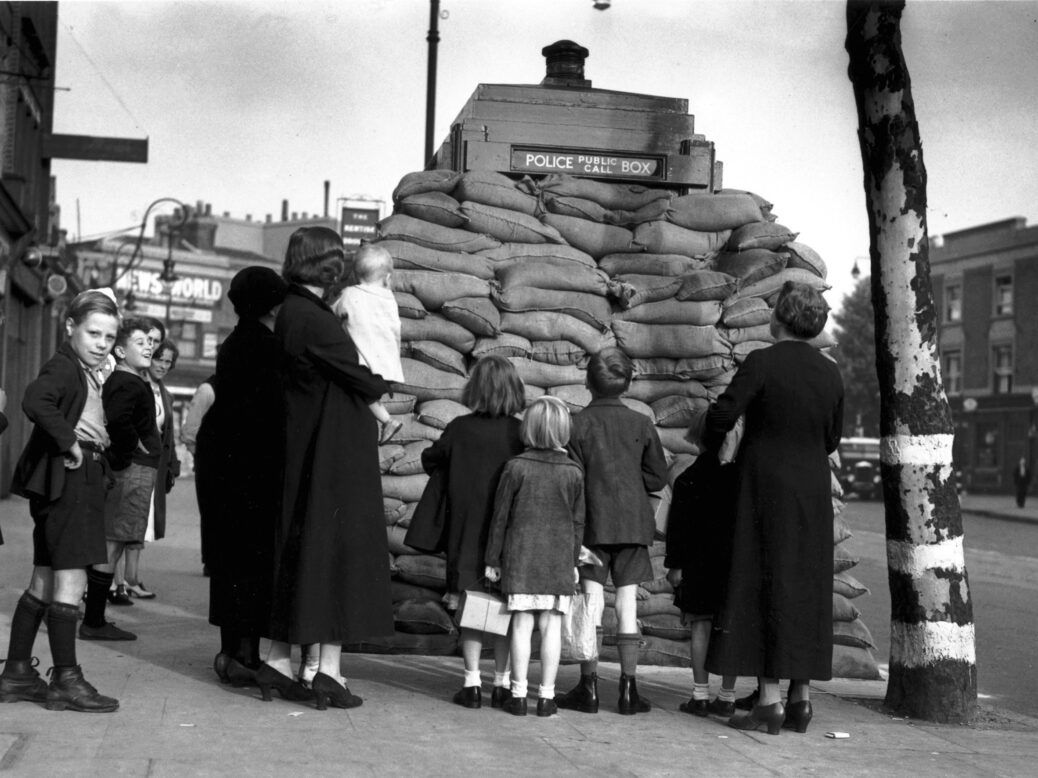
But while the wilder plot points can feel a little silly, Spufford reconstructs London at war with fabulous, awful detail. Londoners huddle each night in smelly public shelters and home-dug Andersons, in tunnels and under kitchen tables, knowing their lives may end in a meaningless flash. Office workers fend off robbers pretending to be rescuers who pillage bombed buildings; each morning people awake to a freshly shattered city, smelling of gunpowder. Iris watches an air raid from a rooftop: “It had a strange stately beauty, like a firework display in slow motion.” On Hampstead Heath incendiaries float down like stars, staining the long grass deep red.
Spufford has played with alternate universes before. Cahokia Jazz (2023) is a murder mystery set in a North America where smallpox didn’t ravage the native population. Light Perpetual (2021) imagines a bleak timeline where five Second World War children killed in a V-2 London attack survived. Across his work – but in Nonesuch most of all – he insists that, however you rewrite the past, you can’t fix human nature.
Nonesuch
Francis Spufford
Faber & Faber, 496pp, £20
Purchasing a book may earn the NS a commission from Bookshop.org, who support independent bookshops
[Further reading: How we became obsessed with the human face]
Content from our partners


Related


This article appears in the 04 Mar 2026 issue of the New Statesman, Trump's global terror
Join the debate
Subscribe here to comment