
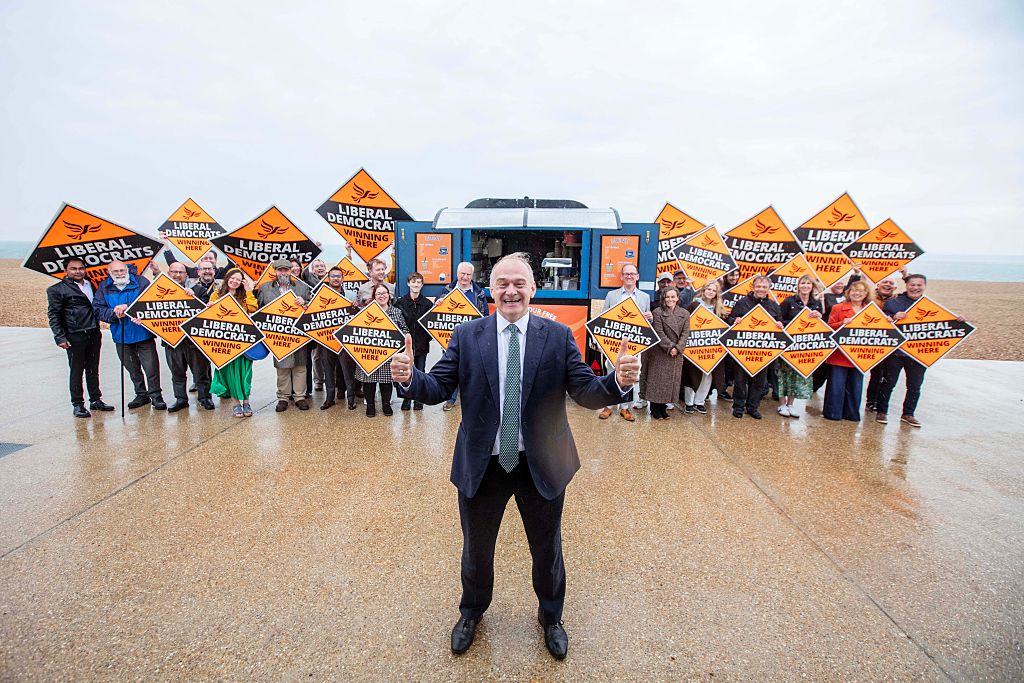
Usual local election caveats all apply: results are still being counted, jumping to broadbrush conclusions when you’ve only got half the picture is a fool’s game, all of this could be out of date by tomorrow. But since the race to build a narrative out of this scrambled polling picture is in full swing, I thought it might be worth taking a moment to look at the party in second place. The one no one is really considering, despite the fact it has overtaken both the two main parties and one of the insurgent parties that has dominated coverage in the run-up to these elections.
I am talking, of course, about the Liberal Democrats – because someone ought to. And also because I think the strategy Ed Davey’s party has taken in this set of elections (in England, anyway) tells us something about the way the electoral landscape is fragmenting.
You might at this moment be realising you haven’t heard much about the Lib Dems this election cycle, at least when it comes to national news. They don’t fit into the narrative that was set long ago: of a deeply unpopular Labour government shedding support on both its left and right flanks, of Nigel Farage’s Reform UK maintaining its ascendency for the second year in a row, of the provocative Zack Polanski and his mission to turn the Greens from an environmentalist project to a vehicle for radical left eco-populism, with all the controversy that comes with it.
The Lib Dems have been left behind by both the narrative and the polling predictions, as the conversation has moved to which of the challenger parties is the biggest threat to Labour. And yet there they are, in second place in terms of council seats declared so far. That isn’t an accident. It’s the result of what we might think of as a stealth campaign. A deliberate bid to slip under the radar. Project Yellow Submarine, if you will.

In conversations with Lib Dem figures across the party over the past year, it has been stressed to me repeatedly that while national presence is obviously good, local is just as important. The disproportionate way with which media organisations treat the various parties (academic research has demonstrated that Reform gets far more coverage on major flagship broadcast shows in relation to the number of MPs it has than the Lib Dems do) has not gone unnoticed.
The party had two responses. First: to set itself up in explicit opposition to Reform, using the 2025 conference to warn that the Lib Dems were the only alternative to a Trump-esque Farage-led Britain. Second: to go hyper-local, launching a regional media team to ensure that its candidates were getting attention in local news outlets, even if they were ignored at a national level.
The latter of these fits into the wider Lib Dem strategy of the Davey era. One fact bears repeating: in 2019, the Lib Dems suffered a total humiliation, winning just 11 MPs on 11.5 per cent of the vote; in 2024, they achieved utter triumph, with 72 MPs on… 12.2 per cent of the vote, a vote share increase of 0.7 points. (In terms of actual votes cast, more people voted for Jo Swinson’s Lib Dems in 2019 than Davey’s Lib Dems did in 2024, due to higher overall turnout.)
Partly, the 2024 success was down to the cratering of the Conservative vote. But it was also the result of a strategy of ruthless targeting, pouring resources into areas which already had a strong Lib Dem presence, rather than spreading them across the whole country.
The Lib Dem strategy for the 2026 locals has been similar, focusing less on national narrative and more on the ground game in places the party really wants to win. I saw for myself the relentless pavement pounding in one very specific London ward. We don’t have the full picture yet, and all the caveats remain, but results from councils like Richmond and South Cambridgeshire, which show North Korean levels of support for the local Lib Dems, suggest there can be a real payoff when resources are laser-focused.
Compare that to the Green results so far. Obviously there are some major gains – the Hackney mayoralty, for example, where Polanski’s party looks on track to take a historic Labour council; seats in Keir Starmer’s patch of Camden; as well as parts of Manchester. But the hype about a Green wave, while more than enough to severely damage Labour, so far isn’t entirely translating into seats, let alone councils. The Greens are certainly making gains in the capital, but muted gains compared to what the polls suggested.
Some of this may be impacted by Polanski’s response to the Golders Green stabbing last week, his spat with the Metropolitan Police and the wider question of antisemitism among some Green Party candidates. But it might also signal that Polanski has fallen into the trap Jo Swinson found herself in back in 2019, when she presented herself as a potential prime minister and as a result spread the party’s resources too thinly, garnering votes in the wrong places which didn’t translate into seats. Looking at the various MPRs published in the run-up to the election, the Lib Dems were inevitably predicted to fare much better than the Greens in terms of seats, with a similar or even lower share of the vote.
Local elections are not general elections, but understanding how to position your party within a rapidly changing electoral landscape matters. As I wrote recently, the Lib Dems consciously took the decision to be everyone’s second choice, aiming to be as non-divisive as possible – a party a voter at any point on the political spectrum might at least consider. This might sound like a bizarre tactic in a winner-takes-all first-past-the-post electoral system where there are no prizes for coming second. But when the question is framed as “who should I vote for to keep out Reform / Labour / the Tories / the Greens?”, there suddenly becomes mileage in being the least disliked.
This only increases as the electorate fragments. In 2025, the councillor voted in with the lowest margin – in Truro Moresk & Trehaverne in Cornwall – won with just 19 per cent of the vote. As I wrote this week in my longread on why this is a pivotal moment for electoral reform and the conversation about proportional representation, the emergence of five-party politics in England makes it highly likely that this round of elections we’ll see far more councillors elected with just one in every five votes cast. And the Lib Dems were ready for that.
The question is what a party does with its coalition of lukewarm supporters who hate them the least. That question is being hotly debated in Lib Dem circles, as are the limitations of the Davey strategy going forward. But a party doesn’t come second in local elections by accident. You might have forgotten about the Lib Dems – but the Lib Dems haven’t forgotten about you.
[Further reading: The Green wave breaks across England]
Content from our partners


Related

Join the debate
Subscribe here to comment