
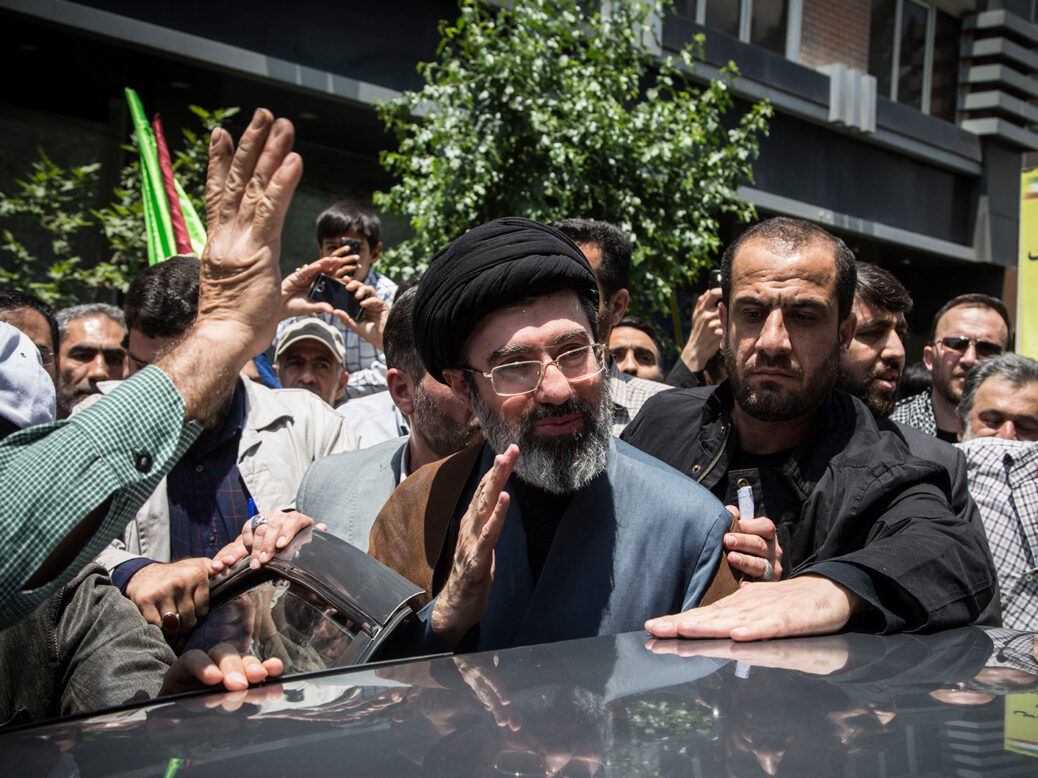
Mojtaba Khamenei, the second son of Iran’s former supreme leader Ali Khamenei, is widely seen as the most political of the leader’s children. He has long been described as the most mysterious member of the Khamenei family, rarely appearing in public and never holding significant office.
He is heavily predicted to succeed his father as the leader of the Islamic Republic, following Ayatollah Ali Khamenei’s assassination in a joint US-Israeli strike on 28 February. Mojtaba Khaemenei reportedly has the backing of the Islamic Revolutionary Guard Corps (IRGC). If he succeeds his father it would be the first time since the 1979 Iranian revolution that power has been transferred within the same family.
His elevation may only be making official the personal power that had long been held by Khamenei; in US diplomatic cables released by Wikileaks 18 years ago, Iranian sources were already complaining about Mojtaba’s power. Previously a gatekeeper and shadowy powerbroker, Mojtaba stands on the cusp of supreme leadership. Khamenei is said to be considerably more violent and ideological than his father, or as one report had it this week, “the most dangerous man in the world”.
Mojtaba Khamenei was born in September 1969 in the northeastern Iranian city of Mashhad, the same city where his father was born. After finishing high school, he entered the Qom religious seminary and followed the traditional path of clerical studies. During the Iran-Iraq War (1980–1988), he joined the front lines as a young volunteer. At the time, his father was serving as president of Iran but not yet the supreme leader.

Khamenei went to the front at the age of 17, joining a unit known as the Habib ibn Mazaher battalion. There he met several figures who would later become influential in Iran’s security and intelligence establishment. Among them were Mehdi Taeb, Hossein Taeb, Alireza Panahian, Ali Fazli, and Hassan Mohaqeq. Over the following decades, many of these men remained close to Mojtaba Khamenei and formed part of a loyal network around him.
At the time, however, few could have imagined that the son of Iran’s president might one day be discussed as a leading candidate to occupy the most powerful position in the country. After all, the revolution that removed the Shah had drawn much energy from mocking the hereditary principle.
In 2003, Mojtaba Khamenei married the daughter of Gholam-Ali Haddad Adel, a prominent conservative politician. Haddad Adel served as speaker of the Iranian parliament from 2004 to 2008. These were also the years when Mojtaba Khamenei’s name began to appear more frequently in discussions about the inner workings of Iranian politics.
Political observers believe he played a significant role behind the scenes in the controversial 2005 presidential election, which brought the conservative politician Mahmoud Ahmadinejad to power. Ahmadinejad was widely seen as a candidate supported by the Islamic Revolutionary Guard Corps (IRGC). Although he later fell out with parts of the conservative establishment, his rise to power was viewed by some analysts as linked to networks close to Mojtaba Khamenei.
One of the first prominent figures to publicly raise the issue of Mojtaba Khamenei’s political influence was Mehdi Karroubi, a reformist cleric and candidate in the 2005 presidential election. Karroubi narrowly failed to advance to the second round of the election, missing it by fewer than 700,000 votes, while Ahmadinejad moved forward instead.
At the time, Karroubi alleged that election fraud had taken place and argued that he should have faced Akbar Hashemi Rafsanjani in the runoff. In a letter to Ali Khamenei that later became widely known in Iranian politics, Karroubi complained about irregularities and referred to the alleged role of Mojtaba Khamenei behind the scenes.
In that letter, Karroubi criticised what he described as the involvement of the supreme leader’s son in deciding political outcomes. According to reports at the time, Ali Khamenei responded to attacks that described Mojtaba as an “aghazadeh” – a critical term used in Iran for the children of powerful officials who benefit from their parents’ influence – by saying that his son was “Agha, not aghazadeh.” Agha, of course, meaning variously “lord,” “master,” “sir,” or “mister”, is a term of respect.
Over the years, a number of figures in the Iranian elite have condemned Mojtaba Khamenei’s alleged political influence. Among them were Ali Akbar Nategh-Nouri, a former parliament speaker, and Mohammad Sarafraz, the former head of Iran’s state television network who was directly appointed by Ali Khamenei.
These pair pointed to Mojtaba’s close relationships with security and intelligence institutions within the Revolutionary Guards. Such claims fuelled speculation about his role during the contested 2009 presidential election, when Ahmadinejad was declared the winner in a result widely disputed by the opposition.
During the protests that followed, supporters of opposition candidate Mir Hossein Mousavi chanted slogans in the streets including: “Mojtaba, may you die before you see the leadership.” The slogan reflected growing speculation, already circulating more than a decade ago, that Mojtaba Khamenei might one day succeed his father as supreme leader.
Under Iran’s constitution, the supreme leader must be a faqih, or Islamic jurist. After the disputed 2009 presidential election, Mojtaba Khamenei began pursuing more advanced religious studies in Qom. The move quickly fed speculation among political observers that he could be positioning himself for a possible future role in Iran’s leadership. In 2022 he was given the title of ayatollah. By then, Khamenei had become a regular at his father’s side at political meetings, played a role in administering his father’s substantial financial holdings and was reportedly playing an influential role in the Islamic Republic’s Broadcasting Corporation.
Mir Hossein Mousavi, under house arrest for more than 15 years following the 2009 protests, repeatedly warned about Khamenei succeeding his father. In a statement issued in August 2023, Mousavi wrote: “God forbid – have the 2,500-year dynasties returned, that a son should inherit power from his father?”
Ali Khamenei has never publicly responded to speculation about his son’s political future. Mojtaba Khamenei himself has never given a media interview; he has never delivered a public speech. Very few photographs of him exist, and his rare public appearances have mostly been limited to attending state-organized rallies.
Many Iranians say they do not even know what his voice sounds like, and it remains unclear whether he is a capable public speaker. Mojtaba Khamenei may hold even more hardline views than his father, particularly on domestic politics and relations with the West.
This perception is partly shaped by the public, hardline positions of people believed to be close to Khamenei. Some of them have openly argued for a strongly anti-Western approach in Iran’s foreign policy. Mojtaba Khamenei’s wife and a son were killed in strikes on Saturday, as was his mother, Mansoureh Khojasteh Bagherzadeh: a turn of events unlikely to soften those anti-Western attitudes.
Under Iran’s constitution, the country’s supreme leader is chosen by the 88-strong Assembly of Experts, a body made up of clerics. In practice, however, powerful security and military institutions, especially the Islamic Revolutionary Guard Corps (IRGC), play a major role in Iran’s political system and can influence this selection process.
Within that power structure, Mojtaba Khamenei may have an advantage over other possible candidates. At the same time, Iran’s political landscape remains unpredictable, particularly during an all-out confrontation with the United States and Israel. At a meeting of the Assembly of Experts in 2024, convened to plan the supreme leader’s succession, Ayatollah Khamenei said that his son should be excluded from consideration.
Iranian history also offers a reminder that succession can be unpredictable. After the death of Ayatollah Ruhollah Khomeini, the founder of the Islamic Republic, few observers expected Ali Khamenei to ultimately become supreme leader.
It remains uncertain whether Mojtaba Khamenei will one day achieve what some believe to be his long-held ambition: succeeding his father at the pinnacle of Iran’s political system. Should Khamenei take power, it may not last very long. Both US and Israeli officials have warned that the next supreme leader will be targeted for assassination.
[Further reading: Iran after Khamenei]
Content from our partners



Related

Join the debate
Subscribe here to comment