
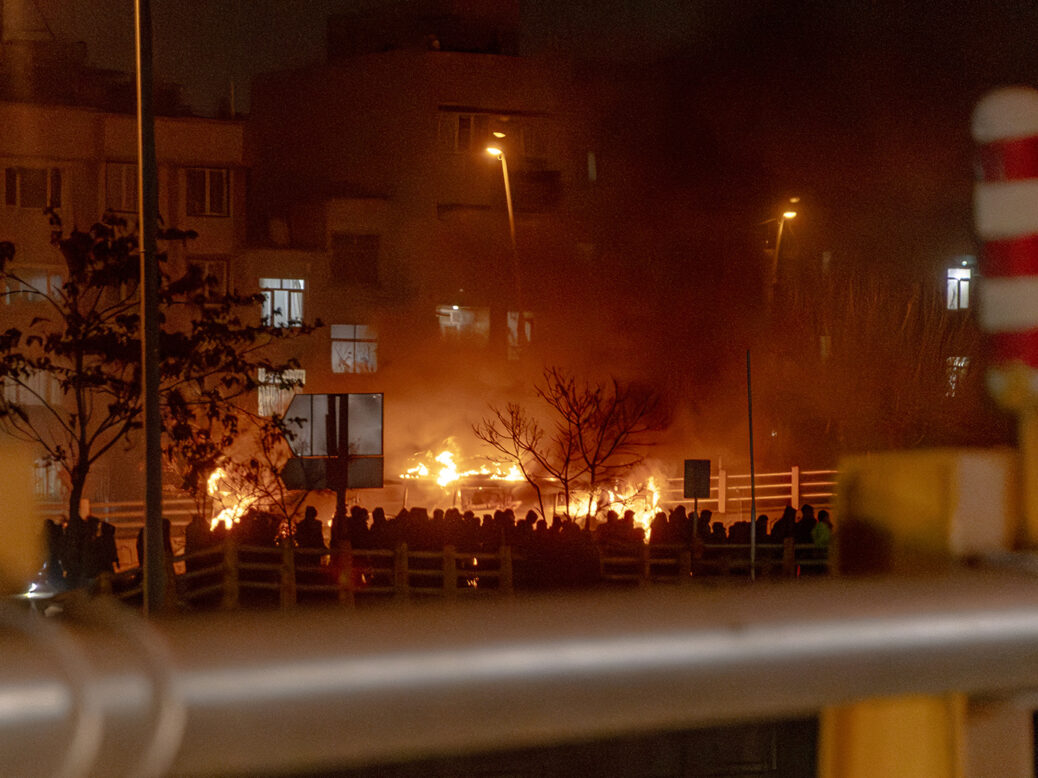
Government brutality is not stopping the Iranian protesters. “Almost everyone is participating in the demonstrations – doctors, engineers, teachers, workers, and shopkeepers,” said Hamid, an Iranian who crossed into Turkey on 11 January. He added that even small towns had joined in the protests which began on 27 December and have continued despite crackdowns and media blackouts.
The protests’ immediate trigger was the sudden collapse of the national currency in Tehran, driven by deep and unresolved economic failures. Within days, the price of basic goods skyrocketed: cooking oil tripled, while chicken and meat doubled. Iranians have been living under constant economic pressure for decades; the shock of the latest increases simply removed the last illusion of stability. The Tehran Grand Bazaar – long considered a political and economic barometer – went on strike, and widespread demonstrations began. What followed has become the largest wave of protests since the 1979 revolution.
Hossein, who works in the import and export of various goods and raw materials in Tehran, said the crisis has effectively paralysed his business. Following the collapse of Iran’s currency, the rial, transactions are increasingly conducted in US dollars. But the dollar’s value now fluctuates by the hour. A product purchased today can mean heavy losses within hours if the exchange rate suddenly shifts. Traders have largely stopped buying and selling, choosing to hold cash and wait. Hossein said “Stability has been promised for years – and it has never arrived.”
Iran has suffered long-term economic deterioration, driven among other factors by sanctions linked to its nuclear programme. Economic pressure intensified following Donald Trump’s 2016 election win and his policy of “maximum pressure” on the Iranian government. At the same time, the government’s chronic inability to control corruption or manage the economy has damaged public trust. Few believe the system capable of stabilising the currency or protecting basic livelihoods – particularly after last summer’s Israeli attack, which laid bare the extent to which the system was already under severe strain.

In the absence of free and independent media, due to strict state control, Iranians turned to social media to document what was happening on the ground. One of the videos widely circulated on X at showed a large crowd in early January flooding into Abdanan, a city in Iran’s western Ilam province near the Iraqi border with a population of around 25,000.
Reza Pahlavi, the son of Iran’s last king Mohammad Reza Shah – who was deposed in 1979 and now lives in Washington – issued a public call urging Iranians to take part in nationwide demonstrations on 7 January. Iranians subsequently gathered in different cities, including Tehran, Karaj, Isfahan, Mashhad, and Tabriz, with videos shared on social media that night showing thousands of people in the streets.
Mahsa, who owns a small shop in Karaj, a major urban centre just 36 kilometres west of Tehran, said she closed her business to join the protests. “I can’t even afford cooking oil anymore, and I can’t buy eggs – how am I supposed to survive? Life is getting unbearably hard,” she said. “People are frustrated and want change. At first, the demonstrations were scattered, but after Reza Pahlavi’s call, the number of people in the streets skyrocketed – at least ten times more.” She said many demonstrators openly expressed support for his return.
Following the major wave of demonstrations, the government moved to severely restrict internet access nationwide on 8 January – a measure widely seen as a threat to public safety. In November 2019, authorities shut down the internet for several days; human rights groups later reported that around 1,500 people were killed during the blackout.
Last Friday, the day after the latest large-scale protests, Iran’s Supreme Leader Ayatollah Ali Khamenei publicly condemned the demonstrations. He described those taking part as “foreign agents” and “rioters,” language widely interpreted as signalling a green light for repression at any cost.
Conservative estimates confirm at least 500 protesters have been killed, while some human rights groups cite sources claim there have been more than 2,000 deaths. (In the current media blackout, exact numbers are nearly impossible to confirm.) A shocking video recently released on social media appears to show evidence of mass killings of protesters at Tehran’s Kahrizak Forensic Medical Center, including a database with at least 250 images of deceased anti-regime demonstrators and footage of more than 100 bodies brought in on 8 January alone. Another clip shows desperate families searching for loved ones outside a Tehran hospital, suggesting the true death toll is far higher than officially reported.
Not all protesters, however, want to be ruled by the Crown Prince. Nassim, who lives in Tehran, says the sudden shift is difficult to process. “Not long ago, people were rejecting the idea of monarchy and calling for democracy,” she said. “Now I see how quickly opinions are changing. I can’t believe how much support he has gained in such a short time.” She described the mood as deeply emotional, driven by exhaustion and frustration. “Now I understand how so many people suddenly followed Khomeini in 1979,” she added. “I used to blame them. Now I understand.”
[Further reading: From the archive: The revolution turns to repression]
Content from our partners
Related
Join the debate
Subscribe here to comment