
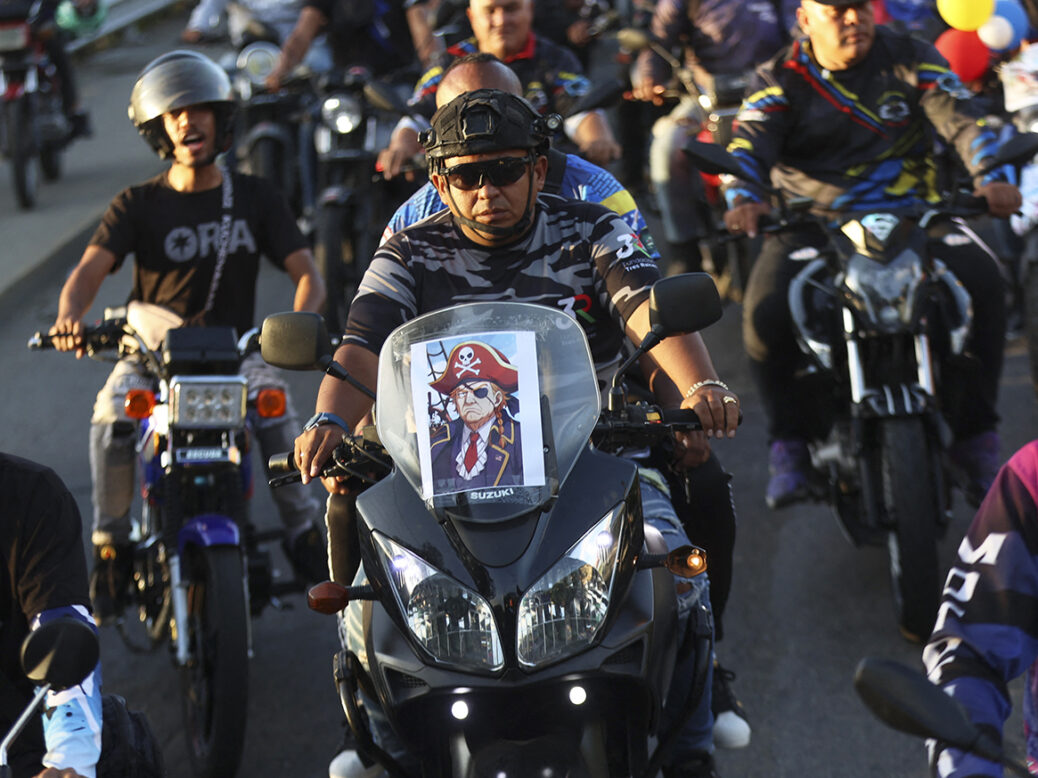
President Nicolás Maduro’s final hours in Venezuela involved encounters with two rival powers whose mutual antipathy sealed his fate. His last diplomatic encounter was with a Chinese delegation; hours later, he was deposed by the United States. Venezuela has long been a theatre in a proxy war between empires. The only change is that, after the American intervention, Maduro has become as powerless as the people he once oppressed.
The coup should come as no surprise. Trump told us he would do it. He threatened Venezuela with war in his first term, and imposed another round of sanctions in 2019. In his second inaugural address, Trump lauded his predecessor, President William McKinley, the subjugator of the Spanish empire and conqueror of Puerto Rico and Cuba. He spelled things out in the new National Security Strategy (NSS), released last month, which invoked the Monroe Doctrine, the 19th century American policy which put an end to further European colonisation in the Western hemisphere. The NSS described a “Trump Corollary” to the Monroe Doctrine, a “common-sense and potent restoration of American power and priorities, consistent with American security interests.”
While the original Monroe Doctrine let European powers keep their existing colonies, the Trump Corollary signalled intent to seize them. Sooner or later, this policy was bound to lead to war with Venezuela. Trump wants American control over its near-abroad, and Maduro’s Chavista regime – which subsidises Cuba, borrows billions of dollars from China and takes advice from Russian military advisors – was always going to be an obstacle to Trump’s desires.
What is perhaps shocking is that Trump did not justify the invasion with the language of exporting democracy that we have come to expect after American interventions. Trump wants the oil: “the money coming outta of the ground is very substantial.” He will “run the country” until such time as a government friendly to American interests may be installed in Caracas. All of the other reasons cited for the invasion – drug trafficking and narco-terrorism, Iranian forces operating in the country – are at best subordinate to the basic goal of regional domination.

Even the legal rationale provided by Secretary of State Marco Rubio is specious: “At its core this was an arrest of two indicted fugitives of American justice, and the Department of War supported the Department of Justice in that job,” Rubio said. What this means in practice, as Harvard Law professor Jack Goldsmith put it, is that “the United States can arrest a foreign dictator on foreign soil in violation of foreign sovereignty and then invoke the self-defence of the arresting forces to bomb the country.”
The ultimate sign of American intention will be whatever it is that the White House decides to do with Maria Corina Machado, the leader of the Venezuelan opposition and recent Nobel Peace Prize winner. Corina Machado is beloved by Venezuelans who oppose the regime (in other words, by most Venezuelans). As of this writing, Trump sees no role for Corina Machado in the new government. “I think it would be very tough for her to be the leader if she doesn’t have the support within, or the respect within the country,” Trump said after the invasion. The White House prefers working with Maduro’s vice president, Delcy Rodriguez, thus leaving the Chavista leadership intact.
The Venezuelan diaspora celebrated Maduro’s downfall as Maduro was escorted to the courthouse in downtown New York later that night. The jubilant crowd waved flags and sang patriotic songs. “It’s fallen, this government has fallen!” they chanted. I spoke with a 60-year-old man named Rafael, who fled Venezuela in 2015. He was a successful businessman who once owned seven retail stores: a perfect target for the revolutionary Chavista state as well as paramilitary forces called “colectivos”. “We have been waiting for a way out for so long… we have been carrying our hearts in our hands for so long,” he told me. “This is the first step. I cannot do anything but be grateful for it.” Everyone was grateful. A few people spoke about the confusing post-invasion press conference, where Trump announced that Delcy Rodriguez would be allowed to assume power. “Trump misspoke,” one person suggested.
I asked Rafael: what is the best thing that Trump can do? “Decapitate the Chavista regime and make Corina Machado president.” Another man, a polished 27-year-old professional, who fled the regime five years ago, added: “Make Corina Machado president… but also include some Chavistas in the government, in order to facilitate the transition… then later send them all to jail.” What do they fear the most? Both said: “Civil war. The colectivos remain armed.” And what is the worst thing that Trump can do now? Again, both men said the same thing: “Keep the Chavistas in power.”
The people before the courthouse, demanding justice: they are caught in the whirlwind of history, their fate of no great interest to the clashing empires. In the last 20 years, they have experienced the suppression of the free press and the crushing of dissent, flagrant disregard for rule of law, the seeding of paramilitary forces, torture of political prisoners, and complete disregard for democratic elections. Their longing for freedom and rule of law has, for a brief moment, coincided with the aspirations of Emperor Trump. But they understand their situation and know that Trump is not a dependable ally.
Carlos Egaña, an exiled writer living in New York, told me: “It’s understandable to be sceptical about how the United States participates in other global affairs … [But] what has happened in Venezuela is a matter of life and death, not a mere intellectual debate; talking about what’s happening there without even considering our wishes and our suffering renders us invisible, stripping us of our importance and humanity.”
Today, Venezuela remains, for the global powers, something between a battlefield and a bargaining chip. During Trump’s second impeachment hearings in 2019, former White House advisor Fiona Hill testified that “the Russians wanted to somehow make some very strange swap arrangement between Venezuela and Ukraine.” Soon thereafter, a senior White House official told the Washington Examiner: “There is no equivalence between Russia’s invasion of Ukraine and the international community’s efforts to support Venezuelan democracy and the Venezuelan people. The United States is giving no consideration to any such preposterous proposal.” Doubts remain about whether Trump will ultimately help or hinder the prospects for rule of law in Venezuela.
“I understand those who criticise American imperialism,” a young Venezuelan told me. “But why not also criticise Chinese economic imperialism in South America? What about what Russia is doing in Africa with the Wagner Group?” He has a point. But today it’s the American empire that controls Venezuela’s future. The Chavista power structure remains in place. The colectivos, or even Colombian guerrillas, like the National Liberation Army (ELN), could raise arms against an American occupying force, and start a civil war. Many Venezuelans are hopeful, but tomorrow could be worse.
[Further reading: The US is a Latin American country]
Content from our partners

Related
Join the debate
Subscribe here to comment