
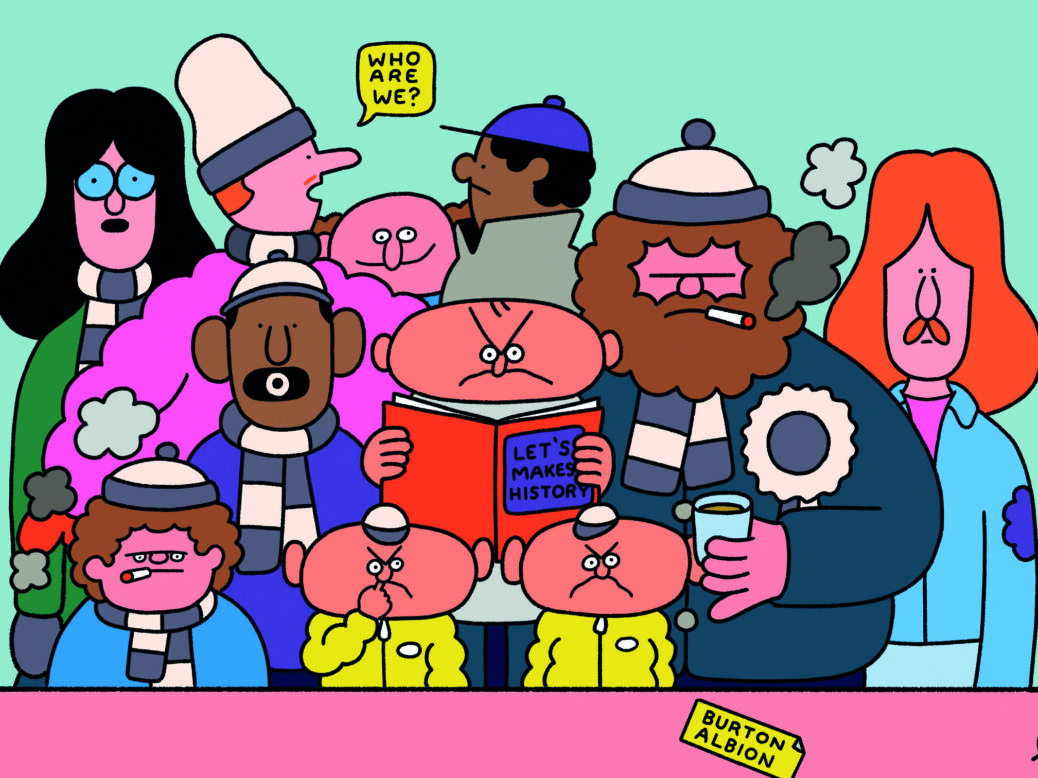
A friend of a friend, a Hampshire lad, once laid out his weekly pub schedule. An inversion of current dieting fashion, it fell into a five-days- on, two-days-off pattern. Thursday, work drinks; Friday, “Friday, innit”; Saturday, matchday; Sunday, quiet one, roast; Monday, darts; Tuesday and Wednesday, off. I was struck by the discipline, the punctuation, the unbreakable reasoning of each day “on”. It is by a version of this timetable that the internal migratory flows of British masculinity are governed. To the pub and from the pub, propelled by family, friends and sporting tradition.
In no case is this truer than matchday. It may as well replace Saturday as a new day of the week: Matchday. And Borehamwood, home of Boreham Wood FC (the football team name survived the space-saving merger) is no exception. We’re up in very south-east Hertfordshire, very north-west London, very Metroland, even if the 1930s poster-villas are now divided into upstairs and downstairs flats. Neither city nor country, this is an exemplary English town.
We were walking down the most normal high street in Britain when something special started to happen. There were takeaways, Union Jacks left over from King Charles’s coronation and now rehoisted, and a Turkish barbershop next to a Turkish restaurant (apparently in partnership, with glass panelling connecting them together). Then the chanting began, from further down the street. I couldn’t hear the words, but the sound was clear. I followed the other men towards it.
This wasn’t just any Matchday. Non-league Boreham Wood FC were facing League One Burton Albion FC in the FA Cup third round. The Wood had already eased past League Two Crawley Town and Newport County with two 3-0 victories. And every football fan knows that, in the cold first weeks of January, with thousands of fans beating their hands for warmth and the magic of the Cup in the air, perhaps, this time, maybe…? At the very least, Boreham might overcome a runtish, formless side who sit in the League One relegation zone.

At the Pick and Shovel, the Wood supporters’ pub, almost everyone was there for the football. (There were a couple of permanent fixtures who’d gone there to read the newspaper; I saw the headline “Menace of drivers high on hippy crack”.) It was a masculine crowd. I could see one woman who didn’t work there – one woman who wasn’t being paid to be there that is. But home and away fans crossed paths without conflict, even if some wanker had put a Burton sticker in the gents’, a garish production of five piggish fans holding a St George’s Cross and a flare.
Spirits were high, though. And only higher when the pub TVs confirmed that non-league Macclesfield had defeated the cup-holders, Crystal Palace, in a victory being called the “most seismic” in FA Cup history. “Who are we?” the question went out, not for the last time. “Wood army!” It was almost 3pm. The pub cleared.
Every fan also knows that plastic fans – football tourists – are the lowest scum to walk the Earth. I was obviously supporting the Wood, the underdogs. So, in lieu of any local connection, attachment or knowledge, I approached turnstile nine with what I thought was an air of habituation, casually worn. But then the stewardess’s scanner made a bad-sounding beep. The gate was still. She looked at me levelly: “You bought a home ticket by mistake?”
“No…?” I looked back, somewhat less levelly.
“You Boreham Wood fan?”
Catastrophe clarified. I had tried to enter from the away end. I glanced backwards, expecting to see the narrowed eyes of the Boreham firm, their drawn daggers. “This is all a mistake,” I readied to protest, hands raised. “Cut me, and I bleed Wood.” Blessedly, there was no one there to witness this humiliation. The stewardess, her kind heart outweighing her suspicions, described an efficient route to the north entrance.
Boreham Wood’s ground, Meadow Park, is squat and corrugated. There are two seated stands, but I made straight for the terraces in the North Bank. I’d never stood up at a match before, and so the very act carried a whiff of English football’s doldrums, of National Front tatts and European bans. England is not completely free of that temper: the modern far right is substantially a mutation of organised hooliganism.
But football attendance, across all leagues, has risen from its 1980s nadir to a peak not seen since the 1950s, with much of the growth driven by lower- and non-league sides like Boreham and Burton. And while the beers flowed and the air was ciggy, there was no sense of threat. “New year, new me,” boasted one lad to his mates as he tore into a pack of Polo mints. “No drugs!”
The main currents in modern football – I’ll keep this brief – are philosophical and mathematical. These days the manager is a highly strung auteur, as capable of defining tactical eras (Man City’s Pep Guardiola) as he is liable to flounce out of institutions that reject his “system” (Man U’s Ruben Amorim). And he makes great use of stats like “ground covered”, pass percentage and xG (expected goals) to Moneyball his way to success: see Brentford FC’s rise, in just five years, from Championship to Champions League hopefuls. This integration of sports and maths is potentially socially revolutionary – the jock laying down with the nerd, and healing the playground schism between U15 nobody and First XI superstar.
This remains a revolution from above, though, and little philosophy could be discerned on the grass of Meadow Park. This is what happened. For the first 20 minutes, Boreham looked good. Switching from flank to flank with searching passes, they besieged Burton’s area. Revelling in space he shouldn’t have been given, Abdul Abdulmalik repeatedly probed the left wing. One forward attempted an overhead kick. In fact, the team looked so decent, I started to think about what happens to these guys when they retire at, say, 34. Go from dancing before thousands to a desk job? Become a Pick and Shovel regular with just the memories – the floodlights, “that” goal and the high street nightclub VIP lounge?
But Boreham could not translate the pressure they were exerting into goals. After the first half-hour, the visitors began to show their class, quality and – that most elusive footballing quality – “desire”. Splitting Boreham’s defence with an inch-perfect through-ball, Kain Adom unleashed Kyran Lofthouse, who struck home, clinically. Several children air-wanked at the scorer from the barrier. But Burton were undeterred. They bundled three more past the butter-fingered Ted Curd, and soon I was left spotting typos in the match programme (“Let’s makes History,” Boreham’s manager had written to the supporters). By the fifth goal, the terraces were emptying. Yellow flares ignited at the Boreham end. My feet were cold.
Why put yourself through this? Why would anyone? As we stamped through the car park back to the Pick and Shovel, several Burton fans were getting into their cars. So: they’d driven down here (two hours), to not drink, and then to drive back. As for the Wood, few supporters managed more than a consolatory pint before heading home.
But it is by such rituals of victory and defeat that people measure their lives. As JB Priestley wrote almost a century ago in The Good Companions, watching football can leave you “elated, downcast, bitter, triumphant… watching a ball shape Iliads and Odysseys for you…” All epics have multiple episodes; football is theoretically eternal. After an hour or two, one old boy in Boreham Wood clobber was dancing to Chic’s “Good Times” on the Pick and Shovel carpet. I checked above the toilets, and that Burton sticker had been scrunched into a urinal. The Wood’s next match is on Saturday 17 January. They’ll all be back.
[Further reading: London may be safer – but it is suffering “chaos creep”]
Content from our partners

Related


This article appears in the 14 Jan 2026 issue of the New Statesman, Battle for power
Join the debate
Subscribe here to comment