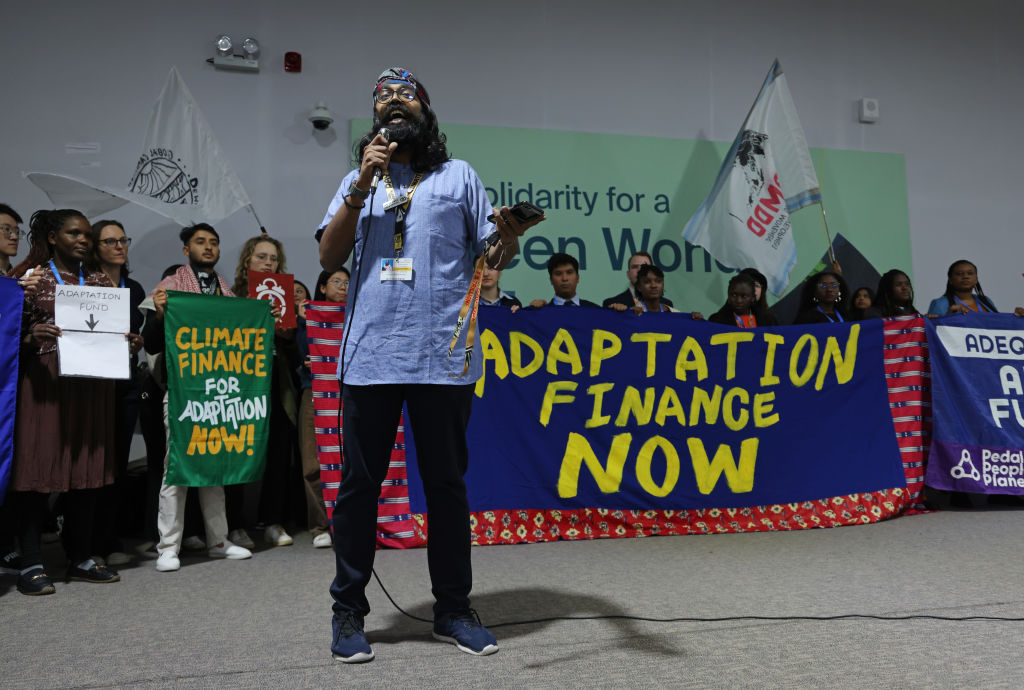
Ahead of the Conference of Parties (COP) negotiations in Belém, Brazil, André Aranha Corrêa do Lago, COP30 president designate, issued a letter asking parties in attendance to consider adaption to climate change as “the next step in human evolution”.
He went on to say evolution is brought about by cooperation and that inequality has a “corrosive” effect on our ability to work together. The letter especially highlighted the impact of the climate crisis on poverty. “Without adaptation, climate change becomes a poverty multiplier, dismantling livelihoods, displacing workers and deepening hunger. As impacts intensify, failure to act is not technical negligence; it is a political choice about who lives and who dies,” he wrote.
It was a bold statement ahead of an event branded as the “implementation COP”. It comes against a backdrop of a growing crisis in international cooperation, as developed nations are reducing their overseas development assistance (ODA) and there are continued challenges in getting private sector investment in adaptation on a similar footing to mitigation.
Global funding and investment in mitigation is at around $1.7trn, compared to adaptation, which comprised a mere $65bn in 2023 against an estimated need of between $187bn and $359bn.

Under the leadership of the UK, 2021’s COP26 produced an agreement that adaptation funding should be double what it was in 2019 by 2025. This has been on course to be achieved, according to the most recent data, which is from 2022. Going into COP30, the group of “Less Developed Countries” is asking for a new target of tripling of adaptation funding by 2030.
Agreeing a new target could also rebuild trust in global climate diplomacy. Last year, the Small Island States group walked out of the negotiations, accusing other parties of practising “petty geopolitics”. Whether negotiators in Belém can agree this, or a more ambitious agreement, is the question and the signals are mixed.
The adaptation funding commitments of 14 countries are coming up for renewal, explains Natalie Unterstell, the founder of Talanoa, a climate-policy think tank. So far, only Denmark has confirmed their support. “We are seeing that most probably from next year onwards there will be a cliff, so we will see like a drop in the resources for adaptation,” Unterstell says. This means that while the political importance of adaptation is growing, the public financing for it is at risk of collapse.
“The current round of NDCs [nationally determined contributions] is highlighting that they’re not they’re not good enough to get us on a 1.5°C trajectory,” says Joe Thwaites, senior advocate, international climate finance at the National Resources Defence Council. “Even if we were incredibly successful at reducing emissions, even if we slash them overnight, there would still be climate impacts that we’re dealing with,” he says.
Those impacts are already hitting the global economy. The International Chamber of Commerce published a report last year estimating the cost of “climate-related extreme weather events” at $2trn over the last decade. The majority of those impacts are on the poorest and most vulnerable and mostly, but not exclusively, in the Global South. “The bitter irony of climate is obviously that those countries have contributed the least to the climate crisis, they’re disproportionately affected, so they are in particular need of support to prepare for and minimise the effects of climate change,” says Thwaites.
But even in the UK, climate adaptation efforts are a long way behind what is needed, according to the Climate Change Committee (CCC). The body’s most recent report on adaptation found UK government policies and plans were “good” in just three of 36 areas outcomes they looked at. None of the delivery and implementation was rated good. The CCC highlighted that the 18 months from October 2022 to March 2024 were the wettest on record for England, submerging enough farmland to make it the second worst arable harvest since modern records began.
Despite the growing domestic impact of climate change, the UK joined the US, France, Germany and Canada in cutting its funding for overseas aid, one of the main sources of adaptation funding that will all have a significant impact on adaptation funding.
This is despite the intention that climate finance should be “new and additional”. “Under Biden, the US was scaling up climate finance quite significantly and that actually helped put pressure other countries,” says Thwaites. “And indeed, other countries were pressuring the US. And so you had that, you had that positive momentum. Now the risk is that it’s going the other way.”
The OECD estimates that overseas aid in 2025 will fall by between 9 and 17 per cent, following on from a 9 per cent cut in 2024. There is still nuance in that trend. The US has been heavily criticised for the scale of its aid cuts, severing any project irrespective of impact. By contrast, the UK has pledged to ring-fence its climate finance contribution of £11.6bn, half committed to adaptation, as have other European countries.
Thwaites argues that adaptation funding is a “strategic investment” in global economic stability, which gets at the root causes of global challenges ranging from inflation and supply chain crises to conflict and forced migration. “All of these things climate has fingerprints on,” he says.
The most visible and accountable adaptation funding comes from governments, but private sector investment is a critical component, according to Thwaites. “One of the big challenges actually, is that the private sector talks a different language, that there is probably more private adaptation investment going on than we’re actually able to track,” he says.
For example, if a business invests in supply chain resilience, then it is investing in adaptation. Even something such as a farmer choosing to plant crops that are more robust to changing weather patterns would be adaptation. Thwaites believes this is the case to make to businesses: to invest in their supply chains, ensuring their buildings and infrastructure are resilient.
“In the past year, I would say there’s been a lot going on and we see the private sector really talking about how to fix the return on investment, how to actually take advantage of this opportunity of building goods and services for adaptation,” says Unterstall. However, she explains, the private sector needs clear signals from governments and from COP, in order to progress their action.
She also believes there is a clear business case. “We don’t know the interest rates for 2035, we don’t know what the GDP growth rate’s going to be, but we know we’re going to be warmer, we know we’re going to have adaptation needs in this next ten years,” she says. But there are limits to what the private sector can do, adds Unterstall, and the majority of adaptation will have to be funded and delivered by governments.
Thwaites agrees: “The more challenging thing is to try and make the case for how and why private entities should invest in in adaptation for other people.” This would be where the benefits of investing would mostly accrue to the public.
Both Unterstall and Thwaites acknowledge the UK has an important leadership role to play. “I think it would be helpful if the government can affirm that it will safeguard climate finance beyond 2026 and indeed make a new commitment,” Thwaites says. This would give a level of certainty to recipients of adaptation funding that would allow them to plan projects.
“It was the UK that promoted the doubling pledge and we would really welcome leadership from the UK – would welcome it at this moment,” says Unterstall. “So far they haven’t renewed their commitment for adaptation finance, and it would be really, really critical if they could do so by or before Belém,” she added.
Heading into COP30, there is a great deal of uncertainty around adaptation and whether the system can cope with the exit of the US – and if negotiators can agree the proposed tripling of adaptation funding while donor countries withdraw from their aid commitments.
There are, however, some reasons for optimism. “I think the multilateral development banks have been scaling up quite a lot,” says Thwaites, “even if some developed countries are cutting back their funding, other parts of the climate finance system have actually been stepping up in big ways, and that may offset some of those cuts at least.”
Content from our partners

Related