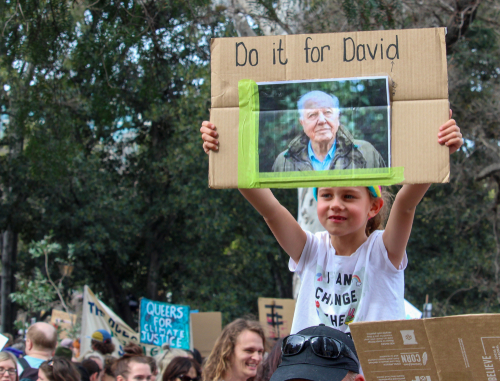
Sir David Attenborough turns 100 today. He has done more than anyone to show us the vast expanses and unimaginable depths of our oceans. From spider crabs living below two metres of Antarctic ice to the jelly-like snailfish existing in total darkness seven miles deep, advances in filming have taken us places that previous generations could not have dreamt of. And all from the comfort of our sofas.
But the last century has also seen the plundering and poisoning of our oceans on an unprecedented scale. Attenborough is one of the last humans alive to have witnessed the transition from sail- and steam-powered trawlers to diesel engines and vast supertrawlers. This transformation from coastal gamble to global industry enabled fish to be harvested faster than they could reproduce. It led to rampant overfishing and the near collapse of species such as the humpback whale, Atlantic cod and bluefin tuna.
Microplastics were first observed by scientists in the Sargasso Sea in the 1970s. Since then Greenpeace has documented plastics in the furthest reaches of our oceans, contributing research that helps us understand that these tiny fragments of plastic waste are both omnipresent and deeply harmful to wildlife. The last few years have seen our oceans heating and acidifying at terrifying speeds.
Attenborough has responded to these changes by shifting from a traditional broadcaster to something of a campaigner in the last few years. Blue Planet II generated a global outpouring of concern about plastic waste, leading several countries to introduce curbs on single-use plastics. It electrified Greenpeace’s campaign to ban microbeads and paved the way for our later victories on banning waste exports to poorer countries and cutting plastic production. Last year, Attenborough’s feature-length documentary Ocean included gut-churning footage of bottom trawlers ploughing up the seabed off the coast of Plymouth. In it he joins our call for ‘no-take zones’ and for a ban on the practice of bottom trawling.

Despite his increasingly direct tone, and no shortage of scientific warnings, governments have been extraordinarily slow to act. The UK cut the ribbon on a series of ‘marine protected areas’ (MPAs) around the British Isles, but they remain little more than ‘paper parks’ or lines on a map. Last year, Greenpeace revealed that supertrawlers spend, on average, 7,380 hours fishing in British MPAs every year.
But this is not a tale of relentless decline and the last century has also seen some glimmers of hope. Huge progress has been mande in tackling illegal fishing and the creation of marine sanctuaries, from Antarctica to our own Lundy Island. We now have an international ban on commercial whaling. Governments are negotiating a stronger Global Plastics Treaty. The recovery of species like bluefin tuna and humpback whales shows how quickly wildlife can rebound when given half a chance.
One of the biggest achievements came this year when the Global Ocean Treaty became international law. This landmark agreement provides the tools for governments to ban destructive activities in vast areas of the ocean beyond their national waters. This could be a game changer in reaching the target to protect 30 per cent of the world’s oceans for wildlife – allowing them to recover from the ravages of the last century.
Sir David has gone from boyish broadcaster to global ambassador for nature. His birthday provides an opportunity for all governments to honour his legacy: not just with warm words and commemorative stamps, but with real action. The UK in particular should use the Global Ocean Treaty to start protecting areas of international waters, such as through a network of marine sanctuaries in the Atlantic Ocean. It should ensure our own MPAs are protected, and get on with implementing a full ban on bottom trawling.
We are a collection of small islands on the edge of the Atlantic Ocean which supports an abundance of precious wildlife: from majestic humpback whales to the tiny glass eels that wriggle thousands of miles from the Sargasso Sea to our shores. If Attenborough’s extraordinary career has taught us anything, it’s that wildlife is more surprising and important to us than we ever could have guessed. Let’s ensure his life’s work has not been in vain by protecting our blue planet and all of the spectacular life within it.
Content from our partners



Related