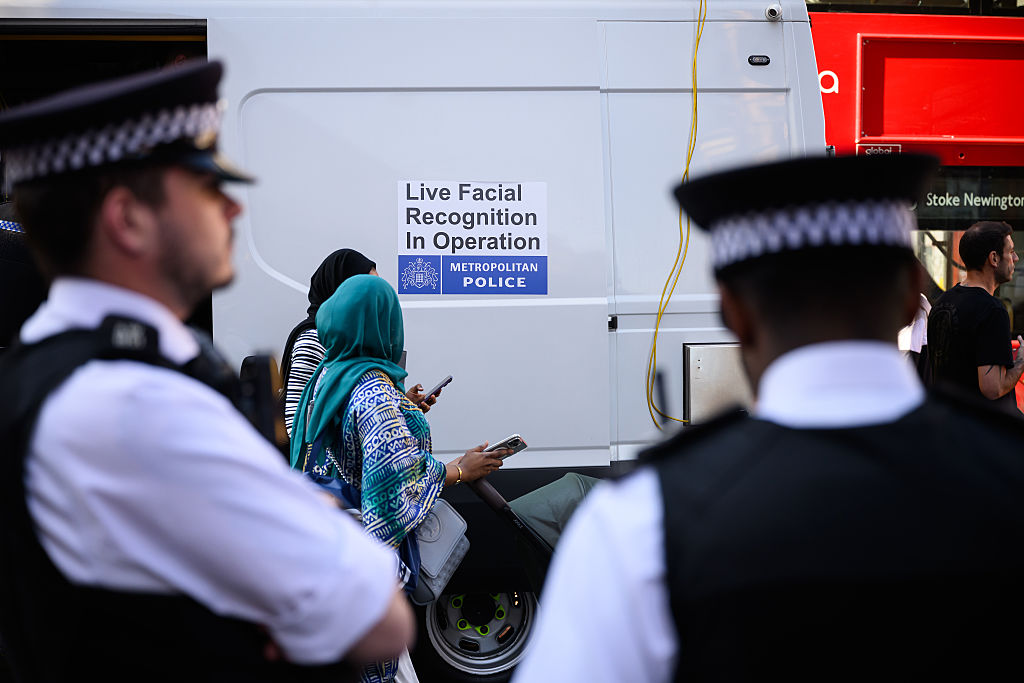
In April, the Home Office announced £115m of new funding to create the “Police.AI” centre. Its aim is to introduce a “rapid and responsible” rollout of AI tools across all 43 forces in England and Wales. The National Police Chief Council (NPCC) claims it will establish UK policing as “a global leader in applied, responsible AI”.
Currently, each police force in the UK largely determines for itself how and when to procure, trial and deploy AI tools, leading to a lack of standardisation and inefficient, costlier procurement practices. This has inevitably led to concerns being raised regarding policy, ethics and accountability – and nowhere has the debate been more pointed than around the use of Live Facial Recognition (LFR).
This is because LFR is already being used at scale. More than 25,000 “retrospective” facial recognition (RFR) searches are carried out per month, with images from CCTV, mobile phones, dashcams, video doorbells and social media compared against a police national database of custody mugshots. In London, between January 2024 and September 2025, over 1,300 suspects were arrested with the help of live facial recognition technology (FRT).
In February, the government concluded a consultation on legislation to govern the use of the technology by police. The Home Office signalled its intentions plainly: “The consultation will pave the way for new laws so all police forces can use this new technology with greater confidence and more often.”
Up to this point, police advocates have stressed that the patchwork of checks and balances in place, such as the AI covenant in policing, and the Surveillance Camera Code of Practice, are sufficient for regulating the use of LFR. Critics counter that the public are being asked to rely on police assurances in what remains a legal grey area. Questions are also being raised about the reliability of platforms currently in use.

Mike Neville, an ex-detective at the Metropolitan police, believes officers are becoming led by technology, rather than doing good old fashioned police work the public expects. The belief within the force is that they can both enhance standards and save on manpower. “The public is being failed by that arrogance,” he says.
A decade ago, Neville founded the world’s first ‘Super Recognisers’ policing unit, staffed by officers from across the Met gifted with extraordinary facial recall abilities. The team spend their days cross-referencing grainy CCTV across London against mugshots accumulated from prior arrests, searching, by eye alone, for a match.
These police officers still exist, but Neville says their role has been stymied by AI – and not to policing’s benefit. Through a FOI request seen by Spotlight, Neville found that between April 2024 and March 2025, the Met received 17,760 unidentified images of suspects in their database. Of those, 10,431 were identified. Of those 10,431, 2,126 were completed by facial recognition software. The remaining 80 per cent were still identified by humans. “So why are they pouring money into technology and not into staff?” he asks.
Lindsey Chiswick, the Met’s lead for facial recognition, is confident their use of technology is “lawful and follows the policy which is published online.”
Chiswick insists that public can be assured that the technology is deployed using “rigorous safeguards”. “Our use of [live facial technology] is subject to strict controls, independent oversight and transparent governance, with robust protections in place to safeguard people’s rights and privacy,” she said in a statement to Spotlight.
But there are a growing number of cases that call into question the tech’s reliability. Alvi Choudhury, a 26-year-old, was arrested at his Southampton home after Thames Valley Police’s facial recognition software matched him to CCTV footage of a burglary 100 miles away in Milton Keynes.
Choudhury, who said he has never visited the city, was left confused by the arrest, after CCTV footage misidentified him with another person of South Asian heritage.
Thames Valley, Neville points out, has around 40 trained super recognisers on its books. None of them, he says, were consulted prior to making the arrest. “I still train them,” he says. “So why weren’t they being used?”
The answer, Neville says, lies in institutional laziness and an unwillingness to question technology. The Surveillance Camera Code of Practice notes any use of facial recognition requires “human intervention” before any decisions are taken that affects an individual. But any officer, he argues, can be put through basic ‘decision-making’ to sign off a facial recognition match.
The Police.AI centre, which will oversee how these tools are developed and deployed nationally, may help raise standards. However, there remains a lack of clarity over what it’s structure and leadership will look like.
“The worst appointment would be someone who is purely an AI expert,” Neville says. “You need an operational detective who knows that the aim is to catch criminals.
“People think facial recognition is like something out of Batman – that the machine is infallible. It isn’t. The machine will tell you what it thinks, and sometimes it will tell you what you want to hear.”
Dr Daragh Murray, a researcher at Queen Mary University London, evaluated the technology’s accuracy at six of the 10 police trials conducted by the Metropolitan Police. He found that, of 42 matches, only eight people were correctly identified – an error rate of 81 per cent. And of those eight, four individuals were never apprehended – a match therefore could not be verified.
In the absence of legislation, the police effectively set their own standards. “What it ends up with,” he says, “is essentially a situation where the police are testing AI tools on the public. That can’t be right.”
Without a unifying legal framework, he contends, Police.AI’s promised safeguards amount to self-regulation. “If you’re cynical,” he says, “you could say the police are taking advantage of delays in the court system to roll out technologies before the courts can catch up.”
According to the NPCC, properly harnessing AI will see the technology complete six million hours of work a year, the equivalent of freeing up 3,000 officers. But how great are the benefits if you can’t trust the automated outputs without extensive human intervention? A single LFR deployment, Murray points out, ties up around 15 officers alone. “Whether that in itself offers an efficiency saving,” he says, “is totally up for debate.”
William Webster, the UK’s biometrics and surveillance camera commissioner, is not inherently opposed to using AI in policing. However, facial recognition technology will require extensive policing of its own. “What we need is an acceptance that [misidentification] is going to happen, and a system for how we deal with it,” he says. “That is why we need very clear protocols in how it’s used.”
Webster fears The Crime and Policing Bill – supposed to include facial recognition governance – will not contain the detail it needs. Most focus on the bill has surrounded the abolition of police and crime commissioners and the consolidation of forces. “My worry,” he said, “is that the bits about meaningful oversight of technology, meaningful regulation of biometrics, will get watered down.”
The previous government had moved to abolish Webster’s office entirely. And, for now, he has no control over facial recognition’s deployment or governance. The surveillance camera code of practice, on which he advises, is owned not by him but by the Home Secretary. And while forces currently operate their own live facial recognition cameras, much of the wider surveillance network, from council CCTV to transport systems, sits outside their direct control.
“The police may not own the cameras”, Webster suggests, “but they own the consequences.”
In some cases, policing has already shown it can respond to flaws in the technology. Essex Police recently paused its use of live facial recognition after identifying issues with the algorithm, a move Webster describes as “good practice”. “They found there was a problem, and they went back and looked into it,” he says.
But the system cannot entirely rely on self-governance. Even a new framework is no guarantee of ensuring better standards. The risk, Webster argues, is that if the rules are written too narrowly around policing, they will miss the reality of how the technology is used.
“We need to avoid a two-tier scenario in which police systems are held to high evidential standards while footage from other sources, including retailers, is not.” Without that, he warns, the system risks collapsing into “a really complicated mess.”
For now, the government is pressing ahead with the rollout of facial recognition and other AI tools across policing. But the legal and regulatory framework remains unsettled, fragmented and, in key respects, incomplete. The risk is not simply that the technology gets ahead of the law, but that it becomes embedded before meaningful scrutiny catches up. By then, these tools may already have reshaped policing to an extent that is difficult to reverse.
Content from our partners


Related