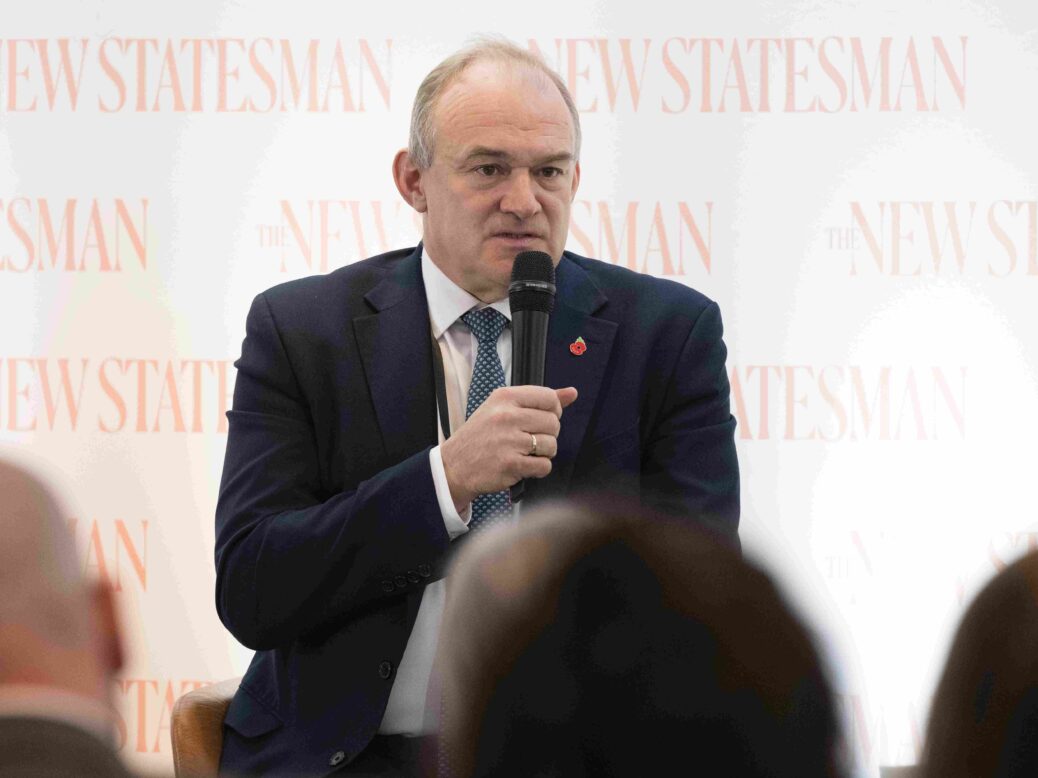
Ed Davey says that reforming care – both paid and unpaid – is not only a moral imperative but an economic necessity. For the Liberal Democrat leader, the issue is deeply personal. Having cared for his mother, grandmother and now his disabled son, Davey has long believed that Britain’s failure to value carers is one of the country’s greatest political blind spots. His recent book, Why I Care: And Why Care Matters, sets out what he calls “a manifesto for compassion and efficiency”: a vision of society that properly supports family carers and integrates social care into the heart of public health policy.
“I’ve been talking about care for most of my political life,” he acknowledged, speaking at the New Statesman’s Future of Healthcare conference in late October. “And yet, since 1997, there have been 25 reviews and select committee inquiries into social care – all saying broadly the same thing – and we still haven’t acted. That tells you something about the system.”
Davey suspects the motivations are likely financial rather than policy-based: “We’ve had so many good reports with good recommendations. But when it comes to implementation, the Treasury blocks or delays. And that’s extraordinary when you look at the numbers.”
Those numbers are stark. Each year, family and friends provide an estimated £162bn worth of unpaid care in England and Wales – close to the entire budget of the NHS. “If those carers stopped tomorrow, the system would collapse,” he said, “and yet we treat them as an afterthought.”

Davey prefers the term “family carers” to the official “unpaid carers”. “It’s about recognising what people actually do,” he explained. “And if we get social care and family care right, it’s a win-win – for the NHS, for patients, and for carers themselves.” That economic argument is central to his case. “It’s both moral and financial,” he said. “If you support carers properly – and it doesn’t have to cost a lot – you reduce hospital admissions and delays. Take discharge: the government’s own figures show that 13 per cent of NHS beds are occupied by people who don’t need to be there. A care home bed costs less than a third of a hospital bed. There’s a free lunch sitting there, and we’re not taking it.”
He offered examples from his Kingston constituency, where a local volunteer group set up a WhatsApp network for dementia carers. “It sounds tiny, but it transformed things. They could swap advice, meet for coffee, stop feeling isolated. If that support means someone can care at home for three months longer on average, think about the savings in hospital and care home costs – and the human benefit. It’s the sort of small-scale innovation we ignore at our peril.”
Davey’s wider policy prescription includes a reformed Carer’s Allowance, describing the current system as “a disaster”. “It’s the least generous benefit we have,” he said, “and it’s absurdly administered – you lose the whole thing if you earn a penny over the weekly limit. No taper, no annual calculation, just a cliff edge. That’s how we end up with the overpayment scandal: carers being told years later to repay money they never realised they weren’t entitled to.”
The Lib Dems would introduce a taper system and annual assessments instead. “It’s simple, affordable, and it would actually increase the incentive to work,” Davey added. “If we made caring compatible with employment, we’d have more people in the workforce and a more sustainable system overall. Everyone wins.”
Frustration with Westminster’s inertia runs deep. As a cabinet minister in the coalition government, Davey backed the 2014 Care Act, which legislated for the reforms proposed by Andrew Dilnot. “We thought we’d sorted it,” he admitted. “But after the 2015 election the Treasury said no, and it’s been kicked down the road ever since.” He credited Dilnot’s model with offering not only fairness but stability.
“It gives people certainty about what they might have to spend on care,” he explained. “That’s good economics. It’s like what we did with contracts for difference in renewable energy – we created stability and investment followed. People plan better when they know the parameters. That’s as true for families as it is for business.”
On the government commissioning Dame Louise Casey to lead yet another review, Davey was sceptical: “Louise is brilliant. I’m a huge fan. But there have been 25 reviews already. This one has a three-year time frame and they’re talking about implementing recommendations halfway through the next decade. That doesn’t fill me with confidence.”
The problem, he argued, is political timidity. “You can’t fix social care on the eve of an election,” he said. “We’ve seen that before with Theresa May’s ‘death tax’. If [Labour] really wants to transform the NHS, they have to back reform now.”
Davey’s book also highlights the 150,000 children providing more than 50 hours of care a week. “It’s a scandal,” he said. “These are kids who should be having a normal childhood. The system often doesn’t even know they exist – it takes two years on average to identify a young carer. That’s a failure of coordination between health, social care and education.”
He called for schools to be part of the solution: “If teachers can identify and support young carers, that’s probably the best education policy you could have. They’d do better at exams, have better life chances. Some [schools] already do this brilliantly. Others say, ‘We don’t have any young carers,’ which is nonsense.”
Beyond social care, Davey links his agenda to a broader vision for community health. “If you treat people in the community, they’re often happier and it’s more cost effective,” he said. The Lib Dem leader is especially critical of the government’s approach to GPs and pharmacies. Despite the rhetoric, GP numbers aren’t increasing fast enough. Community pharmacies have been hit hard.” The NHS’s Pharmacy First scheme was a “step in the right direction,” he said, “but it’s too limited. There are things they could do much more cheaply and effectively than GPs or hospitals.”
For Davey, the health of the NHS depends on fixing care. “Every government reaches for structural reform,” he said. “But most of those reorganisations have failed miserably. They cost money, they distract managers, and they don’t deal with the real issues. If you want real change, start with care – family care, social care, primary care. Get that right, and everything else follows.”
It’s a simple enough message, but one that, as Davey argues, successive governments have failed to hear.
Content from our partners


Related