

After the first wave of bleak English local election results for Labour, Keir Starmer admitted that his party hadn’t given voters enough “hope”. Well, there’s very little hope to be found in the changing electoral map so far for the Prime Minister, with Labour’s support being hollowed out across the board, from the Red Wall and middle England to the inner cities and suburbia.
But drill down into the wards Reform has gained from Labour and there is a hint of a strategic opportunity. At the time of writing, most of the biggest collapses in Labour’s vote have come where the Greens performed well. That is, where a split in the left vote allows Reform to win. Britain’s top polling expert, John Curtice, has noticed a “pattern” emerging whereby a “sharp fall in Labour’s performance is accompanied more often by an above average Green performance than it is by a strong Reform performance”. Put simply by the political scientist Rob Ford: “Labour are losing seats to Reform, but Labour are losing votes to the Greens”.
Of course, this is not true everywhere. There are Labour-to-Reform switchers, disillusioned Labour voters staying at home and people who otherwise wouldn’t have voted turning out for Reform. The picture is clear that Reform is replacing Labour in many of its historic heartlands. And Ford warns that Reform would win regardless of the left’s performance in the Brexit strongholds where it is now a 40-plus per cent party.
But in many places Labour needs to stay in power, the pattern holds up. Our senior data journalist, Ben Walker, who has been updating the New Statesman’s ward-by-ward map overnight, has found this trend playing out around the country, including in Runcorn and in Leigh (where Andy Burnham’s old parliamentary seat was). Runcorn is a stark example: the Green vote is much greater than Reform’s margin of victory. As Ben noted on the New Statesman’s The Politics Show podcast: “In almost all of the Runcorn proper wards that voted Reform yesterday, the Green vote is big enough that had even just two-thirds of it gone Labour, it would’ve been a Labour-won seat in the end.”

Southampton and Southend have had big Reform gains but big Green votes. And take a look at these wards in Hartlepool, Havering and Bolton – places of significant Reform gains and Labour losses:
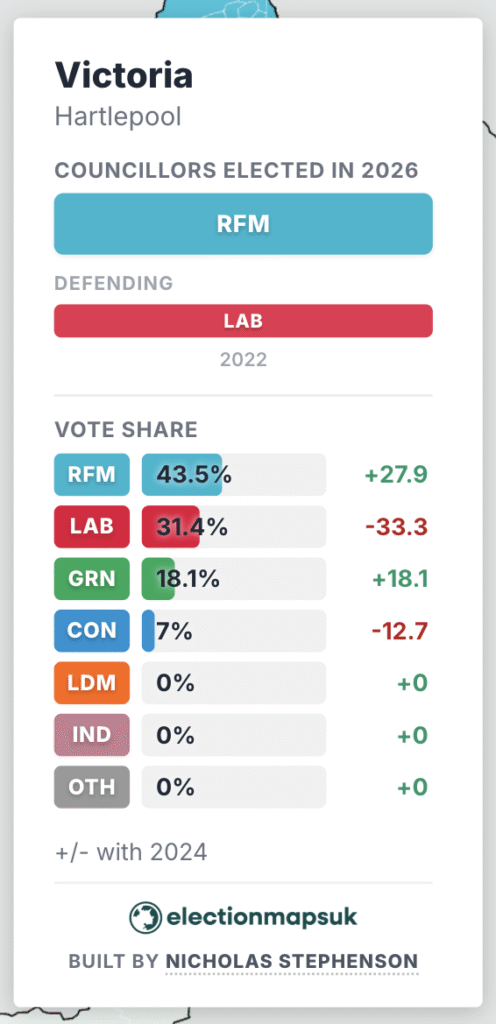
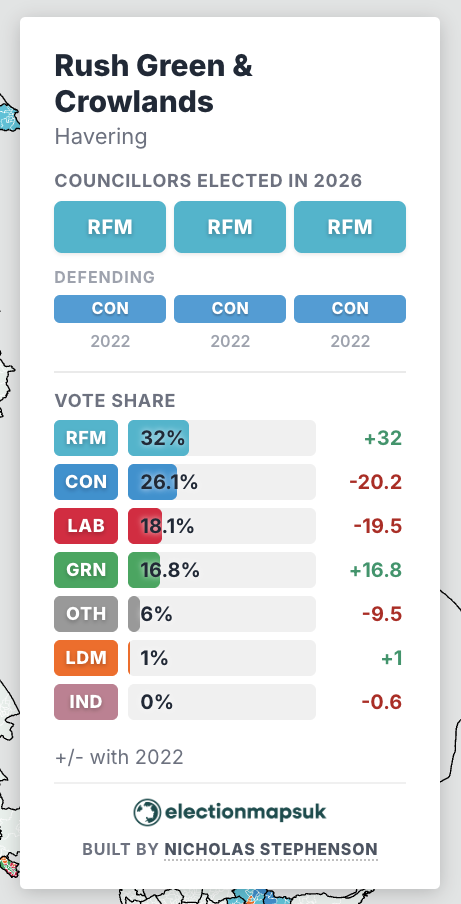
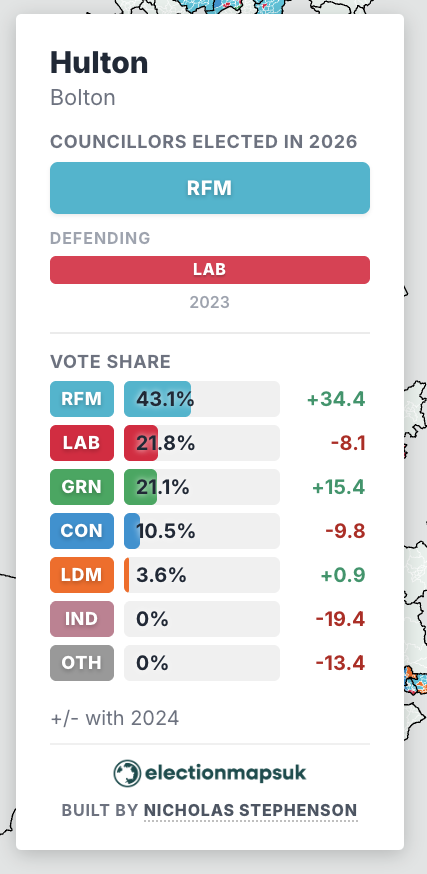
I saw this play out first-hand when out reporting on the campaign trail. For example, Labour canvassers in a deprived ward of Stevenage targeted by Reform were doing nothing but trying to squeeze the Green vote, and win over potential Labour-Green switchers. When I visited to tag along, I had expected them to be putting all their focus on the Reform-curious, but all their attack lines were against the Greens. (“They can’t win here”, “They want to pull out of Nato”). Reform ended up winning the ward.
The fear is that after the Gorton and Denton by-election result, where the Greens beat Reform in what was once a safe Labour seat, the Greens will come to be seen as the party to vote for if you want to beat Reform – when in most places, they are not. A vindication, perhaps, of the party line that voters must choose Labour to stop Reform.
The trend is already being used by progressives and figures on Labour’s soft left to argue that, despite Reform gains, the answer for Labour is not to tack to the right. The Compass campaign group suggests these results undermine the “the premise that adopting a more right-coded agenda will prove beneficial for Labour’s electoral outcomes” and mean it is Labour’s “left flank” that needs shoring up.
Others, however, are sceptical of a wholesale change in direction. Labour politicians are hearing the same frustrations from voters they are losing to both Reform and the Greens: on rising prices and rip-off bills, yes, but also on the leadership of Keir Starmer himself.
A document is making its way around Labour types today on the “respect crisis” of voters wanting more than anything for politicians to respect ordinary people, with three-quarters saying they don’t feel the government does, identified by More in Common and the UCL Policy Lab.
This may sound like a classic reaction against the political class as a whole, but it suggests Starmer is specifically failing on his own terms. When I asked a cabinet minister and close ally of the Prime Minister about his lack of vision, they responded by telling me that they rejected that analysis, and that there is a Starmerism: one of respecting the dignity of ordinary people, of “improving the lives” and “rebalancing the rights” of “working people”. Well if that was his USP, then voters clearly aren’t buying it.
As one floating voter I encountered on the campaign trail, who was trying to choose between Reform and the Greens, asked me: “I don’t think anyone likes the Prime Minister, do they?”
[Further reading: By being true to itself, Labour can win again]
Content from our partners



Related



Join the debate
Subscribe here to comment