
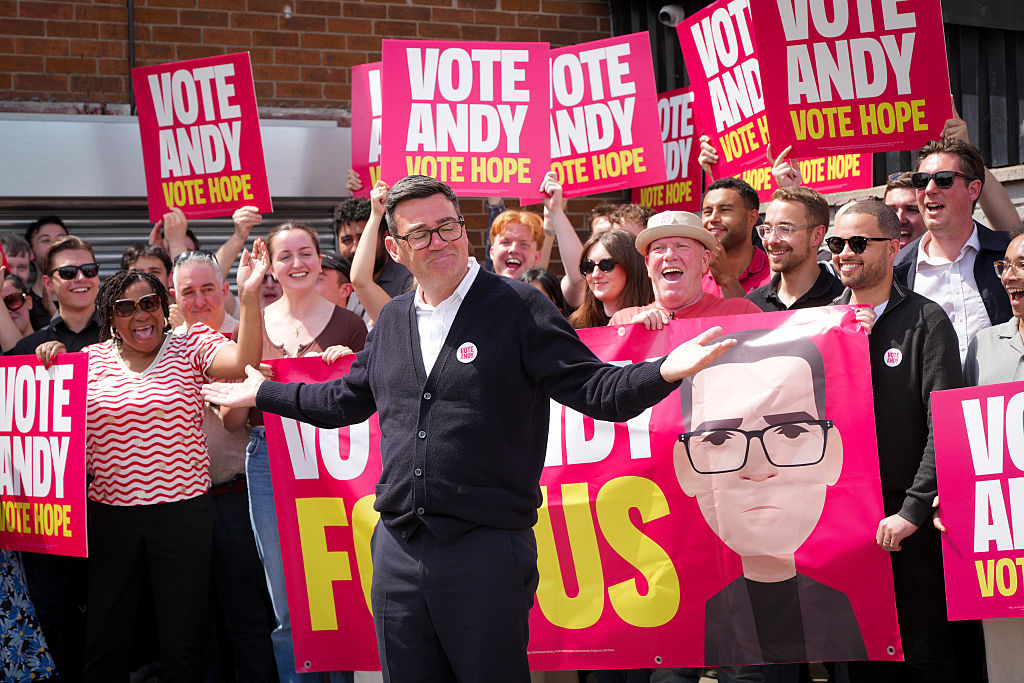
Andy Burnham has won the Makerfield by-election by a large margin. The Greater Manchester mayor won more than half the vote at 55 per cent with 24,937 votes. His nearest rival, Reform’s Robert Kenyon, got 15,696 votes (35 per cent of the vote), leaving Burnham with a majority of 9,231.
Burnham won by a bigger majority than Labour managed here in its 2024 general election landslide. In his victory speech, Burnham made his most explicit statement yet about his intentions to use his new place in the House of Commons to take the reins of power.
“This result will bring about a country that works fairly for everywhere and everybody,” he said, claiming that the people of the Makerfield constituency had “voted for hope”. He called the result “a final chance to change” for the Labour government, which is cripplingly unpopular in the polls.
Reform UK, which had hoped to humiliate Burnham and Labour, fell short of expectations. While some pre-election polls had predicted that Kenyon would only lose to Burnham because of a split on the right, Burnham’s margin of victory was much more comfortable.

Restore Britain, the party set up by ex-Reform MP Rupert Lowe as a far-right opposition to Nigel Farage, had a surprising surge here in Makerfield during the campaign after heavy digital ad spending and a strong ground game.
But the party scored just 3,111 votes or 7 per cent of the vote. That is lower as a percentage and a raw number than the total that the British National Party scored in this constituency at its high watermark at the 2010 general election. The combined vote of Reform and Restore was 42 per cent, 13 points less than Burnham.
The Conservatives, meanwhile, won under a thousand votes and lost their deposit, as they did in the Gorton and Denton by-election. While that disappointment may be tempered by the Tory victory in Thursday’s Aberdeen South by-election, it shows that Reform are now firmly the dominant right-wing force in places like Makerfield.
Burnham acknowledged that voters from the Greens, Liberal Democrats and Tories had leant their votes to him in the by-election after it became clear that the Green and the Lib Dems votes had collapsed compared to the last general election, dropping from the thousands down into the low hundreds.
The new MP for Makerfield plans to hold a rally early on Friday morning as the next stage of his political ascent begins. First he will have to resign his role as Greater Manchester mayor, triggering a swift by-election for the position which Reform will hope to do well in.
Keir Starmer and his allies, in an attempt to defer a challenge from Burnham, have said that he should focus on winning that campaign for the party rather than trying to topple the Prime Minister.
How quickly could he move against Starmer? This is now the question that will obsess Westminster. At Labour’s campaign HQ today there was a clear expectation that the challenge to Starmer is inevitable, but there was trepidation from Burnham’s allies about going too quickly. In Labour, memories pervade of Starmer’s first hundred days as Prime Minister. This period is now widely looked back on as a series of mishaps brought about by lack of planning: the winter fuel allowance cut, the Rose Garden speech dwelling on national decline and the “freebies” scandal.
There is no appetite for a free-fall government collapse triggered by a wave of ministerial resignations, as we saw at the end of Boris Johnson’s premiership. But the clear message from Burnham ultras is that the responsibility for avoiding that rests largely with Starmer, who must accept the new political reality after this result: that Burnham is electorally capable where he no longer is.
As my colleague Ailbhe Rea has reported, Burnham now has the numbers to launch a challenge – 81 Labour MPs, or 20 per cent of the parliamentary party – if he chose to, and could present evidence of this to Starmer as the beginning of negotiations for a transition of power.
[Further reading: Makerfield days]
Content from our partners


Related

Join the debate
Subscribe here to comment