
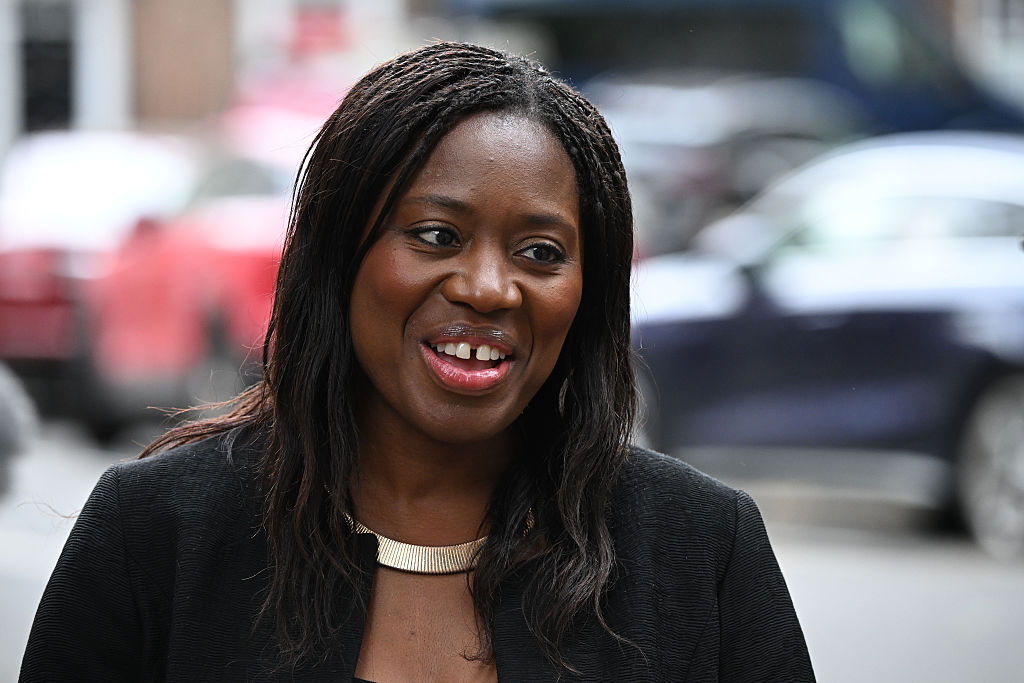
A hell of a lot has been written about “Manchesterism”, so this piece isn’t going to add to the millions of pixels devoted to the genre. Instead, it’s going to sketch out what feels like important emerging thinking in and around Burnham. This is a post about Fahnbullehism, and Miatta Fahnbulleh’s brand of radical co-operativism.
For those that don’t know Fahnbulleh, she was born in Liberia, into a highly political family. Her father was a government minister, and she told Nick Robinson recently that politics and ideas were a central topic of dinner table conversation when she was very young. The family had to flee to England in the Eighties, owing to the civil war. In her professional life, Fahnbulleh trained as an economist, spent time in and out of government, as a Ministry of Housing, Communities and Local Government (MHCLG) official in the coalition years, and eventually headed up the New Economics Foundation think-tank.
From there, she was elected as MP for Peckham in 2024, and went straight onto the frontbench. After a stint working in the Energy Department with her close ally, Ed Miliband, she moved over to the MHCLG as communities minister. Here is where I saw her in action. Our work at Power to Change centres on the department, and we’ve been closely involved in the development of the Pride in Place agenda and the English Devolution and Community Empowerment Act. Both of these policy areas were led by Fahnbulleh.
Most recently, she resigned from the government, citing a lack of confidence in Starmer to lead the country. She is now one of the key soft-left MPs around Burnham, developing and coordinating his platform for government should he soon stride into Downing Street.

As communities minister, Fahnbulleh talked a good game. I saw her speak powerfully on the importance of building growth from the bottom up. I heard her set out a vision for a much more devolved country, with power built from the community level. At the same time, I also discerned a sense of frustration. That the government machine wasn’t moving quickly enough. That the ambition of her rhetoric wasn’t matched by the policy she was able to deliver. That this sense of political mission she held, wasn’t docking into something bigger at the centre.
At the excellent UCL Policy Lab conference a couple of weeks ago, this frustration came spilling out: not in a takedown of the government, or in a drive-by on her MHCLG officials, but in a speech that went big on how she’d do things differently. So what is this vision, and what would it mean for our country, economy and politics?
Some of her diagnosis is a tale we’ve heard before. She senses, in her constituents and the country at large, an impatience for change. She argues that a lack of real change is creating space for the populist right to rise. So far, a similar analysis to many on the Labour benches.
The layers she adds in are interesting. First, owing to her time on the cohesion brief, she has been arguing in recent weeks that the sense of division and fear in the country is palpable. When pointing this out recently, Fahnbulleh has been careful to note that this fear affects all communities. This came into sharp focus after the awful scenes in Northern Ireland.
Second, her diagnosis is one that takes a different line to many of her colleagues. Fahnbulleh makes clear that the lack of change is not just a failure of government delivery. People feel buffeted by the market and state alike. That might be shuttered shops on the high street or labyrinthine public services citizens have to navigate, but it all flows from a sense that power has been stripped away from citizens. Politics that takes this disempowerment seriously, and gives people a stake, a say and a role in delivering change, is at the heart of Fahnbullehism.
Finally, Fahnbulleh has a clear-minded focus on the fact that the current economic model is not working. She talks about the need to address the cost of living and wealth inequality, and how we can get the economic model working for the majority. Interestingly, this is where her thinking might deviate further from Burnham, whose business-friendly socialism sometimes takes a less strident view on the failures of the current economic model.
So, what does Fahnbullehism posit to respond to these challenges? She speaks of “politics of hope and renewal” that “gives people power, control and a stake in the economy”, and one which makes “place” – the economy, culture, identity and relationships that shape a local area – the central organising principle for government. The focus on place is entirely in line with Burnham’s thinking. Fahnbulleh’s approach adds a different dimension to thinking going on in and around Burnham on a more central role for the state with its attention to economic democracy.
Broadly, it’s a politics that has huge ambition for the co-operative movement to which the Labour Party is tied, and which seeks to solve many of our solves problems through community-led action. It is an agenda which puts real weight behind the cooperative economy and creation of local wealth.
It sees community ownership not as a nice-to-have but as a central tool of economic development. Community ownership means local people collectively owning and governing assets in their area, for the benefit of the community. For Fahnbulleh, it’s more than the community taking ownership of their local pub or community centre to save it from closure. It is a powerful third way between state and the market, one that gives people and places that have been left behind the economic power to control their own futures. As someone who has spent years working alongside communities using enterprise to solve challenges where the state and market have failed, like town centre decline and labour market exclusion, I was struck by this bit of her agenda.
In her remarks at UCL East, Fahnbulleh spoke about the Pride in Place programme – a £5.8bn programme investing £20m in almost 300 neighbourhoods across the country and giving citizens a real say in how this money is spent. The programme currently touches just 5 per cent of the country, albeit our most deprived neighbourhoods. She called for us to up our ambition, when it comes to breadth and scale and apply these principles in every community. This would mean focusing power and policy at the hyper-local level, using government investment to seed community-led activity, and the state stepping back over time.
Flowing from this, she also put forward a radical view of what local government might become. She argues that the core purpose of the local state should be to build and support a rich and empowered network of organisations and independent local leaders rooted in their community. This would require a fundamental reshaping of the skills and capabilities needed to work as a local official, and money flowing very differently through the system too. In practice, this could mean national spend flowing directly into assets for communities, outcomes-based rather than departmental budgets in local government, and local spending over longer timeframes, decoupled from the electoral cycle. These changes wouldn’t come without a fight with the Treasury.
This responds to a deeper malaise that political parties everywhere are experiencing, and to which Labour is not immune. As Peter Mair has argued, politics has become disconnected from a social base. For Labour, this has taken hold over decades due to deindustrialisation, declining membership of trade unions, weaker voter attachment and rising technocracy. Starmer has felt this acutely, as his seemingly broad popularity has ebbed away at a rate of knots. These trends aren’t going to be reversed overnight, but Fahnbulleh would argue that her brand of radical cooperativism would be the place to start.
In many ways, Fahnbullehism isn’t anything radically novel. It looks back to the spirit that formed the cooperative movement, and ideas which shaped some of the most fundamental achievements of previous Labour governments. Let’s not forget that it was the people who formed the Tredegar Medical Aid Society who developed the model for the NHS.
Where this thinking does feel contemporary, however, is how it responds to the challenges we face today. At a time when democracy feels buffeted from all sides, and trust in politics and politicians is at an all time low, it urges the state to take a different path. Not to think it can fix everything through “delivery”, but instead to put trust and power in the hands of people and communities to drive change themselves. Should Burnham become prime minister, he will need to make real the picture he has tried to paint – returning power to the people of Makerfield and the North – as he has campaigned. Fahnbulleh is likely to be influential as her agenda aims to do just that.
[Further reading: Labour has no right to win in Makerfield]
Content from our partners



Related
Join the debate
Subscribe here to comment