
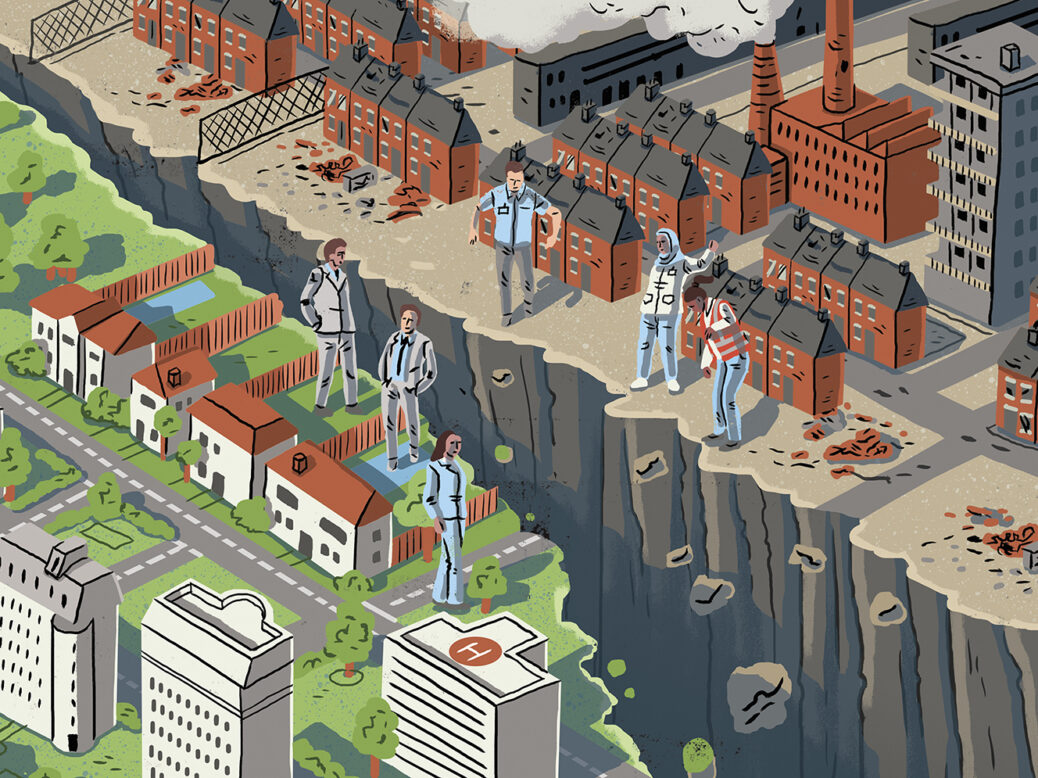
It was Nick Clegg’s Liberal Democrats who first coined the Armando Iannucci-esque phrase “Alarm Clock Heroes”. Reminiscent of the “Quiet Bat People” the political satirist has his hapless fictional shadow cabinet brainstorming in The Thick of It, “Alarm Clock Heroes” and “Alarm Clock Britain” were phrases the former deputy prime minister used to try and signal that his party was standing up for put-upon hardworking Brits.
Fast forward 15 years, and Reform UK are the new tribunes of “Alarm Clock Britain” – or the slogan, at least. Not only does the Reform leader Nigel Farage speak up for “Alarm Clock Britain”, but he also seems happy to show contempt for those out of work. He has expressed mock-surprise that Angela Rayner even has a CV, accused Green voters in Gorton and Denton of not having jobs, and his stock response to protestors at his press conferences seems to be that they “don’t have a job” and should “go back to work”.
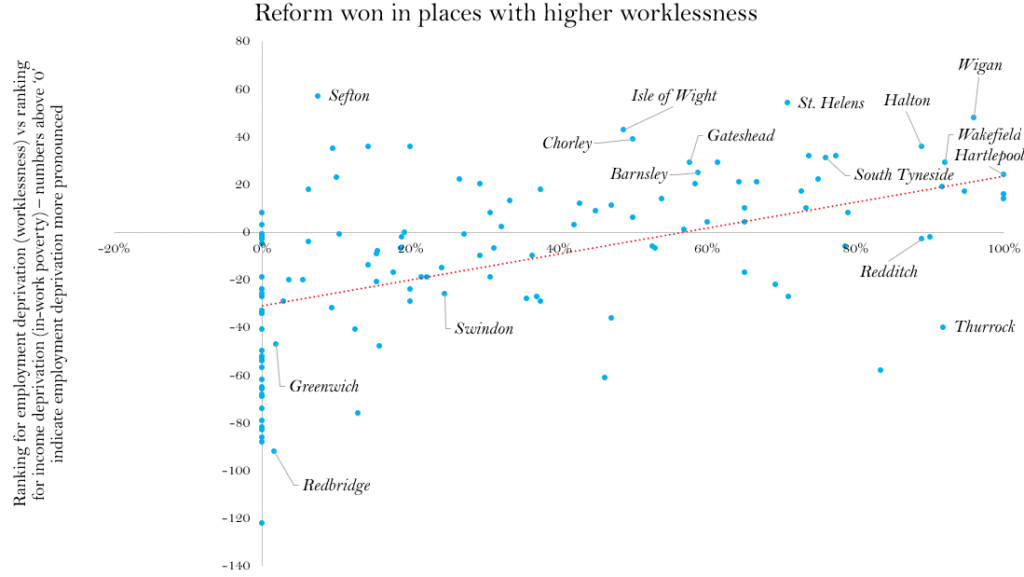
The truth is that this rhetoric bumps up against the reality that Reform is actually disproportionately popular among jobless men. Reform also outperforms in places with high levels of unemployment, according to fresh analysis of the local election results shared exclusively with the New Statesman by the political analyst Chris Clarke.
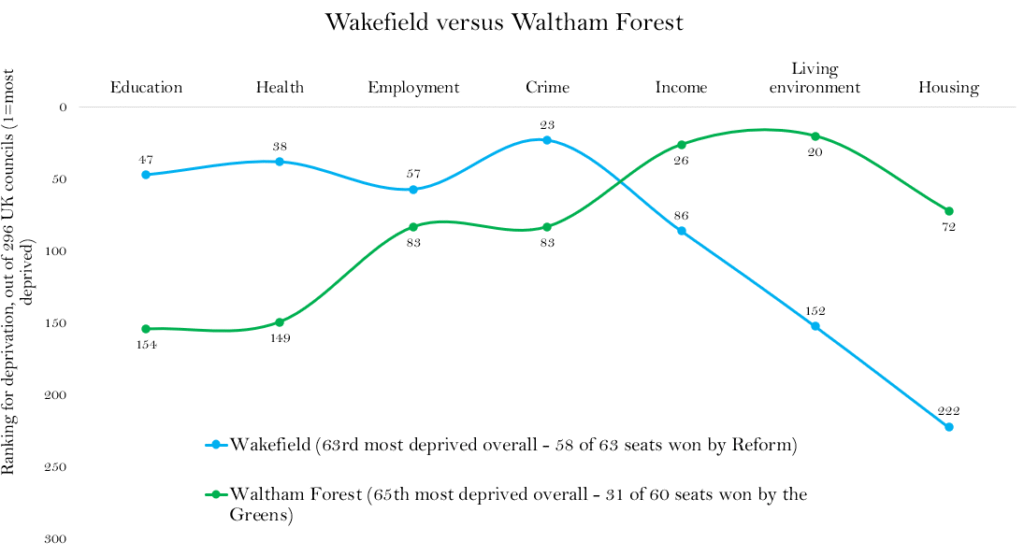
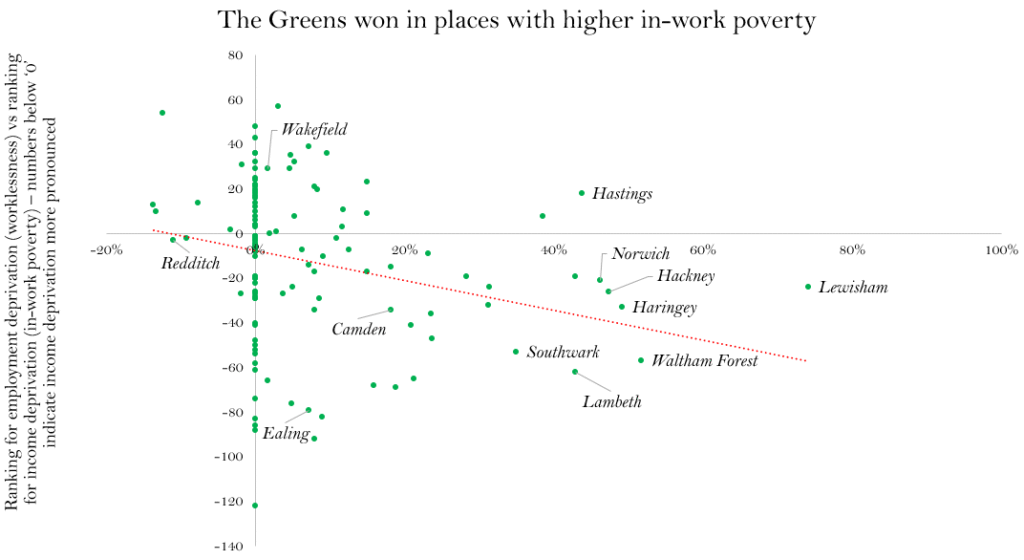
A new picture is emerging of an England as a country of “Two Deprivations”. The first, turning to Reform, is a land of health deprivation (high disability levels, lower life expectancy), educational deprivation (less skilled, poorer access to training, low school attainment) and employment deprivation (worklessness). The second, turning increasingly to the Greens, is one of living environment deprivation (fewer gardens, densely built-up, air pollution), housing deprivation (insecure, expensive and poor quality housing) and income deprivation – amounting to in-work poverty.


Data visualisation by Chris Clarke
“These are two relatively or very different ways in which poverty is experienced in Britain, both of which are challenges, and are almost quite unknown to each other in a strange way,” said Clarke, who mapped the local election results using the Indices for Multiple Deprivation. “Both inner-city, and more ‘left behind’ areas tend to see themselves as at the back of the queue, when actually regional inequality has created these two quite different forms that deprivation takes, and the government, in a respect, is torn between those two things.”
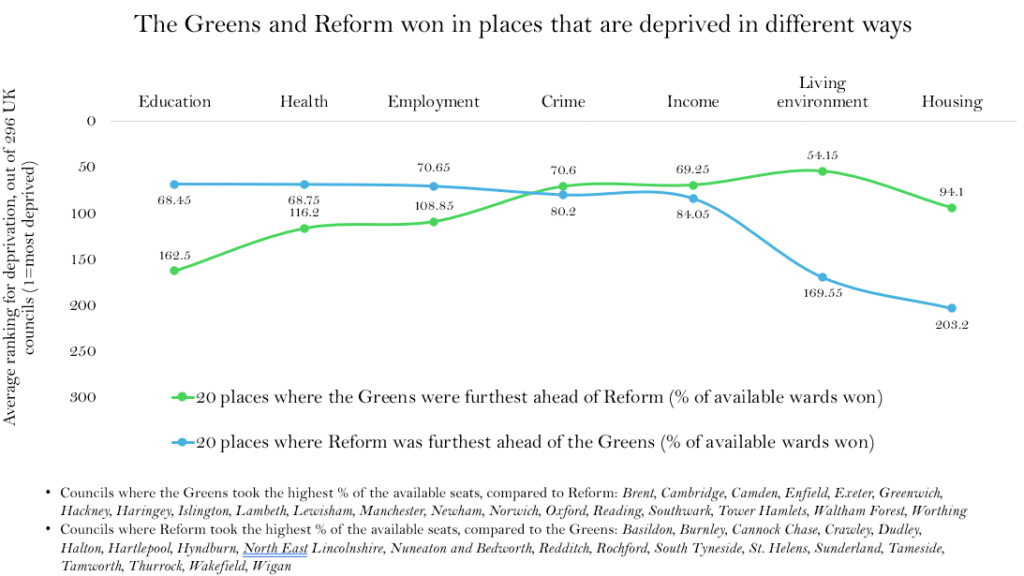
The Two Deprivations framing, which began life as a theory based on polling during the Gorton and Denton by-election, also busts political myths about the support bases of both left and right populism. “It’s a pushback against the idea both that inner-city areas are now all kind of bougie hipster areas that don’t know they’re born”, as well as the idea that Reform is simply replacing the votes of Tories who “don’t have any real problems”.
Of course, it does not necessarily follow that Farage and other Reform politicians would rile their base by sneering about jobless people. In fact, that kind of rhetoric may resonate more in places with higher unemployment and therefore capacity for resentment towards out-of-work benefit claimants.
This is in the same way that narratives about corporations and the super-rich driving inequality may resonate more in what Clarke describes as “behind the glass” places – where inequality is more visually evident (Tower Hamlets is a classic example, with deprived neighbourhoods like Poplar alongside the gleaming towers of Canary Wharf).
But Reform will eventually have to face the trends driving unemployment in their fast-forming heartlands. When I visited Clacton in Essex, Nigel Farage’s seat, it was clear the simplistic remedy of reducing immigration wasn’t going to cut it.
Set back from the seafront, on a high road among cosy-looking caffs with names like Nancy’s and Rosie’s, is a charity shop the size of a small supermarket. Its window display – beachballs, floral skirts, sunglasses – promises a sunnier season than the windy grey of the town outside.
The shop is light and spacious, with easy-to-peruse racks of retired ties, Mardi Gras masks, silver stilettos and full china tea-sets of forget-me-not blue. “Charity shop or not, we still want to be Marks and Spencer,” smiled Alison Brown, who works on the shopfloor.
The shop is run by a Citizens Advice scheme for helping people back into work; people are either referred or can simply walk in off the street to volunteer here for a year to build up their confidence and skills.
Eighty per cent of participants end up in paid or voluntary work at the end of it; a phenomenal success rate as back-to-work programmes go. Around a third of people who join have never worked, and half are long-term unemployed. They don’t only move on into retail – but bar work, care, cleaning, reception work, landscaping, construction, social media management and even tattoo artistry.
A combination of poor mental health and a limited local job market were driving economic inactivity in the town.
I met Teri, 38, who didn’t go outside for ten years after her mental health crashed. Having never previously worked, she joined the service in 2021, was finally prescribed the right medication and therapy after an ADHD diagnosis, and now works in a paid job at the shop and has even built the service an app.
Others had fallen out of the workforce and needed both a CV and self-esteem fix. “I was at a pretty low ebb, I remember walking in the first day and bursting into tears,” said Angie, who had lost her job after 28 years in childcare. She has been working at the shop since joining the service three years ago.
Clacton has some of the country’s highest economic inactivity rates. Like many English seaside towns where Reform has a presence, its work is seasonal and low-paid. “You’ve got caravan parks, tourism, care homes, not a lot else,” said Emma Funnell, who runs Citizens Advice Tendring. “You’ve also got low educational outcomes, you’ve got to leave Clacton to go on to further education.”
Locals also complain about the lack of buses, and poor connections to London – with just one hourly, and expensive, train. “This is not supportive long-term to reduce any reliance on benefits that might exist,” said Funnell. Far from the “snowflake” or “scrounger” narrative of the political right, she observed people coming onto her scheme having been through “normal stuff”. “This is life when it can hit you, and then that can lead to being out of work.”
The Two Deprivations are not created equal. All of the 20 constituencies offering the best social mobility prospects (eg. reaching a top-earning profession) for poor young people are in London, according to the LSE’s Grace Lordan. And inner-city deprivation has fallen by almost a fifth since 2010, reveals new Centre for Cities research. However, deprivation in the UK remains concentrated in cities: about two-thirds of the most-deprived neighbourhoods are in urban areas.
Politics in Britain may be shifting, but the Two Deprivations point to a deepset truth: this is, in so many ways, a poor country. Blaming citizens for this, rather than helping them through it, is unlikely to rouse Alarm Clock Britain from its slumber. As Teri, who overcame a decade of jobless isolation when she was given the chance of flexible work at the Clacton charity shop, told me: “I literally wouldn’t see the sunlight for the whole winter, just because I was asleep. Since I’ve started working I’ve had to shift my sleep pattern to be somewhat normal. It’s a huge change. Now I wake up without an alarm at all.”
[Further reading: Keir Starmer is a dishonest man]
Content from our partners



Related

Join the debate
Subscribe here to comment