
Your body melts in a house fire. Yes, typically, the smoke and toxic gases are what kills you, but if your carcass isn’t recovered then it will contort as its musculature shrinks and fat liquifies. Visceral fat, that which surrounds the organs, starts melting between 30°C and 35°C. Depending on ventilation and fuel load, a fully developed residential fire can reach 1,000˚C. At that temperature bones dehydrate, decompose and invert, before melting and fusing into a new inorganic structure. You know what this looks like, the resulting boxers’ pose, because many of Pompeii’s cast corpses will hold it forever.
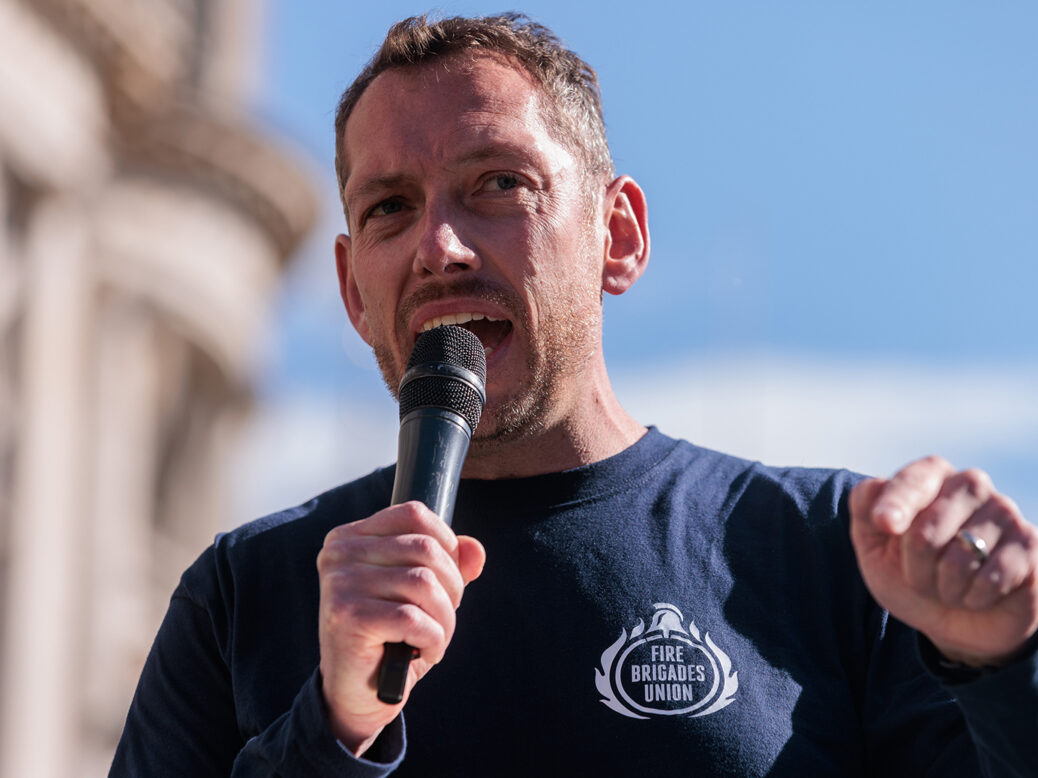
Normal people find these material facts, the physics of danger, horrifying. Others see gainful employment. Steve Wright is one of them; so was his dad, so is his son. Three generations of Wright men have engaged themselves in the art of extinction. Steve, though, as the newest leader of the Fire Brigades Union (FBU), is becoming more relaxed about starting fires.
In the boardroom of the union’s London headquarters, a century’s worth of firefighters’ helmets are displayed behind his athletic frame, alongside the union’s now-retired marching banner. A hulking piece of marble commemorates the FBU members killed in the Second World War, pointedly described in the etching as “the war against fascism.” They are proud of their history. Particularly the bit that involved fighting the far right. Wright draws my attention to a pin badge in the display cabinet, its sky blue is pierced by a red block arrow flanked by the text: “Firefighters against the Nazis.”
“There’s that level of fighting the fascists on the ground,” Wright says. “I attended the Stand Up to Racism rally on 13 September with some of our women members and some of our black and ethnic minority members. They left in tears.

“I think it was frightening that that many people turned out to [Tommy Robinson’s] Unite the Kingdom. There were far-right thugs there who just wanted to fight us. So I think there’s that level of fighting the fascists on the ground – I think it may come to that. The violence that we saw on the 13th I think will only spread, I think that’s empowered them. And I think it is the role of trade unions to take that on. I think it’s about fronting that up, like they did in the 1970s.”
The street politics of the 1970s were highly public and highly violent. As the openly racist National Front (NF) gained popularity, so too did anti-fascist organising, of which the trade unions were a key component. Seeking to intimidate and gain publicity, the NF would conduct marches through black and Asian neighbourhoods which often culminated in confrontation, most notoriously at the Battle of Lewisham in 1977.
Escorted by the police, the “rights for whites” march assembled in New Cross and headed toward Lewisham. There, however, they encountered a human roadblock several thousand people strong, made up of assorted local organisations and individuals, including trade unionists. During the ferocious street fighting that followed between the police – who intended to facilitate and support the NF while containing any counter-protest – and these groups, riot shields were used for the first time on the British mainland, and 214 people were arrested. Nonetheless, the police lines were broken, a relatively rare occurrence, and the procession itself was attacked, leading to its evacuation via “pixie van.” The events demonstrated the capacity of mass mobilisation tactics and community organising to contain the far right and marked a key turning point in the National Front’s eventual decline.
Wright, 42, speaks with the deliberate manner of someone who no longer feels the need to raise their voice: specific, confident, nearly – but not quite – gentle. He continues: “But on my train in from Reading, there were families there with their faces painted with St George’s flags, they were not racist families… Calling everyone that votes Reform racist, I don’t think they fundamentally are. I think Nigel Farage is and if you look at his policies, they certainly are.” Farage denies this in the strongest possible terms. Wright says Richard Tice has called him a “communist” and demanded his resignation.
Reform are odds-on to form the next government, and the FBU leader is preparing for that possibility. “It wasn’t me that came up with this line, but if the miners knew what to expect four years out from Margaret Thatcher coming into power, what would they have done differently? What are we going to do now to organise against Nigel Farage, someone cut from the same cloth?” He is developing a strategy that targets Reform’s approach to local government, using the meltdown at Kent County Council – where a vehement meeting went viral – as a case study. The incident led to the suspension or expulsion of multiple Kent councillors by Reform, and left the county’s fire authority unable to carry out its full functions as a result. He also points to Tice’s open attacks on public-sector pensions.
Recently, informed observers have been speculating about which trade union will be the first to endorse Reform. The FBU is often cited as a contender, and Wright knows it. “You will get people with those policies trying to infiltrate our union, into positions of power. Why wouldn’t you? That’s what we’ve done in the past. And that’s what other political wings do, isn’t it?” He says the FBU’s political school in Sheffield acts as a firewall by educating and training its reps to identify and challenge right-wing organising.
He reserves a comparable – though not equivalent – quantity of opprobrium for the Labour Party. “This policy from the new Home Secretary, I think this is probably the lowest point for Labour in its history, morally. I was disgraced when I heard it. The reason why you can’t feed your kids, why you can’t clothe your children, why your wages are being smashed – that is because of billionaires. It’s not people coming to this country on boats.”
Firefighters see the country at its worst moments. It gives them a strange clarity about what’s broken, because when things fail, they fail in minutes, not election cycles. We’re speaking before Rachel Reeves’s budget, and Wright is fresh from a call with the Chancellor and other union leaders discussing its measures. Would he consider disaffiliating the FBU from Labour? “I’m more resolved in my position of staying affiliated, because I think they probably don’t want us in the room – they’d rather not have trade unions within the Labour Party. Why would we leave? We’ve never – I’ve never – walked away from a fight before.”
His criticism of Labour isn’t universal, and he points to Keir Starmer’s engagement with the Truth About Zane campaign – which the FBU supports – calling for an independent inquiry into the death of seven-year-old Zane Gbangbola during severe flooding of the River Thames in 2014. Wright says Starmer has privately committed to opening that inquiry.
He is, however, sceptical about Rachel Reeves’s claim that there will be no return to austerity under this Labour government. Wright spends most of his time thinking about two kinds of pressure: the kind that builds inside a burning room, and the kind squeezing a public service that has been shrinking for more than a decade. “We are having to run campaigns because, actually, Labour-led fire authorities are closing fire stations in Buckinghamshire and Oxfordshire, and you’re cutting 72 firefighters in Avon.”
“That is austerity. In fact, the measures we are now facing are probably the most drastic we’ve seen in the last five years. We haven’t seen fire station closures for five years. Their only response was, ‘We will look at the funding again in 2027,’ and I was like, ‘Wow, okay.’ I think austerity has accelerated, to be honest. The funding set back in April was an uplift of 1.4 per cent, while inflation at that time was 3.8 per cent. That will mean cuts down the line.”
A century after Britain created its first professional fire brigades, and less than ten years since Grenfell, Wright believes the country has forgotten how easily fire can overwhelm unprepared systems. Modern homes burn differently: plastics ignite faster, smoke turns toxic sooner, and rooms reach flashover – the near-simultaneous ignition of all combustible materials in a space – turning a room into a room on fire with frightening speed. Wright thinks the politics surrounding the fire service have changed with equal brutality: small failures erupting into an inferno.
“I said it to Rachel Reeves. To arrive at an incident, it now takes us three and a half minutes longer than it did in the 1990s. People are put at risk, not just firefighters. Fire-related fatalities, according to the government’s own statistics, have increased by 21 per cent from last year.
“I think the public is being fooled into thinking that a response will automatically come. One single wildfire this summer required 17 different fire and rescue services to respond. Firefighters were traveling from Merseyside to Dorset. They were traveling further to put out fires than they would to go on their summer holidays. In 2022, during the real hot summer we had, they had to get a fire engine out of a museum near Cambridge because there weren’t enough operational fire engines. It’s quite an extreme example – it wasn’t one with wooden ladders, but a museum piece.”
Should the Trades Union Congress be more activist? “Yeah, it needs reforming.” Should trade unions be prepared to break laws around minimum service levels or restrictions on a general strike? “Those laws are there to be broken.”
Few unions have such a visceral relationship with danger as the FBU, not least because of its leader, whose son works nights on the frontline. Every day, during his morning commute, Wright texts to ask about his son’s shift.
“Last night he attended a van fire. The nearest fire engine wasn’t available – they were the fourth to respond – so they had to travel a longer distance. It then spread to a house, and they had to enter because it had reached the roof space. They went straight from that to a chemical suicide, which they’re seeing more and more of now because of the mental health crisis in this country.”
Wright says people who die by suicide in this way often place a warning on their front door so firefighters know what protective equipment and breathing apparatus to wear. His own father died in his 60s of lung and esophageal cancer, a risk firefighters face at higher rates than the general population. This partly motivates one of Wright’s key campaigns: presumptive legislation and improved breathing apparatus.
Official procedure says equipment should only be worn once. Last week, his son used the same kit three times. “Not enough resources,” Wright says.
I ask Wright what bravery means to him, and despite all of this – despite an ancestral proclivity for moving toward danger while everyone else runs away – he pauses and emphatically says, “Standing up.” He adds, “To bosses, to people, to have those conversations. In any workplace, the rhetoric of the right will be cutting through, and people will be talking in discriminatory language about ethnic minorities… Bravery for me is someone saying that’s wrong.”
There’s a moment in every major house fire when, because of a change in pressure, the smoke layer drops and a room’s future is written: flashover. Steve Wright says Britain’s fire service is standing under its own descending ceiling.
[Further reading: Jeremy Corbyn: my apology to Your Party members]
Content from our partners


Related

Join the debate
Subscribe here to comment