
In a world oozing with threat, in a climate of profound geopolitical change, of broken alliances and new ones being forged, what is the case for Scottish independence? Would Scots really consider leaving the UK to strike out on their own in such a fraught environment?
The SNP has been wrestling with this in recent months. The party, with its roots in the pacifist movement and its long-standing opposition to nuclear weapons, has always had an uneasy relationship with matters of war and defence. It has opposed almost every modern conflict in which Britain has become involved. It wasn’t until 2012 that the party voted for an independent Scotland to be part of Nato – prior to that the plan was to sit outside the Western Alliance.
Nato may no longer be what it was – we may not even know what it currently is or will come to be – but in these nervy times the SNP needs some kind of answer to the existential and diplomatic challenges the world, including Scotland, faces. And it needs to make a case for why, in such circumstances, independence might still be a reasonable and rational choice.
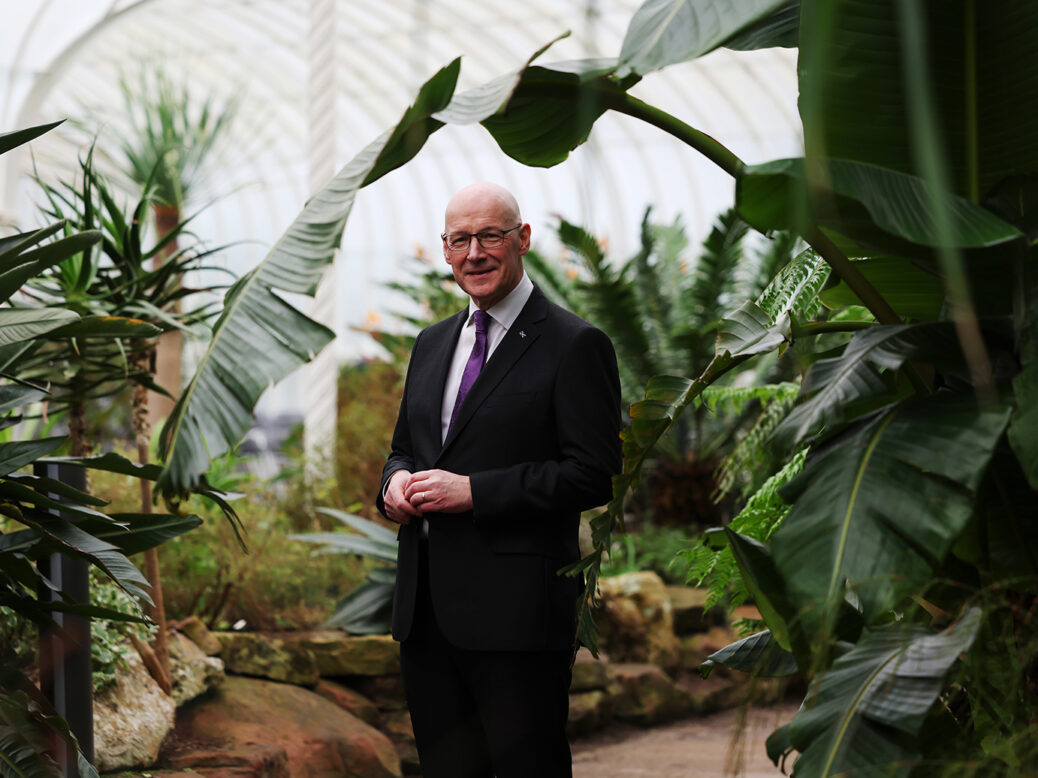
This week, on Wednesday (28 January), John Swinney attempted to square the circle. In a speech at Edinburgh University, the First Minister made a rare foray into international affairs. Inspired by Mark Carney’s acclaimed recent speech at Davos, Swinney gave us his own version. Scotland’s devolved politicians have not been known for their oratorical prowess since the days of Alex Salmond, but agree or disagree with the points Swinney made, this was a weighty and thoughtful intervention.

He began by drawing a distinction between politics, which he said was about power, and law, which was about “normative order”. “Law, the set of communal rules upon which we have agreed, places limits on power. That is, of course, the basis for the constitutional order we enjoy here at home. For eight decades, it has been, also, the basis of the international order, the rules-based international order that, although imperfectly, has brought us peace and prosperity. The reality of power is not denied, but the exercise of power by politicians, even if imperfectly, is controlled.”
After 80 years, that settlement has begun to break down, argued the FM. In the context of US aggression and self-interest, and the rise of a multipolar world, Scotland should embrace independence in order to rejoin the EU and seek security in its embrace. Swinney said he was a leader who “believes in independence in Europe for my nation, and also independence – that is, meaningful strategic autonomy, including in defence, technology and energy – for Europe. Not so the European Union becomes merely an alternative power bloc in a world where only might is right, but rather as part of an alternative vision of a world sustained and built through partnership – and a partnership of equals, where the smallest sit at the same table as the strongest, and where their voice is heard.” The power of a united Europe could be seen in its steadfast response to President Trump’s demand for Greenland, which saw Trump back down on his threats of military action and tariffs.
Brexit, he said, has been a calamity for Scotland and the wider UK, and has left Britain sitting on the sidelines at a time of global transformation. “An insular attitude has separated us from our nearest neighbours, leaving us unnecessarily and dangerously exposed. This year marks ten years since the Brexit referendum – and year on year the scale of the Brexit disaster becomes more apparent. Bit by bit, Britain is being broken by a Brexit that has left families worse off, that has meant less money available to invest in public services like the NHS.”
Those of us who were opposed to leaving the EU – 68 per cent of Scots at the time of the Brexit referendum – could nod along in agreement to this section. The English-led decision to quit the EU damaged fraternal relations with Scotland – something shifted in the soul that day, a wound was opened that still hasn’t quite healed. The prospect of a UK government led by Nigel Farage is an uneasy prospect for many Scots and could, theoretically, reopen the independence debate, which has quietened in recent times.
And so Swinney sees both the challenge and the opportunity in the current crisis. The challenge, I would argue, is that a majority of Scots are unlikely to be persuaded that this looks like a good time to throw the dice on independence. And, bear in mind, the SNP is still unable to convincingly answer questions about currency, trade with England, a projected multi-billion pound deficit, and the other complications that independence would inevitably bring. On top of this, Scotland would, in the short term at the very least, still be outside the EU, and would have to negotiate entry. If it wanted to join the single currency, which is the SNP’s preference, that would require crushing fiscal austerity in order to qualify.
And there is the small matter of the failure of devolution to improve the economy, or to reform public services, or to provide the transparent and accountable politics that was promised at the outset. The SNP has been in power since 2007, and so most of this failure is on it. This hardly inspires confidence that full independence would lead to better things. Meanwhile, Swinney’s view of Europe as a single, unifying, collaborative force might also be challenged – that has hardly been the experience of recent years. Perhaps this will change in the threatening new global climate, but the distinct instincts of and cultural and political differences between nation states remain a powerful brake on integration.
“Scotland is a European nation, and I hope, soon, that Scotland will become the EU’s newest member state,” was Swinney’s closing line. This was probably the best speech he has made since becoming First Minister. But it’s still just a speech. He can hope as much as he likes, but it’s hard to see the vision it sets out becoming a reality any time soon.
[Further reading: The Carney doctrine]
Content from our partners

Related
Join the debate
Subscribe here to comment