
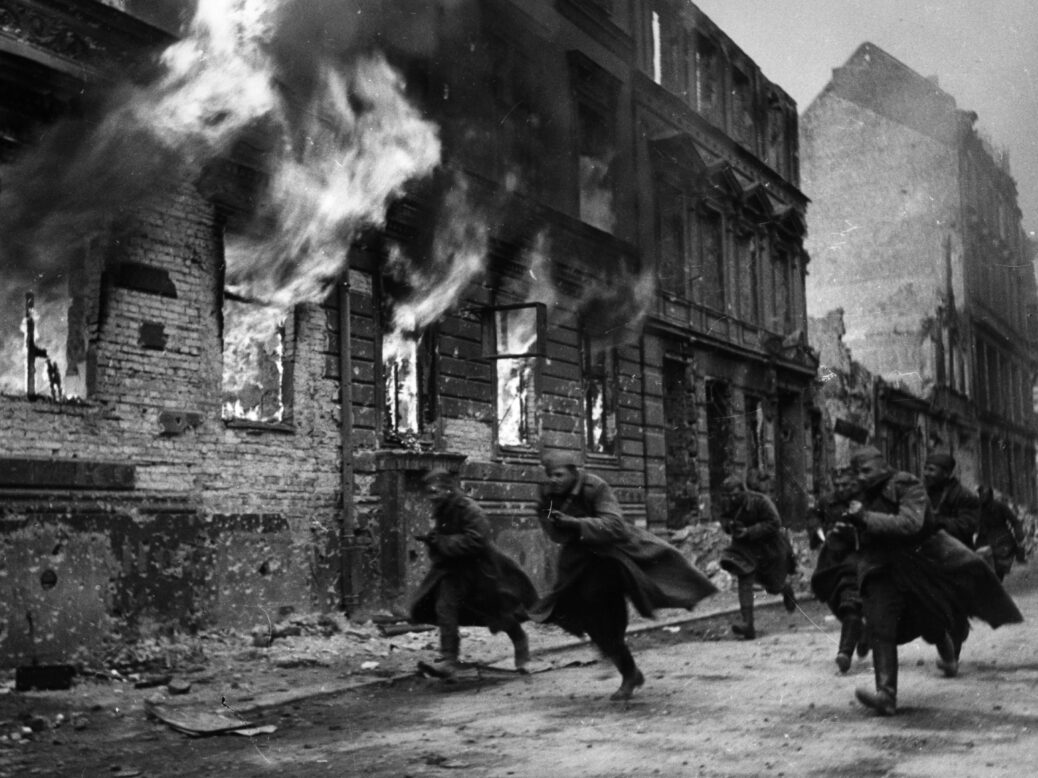
Russia and Poland have been at war with one another 16 times. 13 of these conflicts were caused by Russia invading. (The remaining three were acts of aggression from the Polish-Lithuanian Commonwealth formed in the 16th century.) And since Russia’s 2022 invasion of Ukraine, old tensions have resurfaced. On 9 September this year, Russian drones trespassed the Polish airspace. The day before, a Polish general said in a radio interview, “There will be war with Russia”. As many as 60 per cent of Polish people believe that Russia will defeat Ukraine. There is a real fear hidden behind the memes spreading on the internet about Poland waiting for a reason to trigger Article 5.
A new public exhibition on the Gogolevsky Boulevard in central Moscow about the relations between the two countries suggests Russia remembers its history differently to its western neighbour. Presented by the Russian Military History Society (whose chairman is Vladimir Putin’s advisor, Vladimir Medinsky), “Ten centuries of Polish Russophobia” suggests – guess what? – Poland was actually the aggressor all along.
The organisers of the display hope that the exhibition will address why “Russophobia has become the foundation of Polish political rhetoric” after the country’s “quick rise in nationalism” following the ascension to Nato and the European Union. In the displays are documents and photographs that show, in the words of the deputy of the 7th State Duma Boris Chernyshov, “long-standing manifestations of Russophobia”.
At the opening of the exhibition, the director of the Russian Military History Society, Mikhail Miagkov, argued that the Kingdom of Poland flourished thanks to the Russian Empire in the 19th century. In reality, Russia, Prussia and Austria agreed to partition the Polish-Lithuanian Commonwealth in 1772 between themselves. In 1795, Poland ceased to exist for the next 123 years.

Much of the display is dedicated to the Second World War, where, it claims, Poland “betrayed the USSR”. One of the boards shows a photograph of the Foreign Minister of the Second Republic of Poland, Józef Beck, with Adolf Hitler in 1938. There is no mention of Vyacheslav Molotov meeting with Joachim von Ribbentrop the following year and the signing of the Molotov-Ribbentrop Pact that allowed both powers to invade and divide eastern Europe, and particularly Poland, between themselves.
The history of the Warsaw Uprising is titled “The adventure of the Polish government in exile” and the deportation of millions of German citizens from Poland after the war called “inhumane”. The authors fail to mention that this decision was made at the Potsdam Conference with Joseph Stalin’s involvement.
Perhaps most egregious is the board dedicated to the Katyn Massacre of 1940, where 22,000 Polish military and police officers, border guards and intelligentsia prisoners of war were murdered by the NKVD (Soviet secret police) at Stalin’s orders. The exhibition accuses Poland of falsifying information about the massacre and points towards German, not Soviet, involvement. Unfortunately for the curators of this exhibition, the Russian State Duma approved a declaration condemning Stalin and other Soviet officials for ordering the massacre in 2010.
The display ends on the manifestations of “Russophobia in current day Poland” which include not inviting Vladimir Putin to the 70th anniversary of the liberation of Auschwitz in 2015 following the annexation of Crimea, Volodymyr Zelensky’s state visit to Warsaw and the “thousands of Polish mercenaries” fighting in Ukraine.
This exhibition appears to be a further act of provocation from Russia hoping to sully any relations between the countries domestically and internationally. And Poland has fallen for it. Polish media outlets are attacking the display as “scandalous”, “a litany of lies” and the work of “Putin’s propagandists”. Russia’s exhibition has achieved its aim.
[Further reading: The China spies case’s million-dollar question]
Content from our partners

Related

Join the debate
Subscribe here to comment