
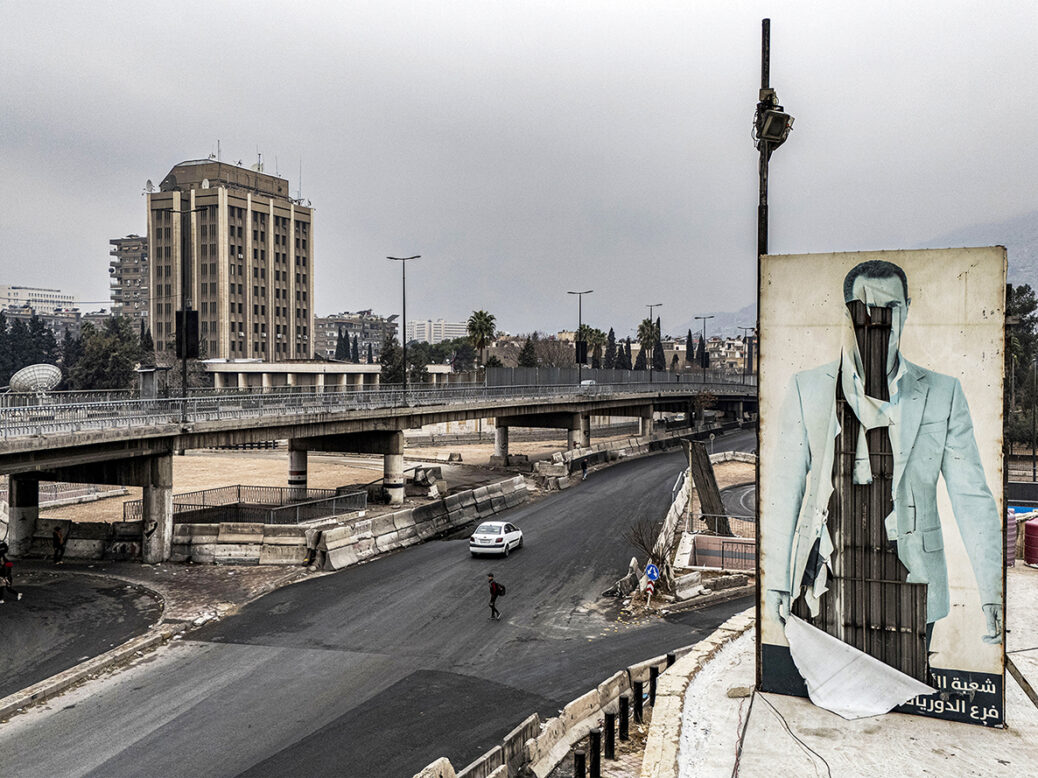
A few weeks ago in Aleppo, 14 men were led by Syria’s new military police up the steps of the Palace of Justice, where they were to be tried publicly. They were charged with the killing of civilians during a wave of violence that swept through the Syrian coast in March.
Half of those men allegedly took part in a violent uprising against Syria’s new government. The other half were members of the government’s security services deployed to the coast to quell the rebellion. The operation quickly spiralled into a bloodbath killing 1,400, mostly civilians from Syria’s minority Alawite community. The killings were motivated by a gruesome mixture of sectarian hatred for a sect that some hardline Sunnis consider “heretical”, and a long-nursed desire for revenge against the group to which former President Bashar al-Assad, and large portions of his security services belonged. That both sides were being tried together symbolises that all Syrians – even those acting on behalf of the government – could now be held to account. In a country pulverised by years of war, corruption and impunity, that in itself marked a remarkable moment.
The 8th of December is the one-year anniversary of the dramatic collapse of Assad’s regime, and the formation of Ahmed Al-Sharaa’s new government. Yet Syria remains a country largely in ruins and wracked by the sectarian tensions that arose in the violence and division of the country’s 13-year civil war under Assad. The hatred is an issue the new government has at best failed to adequately address – and at worst actively been complicit in. But, a year on, the trial in Aleppo suggests a current of accountability may be emerging in the country, where those who commit crimes against the Syrian people will see justice. Yet until the verdict is announced on 25 December, it is impossible to tell if justice will truly be done. And even then huge questions remain about how the country can heal its deep sectarian wounds.
A year after the fall of Assad, much of the sectarian hatred in this Sunni-majority country towards a range of minority groups only seems to be deepening. These groups – from Alawites to Druze and Christians – have, over the last 12 months, faced a grim spectre of violence.

Many of the survivors of the coastal massacres remain terrified. In March, armed groups with links to the former Assad regime launched a coordinated uprising throughout the coast. The attack, which killed 238 members of the security services, overran the government’s positions and so Al-Sharaa responded by calling for a general mobilisation against the uprising. Almost immediately a motley collection of Ministry of Defence fighters, loosely affiliated militias and armed civilians flooded the region. These groups rampaged across the coast over four days, killing and looting en masse. Shock was still visible in Sara’s eyes when I visited her home almost six months after the massacres. That day in March, Sara had been sheltering at home with her husband Ali when a group of gunmen burst into their building asking if they were Alawite or Sunni. To be an Alawite was akin to a death sentence. The gunmen marched Ali and his father up to the roof alongside three other men from the building and shot them dead. Her young daughter witnessed everything. (Both Sara and Ali’s names have been changed to protect the family.)
“The idea of Syria is dead,” Sara told me. “I don’t care about it anymore.” She pointed to her daughter. “This girl is my only nation now.”
A United Nations report into the massacres, published in March, found that the killings were “systematic” and “perpetrated by members of the interim government’s forces,” but that they found “no evidence of a governmental policy or plan to carry out such attacks. For his part, Al-Sharaa formed an independent committee to investigate the violations almost immediately after the violence, which led to last month’s public trials.
The next major challenge to the new government came in Sweida, a region in southern Syria home to the Druze minority, when an explosion of violence resulted in the killing of over 1,000, mostly Druze civilians. In June, tensions were beginning to simmer between the Druze and the local Bedouin community. Historic disputes over land-use, and long-held grudges blossomed into increasingly hostile interpersonal disputes and low-level criminality. In the context of a major security vacuum – with the government’s security services struggling to impose security across the whole country – these disputes sparked cycles of recrimination that were escalating into inter-village clashes; in a country awash with weapons after years of war, these clashes often involve the use of rockets and heavy weaponry.
Individuals like Omar Al-Sabra, a Bedouin who described himself as “a social peacemaker,” were vital to calming this growing anger. Omar’s good standing in both communities allowed him to act as the go-between to “connect the different perspectives of the two sides,” he explained. But by July, things had reached a tipping point. The kidnapping of a Druze man set off a series of revenge kidnappings that exploded into full-blown sectarian conflict across the region. Speaking over the phone amid the crackle of gunfire, Omar told me at the time that “a catastrophe [was] happening”. After two of his brothers were killed, he also took up arms, no longer a neutral mediator. The government then intervened, with its forces committing a string of massacres against Druze civilians. One man lost 18 members of his family in a single day. Rayan, whose name has been changed, told me his family were killed in their home by government forces. I spoke to him over the phone only a short while after the killings. “I heard them shouting ‘you’re pigs’ before they opened fire,” he told me, audibly still in shock.
Israel responded with a campaign of airstrikes – under the pretext of protecting the Druze population – that quickly overwhelmed the Syrian military, culminating in the bombing of the Ministry of Defence in Damascus on 16 July.
The government was forced to withdraw, leaving Sweida under a semi-state of siege. Although Al-Sharaa once again formed an investigative committee to probe into the targeting of civilians during the violence, periodic clashes still occur between the government and the Druze, and the government has restricted access to the region, making it difficult for journalists to enter.
Syria’s north-east is the country’s next potential flashpoint. The region is still controlled by the Syrian Democratic Forces (SDF), a Kurdish-led armed group that was a key US ally in the fight against Isis. Talks, which have been underway since an agreement was signed in March to integrate the SDF’s military into the new Ministry of Defence, have stalled. On 23 November, the commander of the SDF, Mazloum Abdi, said that an agreement on integration could not be completed until the government was willing to discuss changes to the interim constitution that “would ensure inclusive governance and guarantee Kurdish rights”.
In Deir Ez-Zour in the county’s east, the banks of the Euphrates mark the dividing line between government and SDF-held territory. Fierce clashes frequently erupt between the two. Khadija had been collecting firewood outside her home in the village of Mahkan in August when she was killed by a bullet. Her husband, Mohammed Abd Al-Rizk, didn’t know for certain who fired it, only that it came from across the river where the SDF had built defensive positions along the riverbank. Al Rizk told me in November, after a new round of clashes in Makhan, that he believes the war “is not over yet”. He says the revolution that overthrew Assad was “just beginning” – a common sentiment on the government-controlled side of the Euphrates. Many would welcome an offensive against the SDF.
In June, a suicide bombing ripped through a packed congregation in the Christian neighbourhood of Dweila in Damascus and 25 people were killed. On 16 October, five Syrian soldiers were killed by a roadside bomb near the Al-Mahkan. The government blamed both attacks on Isis.
In November, Syria officially joined the US-led global anti-Isis coalition. It marked a remarkable geopolitical pivot for a country that has been one of America’s most staunch enemies in the region for decades. Yet the abrupt shift is in line with Al-Sharaa’s own journey: a former “jihadi” who fought the Americans in Iraq in 2003 and had previously pledged allegiance to Isis and Al-Qaeda, he is now being toasted by Donald Trump in the White House. Following a visit in November, the US president said of Al-Sharaa, “I liked him, and I agree with him. We will do everything we can to make Syria successful.”
For Al-Sharaa, this pivot may be largely motivated by one thing: ending American sanctions on Syria. While Trump has extended a temporary waiver on sanctions, the legislation required to unwind the deep economic restrictions are still making their way through Congress at a glacial pace. Their continued presence risks stifling any effort to rebuild the country, which is already economically struggling.
After 13 years of war under Assad, much of Syria is destroyed. But there have been some improvements: Qatar and Saudi Arabia have gifted millions of barrels of oil to restart many of the country’s decrepit power plants. Electricity, which was only available for a few hours a day at the start of the year, is now often present for 12 hours at a time. This looks set to improve further: in May, a Qatari-led energy consortium pledged to double Syria’s electricity capacity by investing $7 billion in grid infrastructure. There has also been a fundraising bonanza in support of rebuilding. Sharaa’s government has signed a rash of deals at glitzy galas and lavish conferences worth $32 billion. Yet, the World Bank estimates the price tag to rebuild Syria is closer to $216bn.
And, upon closer inspection, many of these deals appear questionable. Most are just “memorandums of understanding” — good for catchy headlines but offering no binding financial commitment and so easy to collapse. Other deals have been marked by their opaque tendering process, raising acute concerns about corruption. In one deal, announced in April, a $2bn construction contract was awarded to an Italian firm with just a single employee and $16,000 worth of capital.
Amidst all this, most Syrians are simply trying to move forward. In the Palestinian neighbourhood of Yarmouk, in southern Damascus, the streets ring with a cacophony of hammers and drills. At the beginning of the year the camp was largely abandoned, but these days life has returned to the streets and many homes, reduced to blasted shells by years of siege and barrel bombing, have been patched up with cinder blocks. Much of this is thanks to the hard work of returnees, like Abu Yasser, who travelled back from Turkey in the weeks after the fall. “I spent a few thousand dollars repairing the house,” he explained, “I had the means and so it wasn’t much of a question to come back home.”
Not everyone is so fortunate. Thousands of destitute families still huddle together in displacement camps across the country, unable to scrape together the money to return home. The Syrian government – itself still largely destitute – is yet to provide any meaningful support for returnees. For Abu Nidal, who owns an engineering firm in Yarmouk, “business remains hard.” As most families can’t afford to rebuild, “they come in asking for discounts”, he explained. “So I am often working for very little profit.”
Rebuilding remains ad hoc. “A year on there’s still no electricity or water,” he said. The camp still lacks connections to the national grids, which were severed during the seven-year siege. Outside his shop, he pointed to a bombed-out building. On its top floor, a huge slab of concrete hung precariously over the edge, dangling ten metres over a small one-storey home. It was held aloft by only a few rods of rusty rebar. “How can we be expected to remove that? It must weigh tonnes,” he said. “Any day it could fall and kill that whole family.”
In a nearby shawarma shop, people grumbled about prices. The government has been laying off public sector workers and massively slashing subsidies in an attempt to boost public finances. “A bottle of gas is now five times more expensive than it was under Assad,” complained the shop owner, Abu Othman. “Life is not really any easier.”
Fundamentally, the economy will define Syria’s future. If the new government can slacken the weight of hardship upon its people’s shoulders, then much of the division – and accompanying violence – may too dissipate. But life remains hard in Syria, and the road forward is unsteady.
For large parts of the country, there is a thin ribbon of hope that their travails could be ending. Yet this would require the government to properly address the country’s sectarian wounds and ensure that rebuilding happens in an efficient, transparent and equitable manner. Achieving both will be extremely difficult for Syria’s new leaders – but their fate may just depend upon it.
[Further reading: Syria’s post-sanction future]
Content from our partners


Related
Join the debate
Subscribe here to comment