
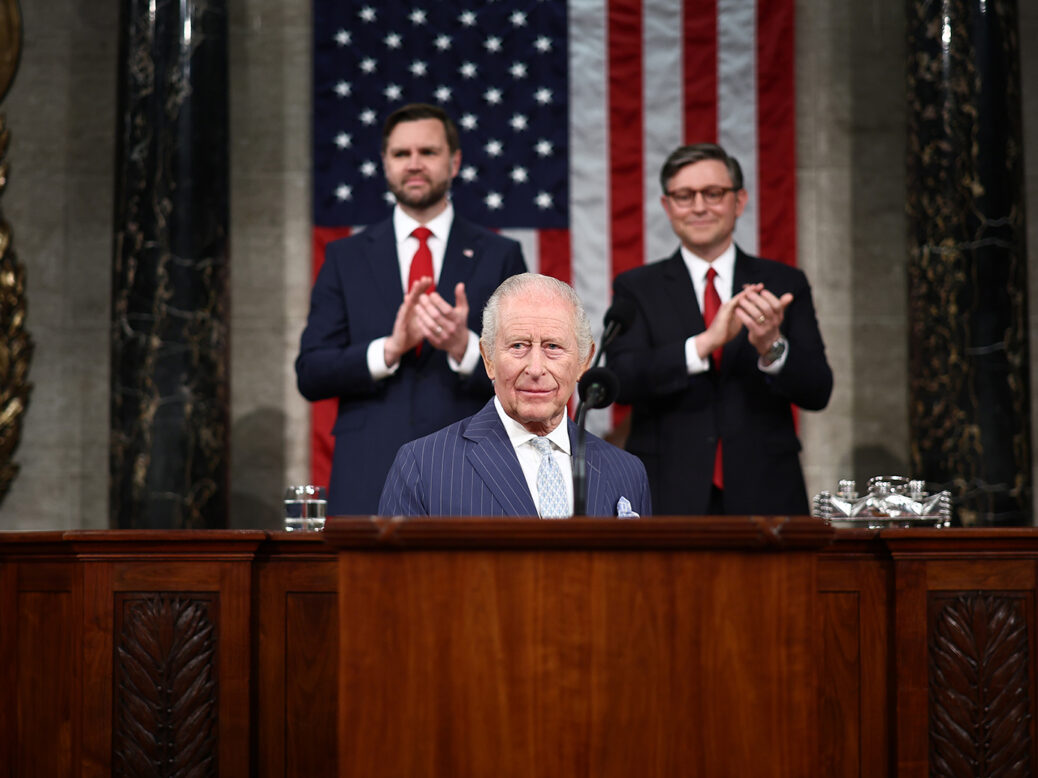
Who else can get away with gently mocking President Donald Trump besides the King? The prodding gibe has been a motif of his four-day visit to the US. “You recently commented, Mr President,” Charles III said at the state dinner this week with an arched eyebrow, “that if it were not for the United States, European countries would be speaking German – dare I say that, if it wasn’t for us, you’d be speaking French!” And dare he did.
It speaks to Charles’s stature, and to his close relationship with Trump, that such teasing was deemed permissible. As ever, the monarch has been able to keep the president in proportion more than the Prime Minister ever has. The trip was going well at this point. He was soon pictured in Virginia’s vertiginous Blue Ridge Mountains where he came eye-to-eye with a bald eagle. Monarch vs beast. Two banknote portraits facing off.
And you could see him cruising around Harlem, New York in his black BMW, flying the Royal Standard, helping children trowel the turf around their collard greens. Mayor Zohran Mamdani, whose father is a leading post-colonial scholar, smiled affably when shaking hands with the King at the 9/11 memorial, even if he had said (as recently as this week) that he would ask the King to return the Koh-i-Noor diamond to India. (Winston Churchill’s unrequited affection for Franklin Roosevelt was always blemished by the president’s constant request that he hand India its independence.) As with Trump, once he meets a supposed opponent, Mamdani lets his smile beam.
While the British diplomatic class certainly has their eye on cultivating relationships with Democrats, the Palace will probably be pleased that Mamdani’s birth abroad means he can never run for president. They have enough problems without an enterprising anti-colonialist lacking fond memories of Britain’s imperial high noon dominating Washington.

The priority, of course, was wooing the incumbent. It seems that one of the tasks the UK government gave their chief diplomat was to ask Trump to drop his tariffs on whiskey. The president was happy to oblige: an act of friendship, he said, which would pay homage to the visit. Buckingham Palace described the move as a “warm gesture”, a parting gift, a memento. “DRAM FINE JOB YOUR MAJESTY”, congratulated the front page of the Sun. We had given them a king to ogle at for a few days, and they had stopped taxing our £1bn whisky exports in return. Call it pomp for pounds.
“Have a good time; have a good trip,” Trump said outside the White House as the King and Queen got into their BMW one last time. The King could leave the US confident he had acquitted himself rather well, making full use of his wit, humour and poise.
And yet, there was something of a facade about the whole thing. It felt like a dreamy illusion that would soon disperse once the piccolos had stopped playing and all the velvet coats were put away. Sky News reports that Trump plans to put his gift – a spanking gold bell from a Second World War submarine called HMS Trump – beside the bust of Churchill in the Oval Office. For how much longer can the mystique of Churchill lend an illusory magic to this relationship?
The reality that relations between the UK and US are actually quite bad was always lurking in the background. A leaked State Department email, for instance, suggested that America would support Argentina’s claim to the Falklands as punishment for Britain’s half-hearted role in the Iran war. This led to much fluster, endangering a memory in the British psyche many see as the time when national pride recovered from the humiliation of Suez. We should wonder how long Marco Rubio’s recent denial that this was the plan will last once the King’s scent (Creed Green Irish Tweed, £295 for 100ml) has wafted out of the White House.
History, of course, provides reasons to be sceptical. After Leopoldo Galtieri’s invasion of the Falklands in 1982, Ronald Reagan could not understand why the British cared so much about a “little ice-cold bunch of land”. Support from the US was not forthcoming. Some in the State Department thought relations with their fascistic hemispheric neighbours mattered more, and that the British ought to be told the use of force would not be allowed – even if the US secretary of defence, Caspar Weinberger, was clear that Britain must win. Days before the Argentine surrender, Reagan was pictured horse-riding with Queen Elizabeth at Windsor Castle. A melange of British pleading, nostalgic administration officials and realist politicians who think Britain is also an ice-cold bunch of land was temporarily forgotten with a touch of royal affection. And on it goes.
[Further reading: A Tale of Two Kings]
Content from our partners


Related

Join the debate
Subscribe here to comment