
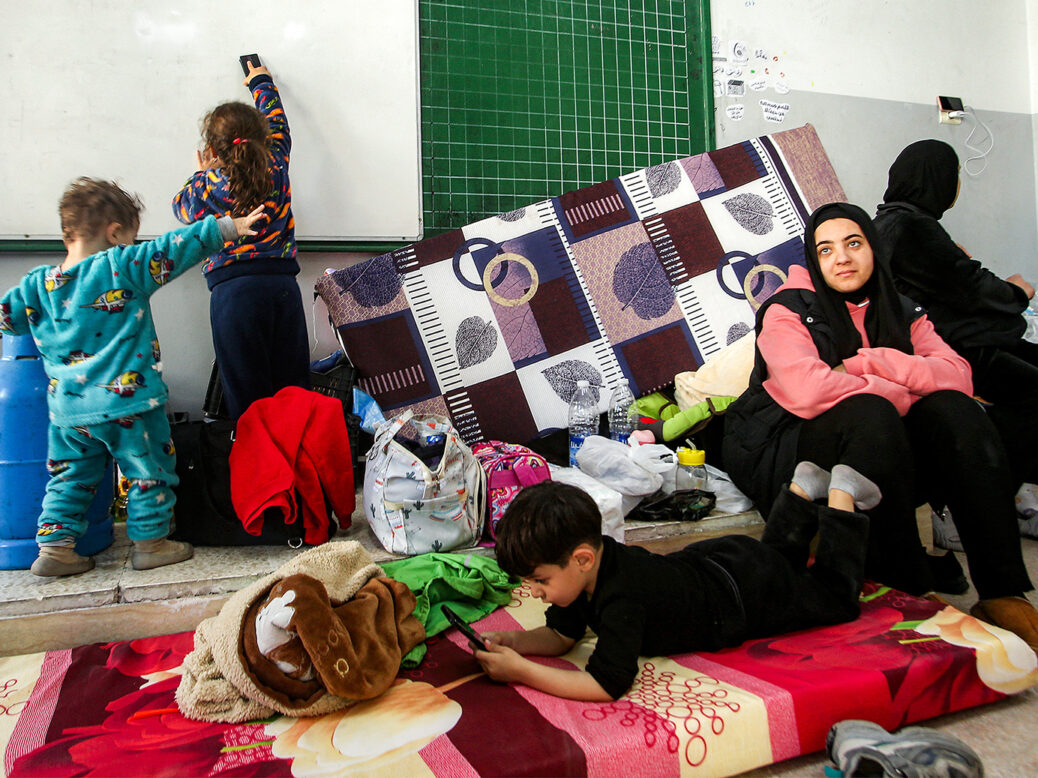
Huddled families eagerly broke their Ramadan fast at the Ras Beirut Girls School on Monday, their conversations interrupted by the din of successive Israeli airstrikes. For the second time in just over a year, the school has become an improvised displacement shelter for families who once again have been forced to flee their homes as war returns to the beleaguered country.
In the early hours of Monday morning, Hezbollah, an armed group closely aligned with Iran, launched several rockets at Israel in retaliation for the assassination of Iran’s Supreme Leader, Ayatollah Ali Khamenei, on Saturday. Israel vowed to meet the attack with a “strong response”, and US officials told local media here that Israel’s “gloves are now off”.
This comes days after the US and Israel launched an attack on Iran, with President Trump calling on Iranians to “be brave and take back your country.” The war has subsequently set the region alight. Iranian missiles are being directed at a swathe of countries as wide reaching as Cyprus and Oman.
There were hopes, however, that Lebanon might remain out of the fight following a Hezbollah statement that condemned the US and Israel’s attack on Iran but didn’t signal any willingness to take part. That hope only lasted a few days.

Afaf sits wrapped in blankets in the corner of the school’s basement, surrounded by four of her children. As soon as she saw the news of the rocket attack, she grabbed what little she could and fled her home in Dahiyeh – Beirut’s southern suburbs, where Hezbollah’s presence is most pronounced. The people of Dahiyeh knew what was coming.
“Everyone was leaving as we knew the bombs would come,” she says, “my kids were so scared. I just told the youngest one that there is nothing to worry about, we are just going on a short trip.”
Israel’s response was immediate and powerful. Waves of airstrikes have been unleashed on southern Lebanon and the suburbs of Dahiyeh in the days since, killing 397 and injuring 1,102 according to Lebanon’s Health Ministry. Israel claims to have also killed several of Hezbollah’s high-ranking officials. On Tuesday, Israeli forces began a ground incursion into Lebanon’s south.
For the single mother, this is all too reminiscent of Lebanon’s last war with Israel. “It is so depressing. Once again I am having to think about where we can go, where we can sleep.”
In 2024, amid the war in Gaza and with Hezbollah and Israel exchanging fire on the border, Israel launched its first ground invasion of Lebanon in almost two decades. A series of strikes killed much of Hezbollah’s leadership, in a war that killed over 4,000 Lebanese citizens.
In the last war, when the streets were clogged with refugees, Afaf and her family found refuge in an abandoned supermarket. This time they were luckier. “We went to a few shelters that turned us away before we finally came here, and thanks be to God they took us in,” she said. “All the people here have been very respectful.”
Afaf, originally from the Syrian city of Deir Ez-Zour, says she will not go back to Syria. Lebanon took in 1.5 million refugees during the Syrian civil war. Now the two countries’ fortunes have reversed.
At Lebanon’s main border crossing with Syria, large crowds had gathered on Monday, hoping to find refuge in a country long ravaged by war that now, somewhat bizarrely, has become an island of safety surrounded by conflict.
“The border guards aren’t letting us through,” complained Hammoud, sitting next to a van whose roof was piled high with his family’s belongings. After 13 years, he is trying to go back to his home in Aleppo. “When we fled the war at home, they tried to stop us from coming. Now there is war here, they’re not letting us leave.”
In Beirut, the buzz of Israeli drones overhead is unending. With the city overwhelmed by the mass influx of displaced peoples, families have taken to sleeping in parks and on pavements. Ali, who fled from the southern town of Ghazieh, was fortunate enough to find shelter at his sister’s home. However, her home, located close to the edges of Dahiyeh, may not necessarily be safe. In the last war, Israel struck a building just a couple hundred metres away. “It’s so frustrating,” he said, “this war is so dumb.”
Much of the country seems in shock by what appears to be a mind-bogglingly illogical decision by Hezbollah to enter the war. “For many Lebanese, they feel like getting dragged into this war was so avoidable,” explains David Wood, senior researcher on Lebanon at the International Crisis Group. “Hezbollah did what the vast majority of Lebanese didn’t want them to do.” The US had reportedly assured the Lebanese government that if no attacks were launched from its territory, then Israel would not attack Hezbollah.
“Hezbollah’s leadership knew it would provoke a furious response from Israel,” he says. “It was virtually suicidal but they did it anyway.”
Hezbollah emerged crippled from its last round of fighting with Israel. Over the last two days, it has fired sporadic salvos containing only a few missiles, all of which have been almost immediately shot down.
In response to Hezbollah’s attack, the government has passed a resolution to ban Hezbollah’s military activities and has authorised the army to disarm the group by any means possible. According to Wood, “such a move was almost unimaginable even a few days ago.”
“There is huge pressure on the government both internationally, and within Lebanon, to implement a state monopoly on arms,” says Wood. “This raises the risk of direct confrontation between Hezbollah and the government, and the potentially disastrous consequences that a showdown might bring.”
The most ominous risk is that “the army itself fragments along sectarian lines,” he adds. Lebanon, which is home to 18 different officially recognised sects, remains riven by sectarian tension. Between 1975 and 1990, that tension descended into full-scale sectarian war during the Lebanese civil war.
The risk of confrontation is that “soldiers who belong to the Shia Muslim community [from which Hezbollah’s support base stems] could desert or even defect to fight on Hezbollah’s side.”
The army may not actually confront the armed group, as there has reportedly been pushback from leadership within its ranks. Regardless, between Israeli bombs and the risk of internal conflagration, this marks the most precarious moment for Lebanon in decades.
For Lebanon’s displaced families, now sleeping in schools, parks and public squares, weary after years of intermittent conflict, their only hope is that somehow the country can find its way back from the abyss.
[Further reading: Trump, Iran and America’s years of iron]
Content from our partners

Related

Join the debate
Subscribe here to comment