
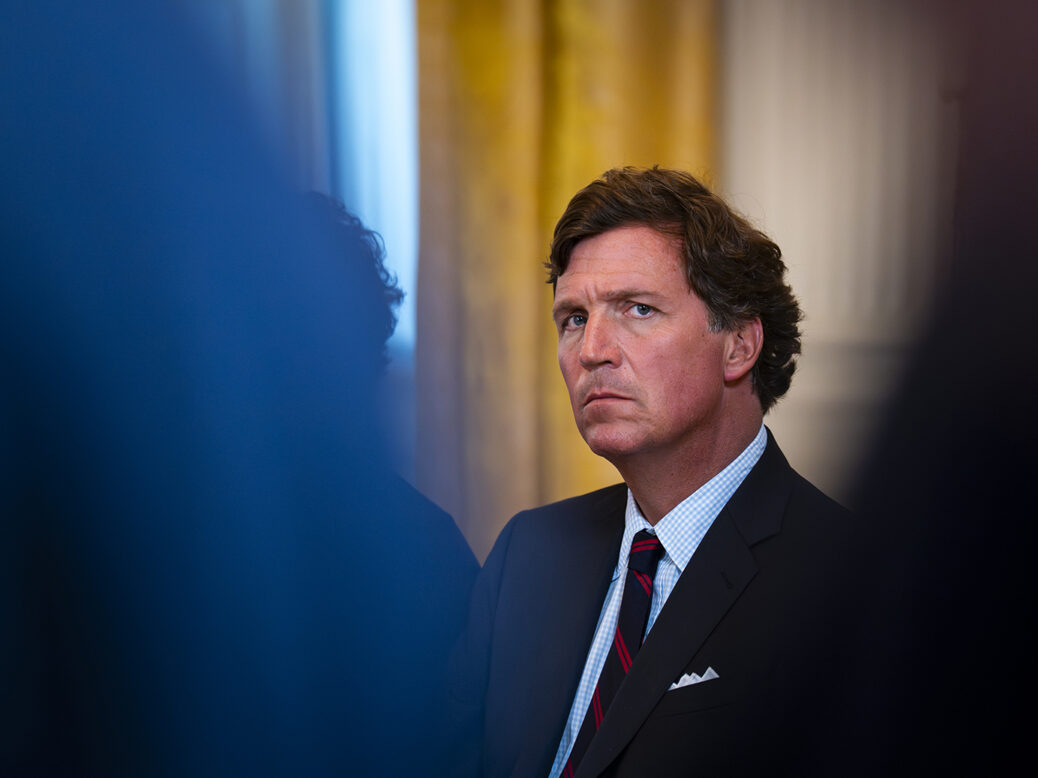
If you didn’t know it was there, you’d drive straight past it. Tucker Carlson’s studio sits deep in the pine forests of rural Maine. A former boat-repair shed, today the building is home to one of America’s most influential podcasts. We arrived first. An hour later, Carlson came through the door, dripping after being caught in a downpour. Before he said a word came the instantly recognisable cackle. He brushed the rain from his jacket and showed us around. The studio felt less like the HQ of a media empire than a museum. Everything was wood. Family photographs sat alongside fishing memorabilia and portraits of American presidents .
We talked about Trump, Iran and the future of the conservative movement. Carlson said he urged Donald Trump “dozens of times” not to attack Iran. When the strikes came, he believed something fundamental had broken – not simply between two men, but within the movement. Ours felt like one of those conversations where politics was shifting while we spoke.
A beautiful gesture
Several days later, I was among England supporters in New Jersey ahead of the match against Panama. Reporting on the World Cup across New Jersey, Boston and Miami, I met Iraqis, Moroccans, Norwegians, Scots, Panamanians, Colombians, Mexicans and England supporters. My favourite was Boston: the Tartan Army had taken over the city, and wherever the Scots went, the singing followed. One day, as they walked through the city, Iraqi supporters stopped to applaud them. The Scots applauded back. It lasted only a few moments, but it captured something hopeful.
Back in New York, I devoted an edition of The World with Yalda Hakim to the tournament’s geopolitics. Among my guests were Andrew Giuliani, the White House’s World Cup chief, and Gary Lineker. One of Lineker’s remarks lingered long after our conversation: never before had a World Cup been hosted by a nation that was at war with one of the competing countries. He believed Iran had been treated unfairly by its host. Giuliani said the responsibility lay with Iran’s leadership.

Corrupted power
By the time I arrived in Havana, Donald Trump had spent weeks repeatedly talking about taking Cuba, describing the island as a “failed state”. Havana remains one of the world’s most beautiful and romantic cities: music drifts through narrow streets; classic American cars rumble past elegant but fading colonial buildings. But what struck me most was the rubbish lining the streets. Locals told me collection trucks often had no fuel, leaving waste to pile up. Supermarket shelves stood half empty. Hospitals were running short of medicines. People spoke openly about blackouts, collapsing salaries and watching their family and friends leave. But they refused to speak as though Cuba was finished.
One woman laughed when I asked what time she woke each morning: “The electricity decides.” If the power returned at 3am, that was when she cooked, washed clothes, charged her phone and pumped water before it disappeared again. Life no longer revolved around the clock. It revolved around electricity.
Fighting talks
When president Miguel Díaz-Canel arrived for our interview, he was holding his wife’s hand. Before we began, she reached across and straightened his tie. He smiled and remarked that they were in this fight together. I expected Díaz-Canel to spend our conversation speaking about sanctions, Cuba’s economic crisis, Trump. He did, but I hadn’t expected Iran to dominate so much of our discussion. To Díaz-Canel, Iran was proof negotiations were no guarantee against military action. The US, he argued, attacked while talks were underway. If that could happen to Iran, why should Cuba believe it would be treated differently?
His comments immediately took me back to our own reporting. Weeks earlier, Sky News had covered a strike on a school in Minab, southern Iran, that killed around 160 people, most of them children, during the opening hours of the war in Iran. The images of shattered classrooms and grieving families were among the most difficult journalism we have broadcast.
Echoes of assignments
There are moments from every assignment that linger long after the headlines have moved on. Carlson’s unmistakable cackle filling a wooden studio, deep in the Maine woods. Scottish and Iraqi fans applauding one another as they passed through the streets of Boston. Díaz-Canel’s wife quietly straightening his tie before we sat down. A Cuban woman laughing as she told me the electricity decided when she woke up. And a classroom in Minab that should have been full of children.
Yalda Hakim is lead world news presenter for Sky News
[Further reading: Winning at Twitter is bad for you]
Content from our partners


Related
This article appears in the 15 Jul 2026 issue of the New Statesman, After Keir Starmer
Join the debate
Subscribe here to comment